Saturday, October 10, 2020

On The 1619 Project

 Opinion

The 1619 Chronicles

Journalism does better when it writes the first rough draft of history, not the last word on it.

Opinion Columnist

Credit...The New York Times

If there’s one word admirers and critics alike can agree on when it comes to The New York Times’s award-winning 1619 Project, it’s ambition. Ambition to reframe America’s conversation about race. Ambition to reframe our understanding of history. Ambition to move from news pages to classrooms. Ambition to move from scholarly debate to national consciousness.

In some ways, this ambition succeeded. The 1619 Project introduced a date, previously obscure to most Americans, that ought always to have been thought of as seminal — and probably now will. It offered fresh reminders of the extent to which Black freedom was a victory gained by courageous Black Americans, and not just a gift obtained from benevolent whites.

It showed, in a stunning photo essay, the places where human beings were once bought and sold as slaves — neglected scenes of American infamy. It illuminated the extent to which so much of what makes America great, including some of our uniquely American understandings of liberty and equality, is unthinkable without the struggle of Black Americans, as well as the extent to which so much of what continues to bedevil us is the result of centuries of racism.

ADVERTISEMENT

Continue reading the main story

And, in a point missed by many of the 1619 Project’s critics, it does not reject American values. As Nikole Hannah-Jones, its creator and leading voice, concluded in her essay for the project, “I wish, now, that I could go back to the younger me and tell her that her people’s ancestry started here, on these lands, and to boldly, proudly, draw the stars and those stripes of the American flag.” It’s an unabashedly patriotic thought.

But ambition can be double-edged. Journalists are, most often, in the business of writing the first rough draft of history, not trying to have the last word on it. We are best when we try to tell truths with a lowercase t, following evidence in directions unseen, not the capital-T truth of a pre-established narrative in which inconvenient facts get discarded. And we’re supposed to report and comment on the political and cultural issues of the day, not become the issue itself.

As fresh concerns make clear, on these points — and for all of its virtues, buzz, spinoffs and a Pulitzer Prize — the 1619 Project has failed.

***

Those concerns came to light last month when a longstanding critic of the project, Phillip W. Magness, noted in the online magazine Quillette that references to 1619 as the country’s “true founding” or “moment [America] began” had disappeared from the digital display copy without explanation.

These were not minor points. The deleted assertions went to the core of the project’s most controversial goal, “to reframe American history by considering what it would mean to regard 1619 as our nation’s birth year.”

ADVERTISEMENT

Continue reading the main story

That doesn’t mean that the project seeks to erase the Declaration of Independence from history. But it does mean that it seeks to dethrone the Fourth of July by treating American history as a story of Black struggle against white supremacy — of which the Declaration is, for all of its high-flown rhetoric, supposed to be merely a part.

In a tweet, Hannah-Jones responded to Magness and other critics by insisting that “the text of the project” remained “unchanged,” while maintaining that the case for making 1619 the country’s “true” birth year was “always a metaphoric argument.” I emailed her to ask if she could point to any instances before this controversy in which she had acknowledged that her claims about 1619 as “our true founding” had been merely metaphorical. Her answer was that the idea of treating the 1619 date metaphorically should have been so obvious that it went without saying.

She then challenged me to find any instance in which the project stated that “using 1776 as our country’s birth date is wrong,” that it “should not be taught to schoolchildren,” and that the only one “that should be taught” was 1619. “Good luck unearthing any of us arguing that,” she added.

Here is an excerpt from the introductory essay to the project by The New York Times Magazine’s editor, Jake Silverstein, as it appeared in print in August 2019 (italics added):

“1619. It is not a year that most Americans know as a notable date in our country’s history. Those who do are at most a tiny fraction of those who can tell you that 1776 is the year of our nation’s birth. What if, however, we were to tell you that this fact, which is taught in our schools and unanimously celebrated every Fourth of July, is wrong, and that the country’s true birth date, the moment that its defining contradictions first came into the world, was in late August of 1619?”

Now compare it to the version of the same text as it now appears online:

“1619 is not a year that most Americans know as a notable date in our country’s history. Those who do are at most a tiny fraction of those who can tell you that 1776 is the year of our nation’s birth. What if, however, we were to tell you that the moment that the country’s defining contradictions first came into the world was in late August of 1619?”

In an email, Silverstein told me that the changes to the text were immaterial, in part because it still cited 1776 as our nation’s official birth date, and because the project’s stated aim remained to put 1619 and its consequences as the true starting point of the American story.

Readers can judge for themselves whether these unacknowledged changes violate the standard obligations of transparency for New York Times journalism. The question of journalistic practices, however, raises deeper doubts about the 1619 Project’s core premises.

ADVERTISEMENT

Continue reading the main story

***

In his introduction, Silverstein argues that America’s “defining contradictions” were born in August 1619, when a ship carrying 20 to 30 enslaved Africans from what is present-day Angola arrived in Point Comfort, in the English colony of Virginia. And the title page of Hannah-Jones’s essay for the project insists that “our founding ideals of liberty and equality were false when they were written.”

Both points are illogical. A “defining contradiction” requires a powerful point of opposition or inconsistency, and in the year 1619 the points of opposition were few and far between. Slavery and the slave trade had been global phenomena for centuries by the early 17th century, involving Europeans and non-Europeans as slave traders and the enslaved. The Africans who arrived in Virginia that August got there only because they had been seized by English privateers from a Portuguese ship headed for the port of Veracruz in Mexico, then a part of the Spanish Empire.

In this sense, and for all of its horror, there was nothing particularly surprising in the fact that slavery made its way to the English colonies on the Eastern Seaboard, as it already had in the rest of the Western Hemisphere.

What was surprising was that in 1776 a politically formidable “defining contradiction” — “that all men are created equal” — came into existence through the Declaration of Independence. As Abraham Lincoln wrote in 1859, that foundational document would forever serve as a “rebuke and stumbling block to the very harbingers of reappearing tyranny and oppression.” It’s why, at the dedication of the Gettysburg cemetery, Lincoln would date the country’s founding to “four score and seven years ago.”

As for the notion that the Declaration’s principles were “false” in 1776, ideals aren’t false merely because they are unrealized, much less because many of the men who championed them, and the nation they created, hypocritically failed to live up to them. Most of us, at any given point in time, are falling short of some ideal we nonetheless hold to be true or good.

These two flaws led to a third, conceptual, error. “Out of slavery — and the anti-Black racism it required — grew nearly everything that has truly made America exceptional,” writes Silverstein.

Nearly everything? What about, say, the ideas contained by the First Amendment? Or the spirit of openness that brought millions of immigrants through places like Ellis Island? Or the enlightened worldview of the Marshall Plan and the Berlin airlift? Or the spirit of scientific genius and discovery exemplified by the polio vaccine and the moon landing? On the opposite side of the moral ledger, to what extent does anti-Black racism figure in American disgraces such as the brutalization of Native Americans, the Chinese Exclusion Act or the internment of Japanese-Americans in World War II?

ADVERTISEMENT

Continue reading the main story

Monocausality — whether it’s the clash of economic classes, the hidden hand of the market, or white supremacy and its consequences — has always been a seductive way of looking at the world. It has always been a simplistic one, too. The world is complex. So are people and their motives. The job of journalism is to take account of that complexity, not simplify it out of existence through the adoption of some ideological orthodoxy.

This mistake goes far to explain the 1619 Project’s subsequent scholarly and journalistic entanglements. It should have been enough to make strong yet nuanced claims about the role of slavery and racism in American history. Instead, it issued categorical and totalizing assertions that are difficult to defend on close examination.

It should have been enough for the project to serve as curator for a range of erudite and interesting voices, with ample room for contrary takes. Instead, virtually every writer in the project seems to sing from the same song sheet, alienating other potential supporters of the project and polarizing national debate.

***

An early sign that the project was in trouble came in an interviewlast November with James McPherson, the Pulitzer Prize-winning author of “Battle Cry of Freedom” and a past president of the American Historical Association. He was withering: “Almost from the outset,” McPherson told the World Socialist Web Site, “I was disturbed by what seemed like a very unbalanced, one-sided account, which lacked context and perspective.”

In particular, McPherson objected to Hannah-Jones’s suggestion that the struggle against slavery and racism and for civil rights and democracy was, if not exclusively then mostly, a Black one. As she wrote in her essay: “The truth is that as much democracy as this nation has today, it has been borne on the backs of Black resistance.”

McPherson demurs: “From the Quakers in the 18th century, on through the abolitionists in the antebellum, to the Radical Republicans in the Civil War and Reconstruction, to the N.A.A.C.P., which was an interracial organization founded in 1909, down through the civil rights movements of the 1950s and 1960s, there have been a lot of whites who have fought against slavery and racial discrimination, and against racism,” he said. “And that’s what’s missing from this perspective.”

In a lengthier dissection, published in January in The Atlantic, the Princeton historian Sean Wilentz accused Hannah-Jones of making arguments “built on partial truths and misstatements of the facts.” The goal of educating Americans on slavery and its consequences, he added, was so important that it “cannot be forwarded through falsehoods, distortions and significant omissions.”

ADVERTISEMENT

Continue reading the main story

Wilentz’s catalog of the project’s mistakes is extensive. Hannah-Jones’s essay claimed that by 1776 Britain was “deeply conflicted” over its role in slavery. But despite the landmark Somerset v. Stewart court ruling in 1772, which held that slavery was not supported by English common law, it remained deeply embedded in the practices of the British Empire. The essay claimed that, among Londoners, “there were growing calls to abolish the slave trade” by 1776. But the movement to abolish the British slave trade only began about a decade later — inspired, in part, Wilentz notes, by American antislavery agitation that had started in the 1760s and 1770s. The list goes on.

Then there was an essay in Politico in March by the Northwestern historian Leslie M. Harris, an expert on pre-Civil War African-American life and slavery. “On Aug. 19 of last year,” Harris wrote, “I listened in stunned silence as Nikole Hannah-Jones … repeated an idea that I had vigorously argued against with her fact checker: that the patriots fought the American Revolution in large part to preserve slavery in North America.”

None of this should have come as a surprise: The 1619 Project is a thesis in search of evidence, not the other way around. Nor was this fire from the right: Both Wilentz and Harris were at pains to emphasize their sympathy with the project’s moral aims.

Yet, aside from a one-word “clarification” issued in March — after months of public pressure, The Times conceded that only “some” colonists fought for independence primarily to defend slavery — the response of the magazine has been, in effect, “nothing to see here.” In a pair of lengthy editor’s notes, Silverstein has defended much of the scholarship in the project by citing another slate of historians to back him up. That’s one way of justifying the final product.

The larger problem is that The Times’s editors, however much background reading they might have done, are not in a position to adjudicate historical disputes. That should have been an additional reason for the 1619 Project to seek input from, and include contributions by, an intellectually diverse range of scholarly voices. Yet not only does the project choose a side, it also brooks no doubt.

“It is finally time to tell our story truthfully,” the magazine declares on its 1619 cover page. Finally? Truthfully? Is The Times suggesting that distinguished historians, like the ones who have seriously disputed aspects of the project, had previously been telling half-truths or falsehoods?

***

Almost inevitably, what began as a scholarly quarrel became a political one.

About a month before the project’s publication, Silverstein reached out to the Pulitzer Center to propose a 1619 curriculum for schools. Soon thereafter, the project was being introduced into classrooms across the country.

ADVERTISEMENT

Continue reading the main story

It’s one thing for a newspaper to publish the 1619 Project by way of challenging its subscribers: After all, they pay for the product. It’s quite another to become a pedagogical product for schoolchildren who, along with their parents, in most cases probably don’t subscribe. This was stepping into the political fray in a way that was guaranteed to invite not just right-wing blowback, but possible federal involvement.

That’s exactly what has happened. When “1619” was spray-painted on a toppled statue of George Washington, many people took angry or horrified notice. When Hannah-Jones tweeted that “it would be an honor” for the summer’s unrest to be called “the 1619 riots,” the right took notice again. For many, the 1619 Project smacked of fake history coming from the “fake news” — with results that were all too real. As unbidden gifts to Donald Trump go, it could hardly have been sweeter than that.

Sure enough, last month Trump suggested he would cut off federal funding to any public school using it in its curriculum. He even proposed establishing a “1776 Commission” to help “restore patriotic education to our schools.” Many Americans shudder at the thought of what the president might have in mind by “patriotic education.” But ideas have consequences. They aren’t always the ones that authors — or publishers — anticipate or desire.

Beyond these political disputes is a metaphysical question that matters. What is a founding? Why have generations of Americans considered 1776 our birth date — as opposed to 1781, when we won our independence militarily at Yorktown; or 1783, when we won it diplomatically through the Treaty of Paris; or 1788, when our system of government came into existence with the ratification of the Constitution?

The answer is that, unlike other dates, 1776 uniquely marries letter and spirit, politics and principle: The declaration that something new is born, combined with the expression of an ideal that — because we continue to believe in it even as we struggle to live up to it — binds us to the date.

Contrary to what the 1619 Project claims, 1776 isn’t just our nation’s “official” founding. It is our symbolic one, too. The metaphor of 1776 is more powerful than that of 1619 because what makes America most itself isn’t four centuries of racist subjugation. It’s 244 years of effort by Americans — sometimes halting, but often heroic — to live up to our greatest ideal. That’s a struggle that has been waged by people of every race and creed. And it’s an ideal that continues to inspire millions of people at home and abroad.

***

For obvious reasons, I’ve thought long and hard about the ethics of writing this essay. On the one hand, outside of exceptional circumstances, it’s bad practice to openly criticize the work of one’s colleagues. We bat for the same team and owe one another collegial respect.

ADVERTISEMENT

Continue reading the main story

On the other, the 1619 Project has become, partly by its design and partly because of avoidable mistakes, a focal point of the kind of intense national debate that columnists are supposed to cover, and that is being widely written about outside The Times. To avoid writing about it on account of the first scruple is to be derelict in our responsibility toward the second.

All the more so as journalists, in the United States and abroad, come under relentless political assault from critics who accuse us of being fake, biased, partisan and an arm of the radical left. Many of these attacks are baseless. Some of them are not. Through its overreach, the 1619 Project has given critics of The Times a gift.

Friday, October 9, 2020

Wouldn't You Know It


Shared with Your friends
Friends

Wouldn't you know it? It's raining in Shelby County. So much for the picnic I had planned for today. (A solo picnic isn't much fun anyways, is it?) So much for shopping for my Halloween costume. So much for getting down to the thrift store in Alabaster to shop for new clothes. So much for going on a joyride up to Cullman. I guess I'll just mope around and grouse all day. 


Shared with Your friendWouldn't you know it? It's raining in Shelby County. So much for the picnic I had planned for today. (A solo picnic isn't much fun anyways, is it?) So much for shopping for my Halloween costume. So much for getting down to the thrift store in Alabaster to shop for new clothes. So much for going on a joyride up to Cullman. I guess I'll just mope around and grouse all day.

Wednesday, October 7, 2020

Teaching the Truth About Slavery

 IDEAS

BETTMANN / GETTY

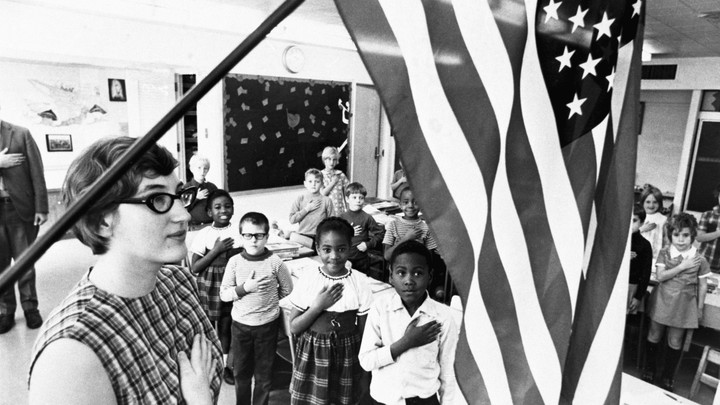
Last week, at the White House Conference on American History, President Donald Trump denounced the way “the left has warped, distorted, and defiled the American story with deceptions, falsehoods, and lies,” attacking Howard Zinn, critical race theory, and The New York Times’ 1619 Project (to which I was a contributor). The president emphasized the need for “patriotic education” in our schools, and seemed to downplay the centrality of slavery, and perhaps any sort of oppression, to America’s founding.

“Our mission is to defend the legacy of America’s founding, the virtue of America’s heroes, and the nobility of the American character,” Trump said at the event. “We must clear away the twisted web of lies in our schools and classrooms, and teach our children the magnificent truth about our country. We want our sons and daughters to know that they are the citizens of the most exceptional nation in the history of the world.”

“Our histories tend to discuss American slavery so impartially,” W. E. B. Du Bois wrote in his 1935 book, Black Reconstruction in America, “that in the end nobody seems to have done wrong and everybody was right.”

Listening to Trump, one would think that a rigorous examination of slavery and its implications was a central fixture of American classrooms. Recent surveys, however, show that young people in America have enormous gaps in what they understand about the history of slavery in this country. According to a 2018 report from the Southern Poverty Law Center, only 8 percent of high-school seniors surveyed were able to identify slavery as the central cause of the Civil War. Two-thirds of students did not know that a constitutional amendment was necessary to formally end slavery.

What fascinated me most about Trump’s speech was his choice to frame it around “indoctrination.” It was strange to realize that providing a holistic account of what slavery was, and the horror it wrought, might be understood as indoctrination—especially if the only stories one has been told about America have been cloaked in the one-dimensional mythology of exceptionalism.

“We have too often a deliberate attempt so to change the facts of history that the story will make pleasant reading for Americans,” Du Bois wrote in Black Reconstruction.

Du Bois was writing during a moment when the narrative of slavery as a benevolent, amicable arrangement between the enslaver and the enslaved had come to dominate America’s collective memory of that historical period. Many Americans saw slavery as an arrangement in which Black people were happy to serve the white people who owned them, and in which those who owned them treated their laborers with a paternal and generous kindness. Such a narrative was propagated by the Columbia historian Ulrich Bonnell Phillips, whose 1918 book, American Negro Slavery, would shape how white Americans understood the institution. “On the whole,” Phillips wrote, “the plantations were the best schools yet invented for the mass training of that sort of inert and backward people which the bulk of American negroes represented.”

As a graduate student, Phillips studied under the historian William A. Dunning, namesake of the Dunning School—which was not a physical institution, but a racist intellectual movement. The Dunning School’s legacy includes entrenching within American public consciousness the idea that, following the Civil War, Black people had proved themselves, through both elected office and suffrage, incapable of participating in democracy. As the historian Eric Foner has put it, “The traditional or Dunning School of Reconstruction was not just an interpretation of history. It was part of the edifice of the Jim Crow System.” At the core of Phillips’s scholarship was the idea that slavery was not in fact an inhuman institution predicated on physical and psychological torture, and that its role in the growth of the American economy was minimal.

Teaching the actual history of slavery does not necessitate skewing, omitting, or lying about what happened in this country; it takes only an exploration of the primary source documents to give one a sense of what it was and the legacy that it has left.

All teachers need to do to help their students understand the horrors of the transatlantic slave trade is have them spend time with the writings of people who experienced it firsthand. “I was soon put down under the decks, and there I received such a salutation in my nostrils as I had never experienced in my life: so that, with the loathsomeness of the stench, and crying together, I became so sick and low that I was not able to eat,” wrote the formerly enslaved Olaudah Equiano in his 1789 autobiography. “The closeness of the place, and the heat of the climate, added to the number in the ship, which was so crowded that each had scarcely room to turn himself, almost suffocated us. This produced copious perspirations, so that the air soon became unfit for respiration, from a variety of loathsome smells, and brought on a sickness among the slaves, of which many died.”

A teacher does not need to lie about the Confederacy being founded on the principles of intergenerational torture and human bondage when the Confederates said as much  in their declarations of secession:

“The people of the slave holding States are bound together by the same necessity and determination to preserve African slavery,” stated Louisiana.

“Our position is thoroughly identified with the institution of slavery—the greatest material interest of the world,” stated Mississippi.

“The election of Mr. Lincoln cannot be regarded otherwise than a solemn declaration, on the part of a great majority of the Northern people, of hostility to the South, her property and her institutions,” stated Alabama, “consigning her citizens to assassinations, and her wives and daughters to pollution and violation, to gratify the lust of half-civilized Africans.”

“The servitude of the African race, as existing in these States,” stated Texas, “is mutually beneficial to both bond and free, and is abundantly authorized and justified by the experience of mankind, and the revealed will of the Almighty Creator.”

It wasn’t just the elected representatives of these states who felt this way. The historian James Oliver Horton found plenty of examples of Confederate soldiers saying the same. As he notes, one Southern prisoner of war told the Union soldiers standing watch, “You Yanks want us to marry our daughters to niggers.” An indigent white farmer from North Carolina said that he could not and would not stop fighting, because Lincoln’s government was “trying to force us to live as the colored race.” A Confederate artilleryman from Louisiana said that his army had to fight even against difficult odds because he would “never want to see the day when a Negro is put on an equality with a white person.”

An educator doesn’t have to make up stories about what our Founding Fathers thought of Black people, when they said it clearly themselves.

“Comparing them by their faculties of memory, reason, and imagination, it appears to me, that in memory they are equal to the whites; in reason much inferior, as I think one could scarcely be found capable of tracing and comprehending the investigations of Euclid; and that in imagination they are dull, tasteless, and anomalous,” wrote Thomas Jefferson in Notes on the State of Virginia. “I advance it therefore as a suspicion only, that the blacks, whether originally a distinct race, or made distinct by time and circumstances, are inferior to the whites in the endowments both of body and mind.”

No teacher needs to lie about how enslavers were allowed to abuse their enslaved workers when the Virginia slave codes made clear that it was permissible under the law for a white person to murder an enslaved Black person:

“WHEREAS the only law in force for the punishment of refreactory servants (a) resisting their master, mistris or overseer cannot be inflicted upon negroes, nor the obstinacy of many of them by other then violent meanes supprest, Be it enacted and declared by this grand assembly, if any slave resist his master (or othe by his masters order correcting him) and by the extremity of the correction should chance to die, that his death shall not be accompted ffelony, but the master (or that other person appointed by the master to punish him) be acquit from molestation, since it cannot be presumed that prepensed malice (which alone makes murther ffelony) should induce any man to destroy his owne estate.”

It is not necessary to dramatize or exaggerate the power imbalance between enslavers and enslaved people—and the violence  through which such imbalance manifested itself between enslaved women and white men—when countless examples of slave narratives share stories of the sexual abuse Black women experienced at the hands of their owners. Take this 1937 account from the formerly enslaved W. L. Bost, taken as part of the WPA’s Federal Writers’ Project by a white interviewer, and transcribed in the sort of thick dialect that these writers often ascribed to their Black subjects:

Plenty of the colored women have children by the white men. She know better than to not do what he say. Didn’t have much of that until the men from South Carolina come up here [to North Carolina] and settle and bring slaves. Then they take them very same children what have they own blood and make slaves out of them. If the Missus find out she raise revolution. But she hardly find out. The white men not going to tell and the nigger women were always afraid to. So they jes go on hopin’ that thing[s] won’t be that way always.

Or this excerpt from Harriet Jacobs, in her 1861 book, Incidents in the Life of a Slave Girl:

My master met me at every turn, reminding me that I belonged to him, and swearing by heaven and earth that he would compel me to submit to him. If I went out for a breath of fresh air after a day of unwearied toil, his footsteps dogged me. If I knelt by my mother’s grave, his dark shadow fell on me even there. The light heart which nature had given me became heavy with sad forebodings.

To understand the impact and human toll of family separation, one need look no further than the ads placed in newspapers by enslaved people in the years and decades following the end of the Civil War and the formal abolition of slavery. Like this one from Philadelphia, taken out by Eliza Holmes in 1895:

INFORMATION WANTED OF my husband and son. We parted at Richmond, Va., in 1860. My son's name was Jas. Monroe Holmes; my husband's name was Frank Holmes. My son was sold in Richmond, Va. I don't know where they carried him to. My husband was not sold; I left him in Richmond, Va. and I and five children, Henry, Gabriel, Charles, Dortha and Jacob were sold to a trader who lived in Texas. I am now old, and don’t think that I shall be here long and would like to see them before I die. Any information concerning them will be thankfully received by Eliza Holmes, Flatonia, Fayette Co., Texas.

The intensity of the opposition that Trump and many others display to centering slavery, or even simply reorienting our country’s history so that slavery is no longer peripheral to the founding of the American project, stems from their understanding of the stakes of this debate. So much of the legitimacy of America’s social, economic, and political infrastructure is predicated on an ahistorical myth—one that embraces all that makes America exceptional, without reckoning with the fact that so much of what created exceptional lives for some citizens was made possible by the intergenerational oppression of millions of others. The study of slavery aptly demonstrates these contradictions and entanglements. Trump and others aligned with his message know that once people understand slavery’s entanglement in every facet of U.S. history, the legitimacy of its systems unravels—and with it, the legitimacy of those occupying the spaces of power.

If students don’t learn about the history of slavery, then they might believe that the Electoral College is a benign institution predicated on establishing democratic fairness for Americans across the country. They might grow up to believe that the enormous wealth gap between Black and white Americans is simply a result of one group working harder than another. They might think that our prison system looks the way it does because Black people are inherently more violent.

“No one can read that first thin autobiography of Frederick Douglass and have left many illusions about slavery,” Du Bois wrote in Black Reconstruction. “And if truth is our object, no amount of flowery romance and the personal reminiscences of its protected beneficiaries can keep the world from knowing that slavery was a cruel, dirty, costly and inexcusable anachronism, which nearly ruined the world’s greatest experiment in democracy.”

This is what Trump is afraid students will find out. But the truth is that our country is not made worse by young people reckoning fully with the legacy of slavery. Such reckoning better prepares them to make sense of how our country has come to be, and how to build systems and institutions predicated on justice rather than oppression. Nothing is more patriotic than that.

We want to hear what you think about this article. Submit a letter to the editor or write to letters@theatlantic.com.

Monday, October 5, 2020

Stage Fright


Act 3 Scene 322 Another day in the life. Willie Loman is sitting on a footstool in one corner of the stage staring into space. In the background Peggy Lee is softly singing "Is this all there is?" Richard Pryor gets the audience rocking with an hysterical monologue. A chorus sings "Nearer My God to Thee." The orchestra stikes up "Dixie." A masked Donald Trump waves at the audience from the back of a fake limmo. Mitt Romney comes on stage in blackface playing Kingfish. "I say there, Andy, are you sure about that?" Porky Pig closes saying, "Tha tha tha tha that's all folks." The stage goes black.

Saturday, October 3, 2020

New York, New York


Shared with Your friends
Friends

You better believe I'd like to visit NYC again. Just one more time. Matter of fact, if I had the money I'd be living in NYC with all that's there. Positively absolutely. New York, New York. What do you think about that, my friends? 

Friday, October 2, 2020

Feeling Groovy


Shared with Your friends
Friends
It seems that I still haven't lost the capacity to reach conclusions quickly without going thru the laborious process of considering facts and reason and needing instruction. I don't have to think about it; some things just come to me intuitively.
For example, to roast a marshmallow attach the marshmallow to a stick and hold it over an open fire. I did not need an instruction booklet or a Youtube video to know this.
To start the car, step on the break and push the button. The saleslady didn't have to instruct. I knew this intuitively.
Karma is dangerous and is to be strenuously avoided. I have always known about bad Karma. Nobody had to tell me that what goes around comes around.
I was reading the New Testament at three. Nobody had to tell me it was important.
I never took Grimm's fairy tales seriously. I always knew they were just scary stories and not to be taken seriously. Wolves don't eat young girls unless they are really, really, really hungry.
Cities are sinful places. Small country towns are salubrious. I knew the word "salubrious" without having to look it up at age 8 Use it in a sentence? Okay. The small town of Winfield where I grew up was a salubrious place to grow up unlike Birmingham.
I just know things. I can't help it. I have good genes.

Thursday, October 1, 2020

I Just Know Things


Shared with Your frie
Friends
It seems that I still haven't lost the capacity to reach conclusions quickly without going thru the laborious process of considering facts and reason and needing instruction. I don't have to think about it; some things just come to me intuitively.
For example, to roast a marshmallow attach the marshmallow to a stick and hold it over an open fire. I did not need an instruction booklet or a Youtube video to know this.
To start the car, step on the break and push the button. The saleslady didn't have to instruct. I knew this intuitively.
Karma is dangerous and is to be strenuously avoided. I have always known about bad Karma. Nobody had to tell me that what goes around comes around.
I was reading the New Testament at three. Nobody had to tell me it was important.
I never took Grimm's fairy tales seriously. I always knew they were just scary stories and not to be taken seriously. Wolves don't eat young girls unless they are really, really, really hungry.
Cities are sinful places. Small country towns are salubrious. I knew the word "salubrious" without having to look it up at age 8 Use it in a sentence? Okay. The small town of Winfield where I grew up was a salubrious place to grow up unlike Birmingham.
I just know things. I can't help it. I have good genes.