Saturday, September 5, 2020

What Biden Understands

 IDEAS

SEAN RAYFORD / GETTY

All through the primaries, Joe Biden was portrayed as an anachronism, a man who had missed his moment by a decade or three. Even as mainstream media outlets published fawning profiles of his many rivals, they largely dismissed his chances. Most pundits seemed to believe that nobody would support Biden if he didn’t happen to be the most senior Democrat in the race. But Biden not only beat a dozen competitors to win the Democratic Party’s nomination he has also persistently led Donald Trump in the polls, adeptly handling the extraordinarily turbulent politics of 2020.

The simplest explanation is that people like Joe Biden, and they like him for a reason: In contrast to Trump and certain vocal parts of the Democratic Party, he actually expresses the view of most Americans. If Democrats manage to win back the White House—and avert the danger that four more years of Trump would pose to peace, unity, and democracy in America—it will be thanks to qualities that a younger or more radical candidate would probably lack.

When mass protests over the killing of George Floyd spread across the United States, the American public reacted in a far less divided way than a quick look at the partisan media landscape might suggest. According to opinion polls, most Americans believe that Derek Chauvin committed murder, that police brutality is a serious problem, and that we need to do more to eliminate racism. Other polls show that most Americans also believe that violent protest is illegitimate and that it is a bad idea to “defund the police.”

But many political and media elites have failed to capture this consensus. The worst offender is, as always, Donald Trump, who seems unable to express empathy for those who suffer from injustice, and still seems to think that he can boost his standing by inflaming the country’s racial tensions. But some on the left have also veered toward the extremes. They have embraced deeply unpopular messages such as “defund the police,” or refrained from criticizing violent protesters.

In the past few months, writers for publications including The Nation and The New York Times have dismissed the idea that looting and rioting are forms of political violence. Just a few days ago, NPR published a soft interview with a white author who defends looting by claiming that it “strikes at the heart of property, of whiteness and of the police.” And anyone on Twitter will have seen numerous versions of the argument that rioting and looting aren’t happening at a significant scale, that it doesn’t matter if they are happening, and that at any rate, such behavior is a reasonable reaction to injustice.

This abdication of moral responsibility by parts of the commentariat has made it more difficult for elected Democrats to oppose political violence. On Saturday, for example, Senator Chris Murphy wrote on Twitter: “This isn’t hard. Vigilantism is bad. Police officers shooting black people in the back is bad. Looting and property damage is bad. You don’t have to choose. You can be against it all.” When some social-media users criticized his message, he took it down, and apologized for giving the impression that he “thought there was an equivalency between property crime and murder.”

Murphy was right the first time: It shouldn't be hard to support peaceful protests for racial justice while unequivocally denouncing looting. But evidently, the easy test proved too hard for him to pass.

On the ground, the failure to pass this same test has had dire consequences. Authorities in Portland, Oregon, have, in all but the most egregious cases, declined to press charges against protesters who break the law. One man who benefited from this policy is Michael Reinoehl, a white man who wrote on social media that “every Revolution needs people that are willing and ready to fight ... I am 100 % ANTIFA all the way!”

In July, Reinoehl was apprehended at a local protest for being in possession of a loaded gun and resisting arrest. But he was quickly let go. A few weeks later, the charges against him were dropped. On Saturday, he attended a protest in Portland, where he allegedly shot and killed a Trump supporter. (Reinoehl was killed Thursday night when a federal fugitive task force moved to arrest him.)

As george packer has rightly noted in these pages, the violent clashes in Kenosha, Wisconsin; Portland; and other cities around the country have opened a big opportunity for the incumbent president: "If Donald Trump wins, in a trustworthy vote, what’s happening this week in Kenosha, Wisconsin, will be one reason." Voters, Packer said, believe Democrats are being sincere when they denounce police brutality. But do they also believe that Democrats are being sincere when they criticize political violence—often, like Murphy, rather gingerly?

Thankfully, most Black officials and community leaders have ignored online hand-wringing about the perils of criticizing lawlessness. They have wholeheartedly embraced the mass movement for racial justice—and unreservedly condemned the extremists and opportunists who loot stores, burn down neighborhoods, or engage in juvenile fantasies of political revolution.

Black politicians including Keisha Lance Bottoms, the mayor of Atlanta, and John J. DeBerry Jr., a Democratic state representative in Tennessee, have denounced those intent on destruction. Citizens with the most personal reasons to seek revenge, including George Floyd’s brother and Jacob Blake’s mother, have made moving pleas not to descend into disorder.

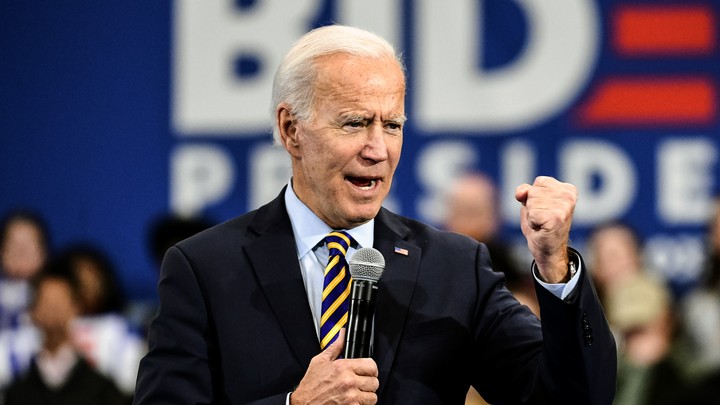
The Democratic Party’s nominee for president has also condemned violence early, often, and without ambiguity. On June 2, Biden made clear that he does not condone riots, no matter the cause they supposedly serve: "There is no place for violence, no place for looting or destroying property or burning churches, or destroying businesses.”

Since then, Biden has repeatedly made the same point much more directly than many of his colleagues have. In a live speech from Pittsburgh on Monday, he drove the point home: "Rioting is not protesting. Looting is not protesting. Setting fires is not protesting," he insisted. "It's lawlessness, plain and simple. And those who do it should be prosecuted."

Perhaps the most powerful moment of Biden's speech came when he dismissed, with a wry smile, the idea that he might have secret sympathies for political violence: "Do I look like a radical socialist with a soft spot for rioters? Really?"

The question biden put to the American people in Pittsburgh is whether they would feel safer under his watch or that of a president who, in hope of political gain, has embraced chaos for the past three months. Polls suggest an answer. Some 40 percent of Americans say that a Biden victory would make them feel less safe. But that figure is 50 percent for Trump.

As long as Biden continues to be as emphatic about his views as he was on Monday, voters will see that his disavowal of violence is sincere. And if they are faced with a decision between a president who is forever making excuses for those who commit violence in his name, and a challenger who is willing to call out the sins of his “own” side, their decision shouldn’t be difficult.

If unrest isn’t becoming a vulnerability for Biden, that’s because he has been so much more astute in avoiding Trump’s trap than the young and online. The latter have absorbed the preposterous lesson that to criticize riots (many of which are perpetrated by white political extremists) is to betray the movement for racial justice.

Far from being a source of weakness, the fact that Biden honed his political instincts over many decades is a source of electoral strength. And if Biden becomes the 46th president of the United States, it will not be despite his failure to understand (what most members of his own party believe to be) the spirit of the moment; it will be because he had the good political judgment to eschew it.

We want to hear what you think about this article. Submit a letter to the editor or write to letters@theatlantic.com.
Friday, September 4, 2020

Trumpets Cannot Admit the Truth

SHUTTERSTOCK / THE ATLANTIC

To understand the corruption, chaos, and general insanity that is continuing to engulf the Trump campaign and much of the Republican Party right now, it helps to understand the predicate embraced by many Trump supporters: If Joseph R. Biden Jr. wins the presidency, America dies.

During last week’s Republican National Convention, speaker after speaker insisted that life under a Biden presidency would be dystopian. Charlie Kirk, the young Trump acolyte who opened the proceedings, declared, “I am here tonight to tell you—to warn you—that this election is a decision between preserving America as we know it and eliminating everythingthat we love.” President Trump, who closed the proceedings, said, “Your vote will decide whether we protect law-abiding Americans or whether we give free rein to violent anarchists and agitators and criminals who threaten our citizens. And this election will decide whether we will defend the American way of life or allow a radical movement to completely dismantle and destroy it.” And in between Americans were told that Democrats want to “disarm you, empty the prisons, lock you in your home, and invite MS-13 to live next door” and that they “want to destroy this country and everything that we have fought for and hold dear.”

“They’re not satisfied with spreading the chaos and violence into our communities. They want to abolish the suburbs altogether,” a St. Louis couple who had brandished weapons against demonstrators outside their home, told viewers. “Make no mistake, no matter where you live, your family will not be safe in the radical Democrats’ America.”

One does not have to be a champion of the Democratic Party to know this chthonic portrait is absurd. But it is also essential, because it allows Trump and his followers to tolerate and justify pretty much anything in order to win. And “anything” turns out to be quite a lot.

In just the past two weeks, the president has praised supporters of the right-wing conspiracy theory QAnon, which contends, as The Guardian recently summarized it, that “a cabal of Satan-worshipping Democrats, Hollywood celebrities and billionaires runs the world while engaging in pedophilia, human trafficking and the harvesting of a supposedly life-extending chemical from the blood of abused children.” Trump touted a conspiracy theory that the national death toll from COVID-19 is about 9,000, a fraction of the official figure of nearly 185,000; promoted a program on the One America News Network accusing demonstrators of secretly plotting Trump’s downfallencouraged his own supporters to commit voter fraud; and claimed Biden is controlled by “people that are in the dark shadows” who are wearing “dark uniforms.”

Trump believes his own government is conspiring to delay a COVID-19 vaccine until after the election. He retweeted a message from the actor James Wood saying New York Governor Andrew Cuomo “should be in jail” and another from an account accusing the Portland, Oregon, mayor of “committing war crimes.” The president is “inciting violence,” in the words of Maryland’s Republican Governor, Larry Hogan. Trump defended 17-year-old Kyle Rittenhouse, a supporter who is charged with first-degree homicide; and statedthat if he loses the election in November it would be because it was “rigged.” At the same time, the second-ranking House Republican, among other of the president’s supporters, has shared several manipulated videos in an effort to damage Biden.

This is just the latest installment in a four-year record of shame, indecency, incompetence, and malfeasance. And yet, for tens of millions of Trump’s supporters, none of it matters. None of it even breaks through. At this point, it appears, Donald Trump really could shoot someone on Fifth Avenue and not lose his voters.

This phenomenon has no shortage of explanations, but perhaps the most convincing is the terror the president’s backers feel. Time and again, I’ve had conversations with Trump supporters who believe the president is all that stands between them and cultural revolution. Trump and his advisers know it, which is why the through line of the RNC was portraying Joe Biden as a Jacobin.

Republicans chose that theme despite the fact that during his almost 50 years in politics, Biden hasn’t left any discernible ideological imprint on either the nation or his own party. Indeed, Biden is notable for his success over the course of his political career in forging alliances with many Republicans. I worked at the Office of National Drug Control Policy in the early 1990s when William Bennett was its director and George H. W. Bush was president. Biden was then chair of the Senate Judiciary Committee; he and his staff were supportive of our work, and not in the least ideological. There will be no remaking of the calendar if Joe Biden becomes president.

Still, in the minds of Trump’s supporters lingers the belief that a Biden presidency would usher in a reign of terror. Many of them simply have to believe that. Justifying their fealty to a man who is so obviously a moral wreck requires them to turn Joe Biden and the Democratic Party into an existential threat. The narrative is set; the actual identity of the nominee is almost incidental.

A powerful tribal identity bonds the president to his supporters. As Amy Chua, the author of Political Tribes: Group Instinct and the Fate of Nations, has argued, the tribal instinct is not just to belong, but also to exclude and to attack. “When groups feel threatened,” Chua writes, “they retreat into tribalism. They close ranks and become more insular, more defensive, more punitive, more us-versus-them.”

That works both ways. Fear strengthens tribalistic instincts, and tribalistic instincts amplify fear. Nothing bonds a group more tightly than a common enemy that is perceived as a mortal threat. In the presence of such an enemy, members of tribal groups look outward rather than inward, at others and never at themselves or their own kind.

The danger of this mindset—in which the means, however unethical, justify the ends of survival—is obvious. And so in this case, Trump supporters will tolerate everything he does, from making hush-money payments to porn stars and engaging in sexually predatory behavior, to inviting America’s adversaries to intervene in our elections, to pressuring American allies to dig up dirt on the president’s opponent, to cozying up to some of the worst dictators in the world, to peddling crazed conspiracy theories, to mishandling a pandemic at the cost of untold lives, to countless other ethical and governing transgressions. Trump is given carte blanche by his supporters because they perceive him as their protector, transforming his ruthlessness from a vice into a virtue.

In my experience, if Trump supporters are asked to turn their gaze away from their perceived opponents, and instead to focus and reflect on him and on his failures, they respond in a couple of consistent ways. Many shift the topic immediately back to Democrats, because offering a vigorous moral defense of Donald Trump isn’t an easy task. It’s like asking people to stare directly into the sun; they might do it for an instant, but then they look away. But if you do succeed in keeping the topic on Trump, they often twist themselves into knots in order to defend him, and in some cases they simply deny reality.

“Motivation conditions cognition,” Jonathan Rauch, a senior fellow at the Brookings Institution and a contributing writer at The Atlantic, wisely told me. Very few Trump supporters I know are able to offer an honest appraisal of the man. To do so creates too much cognitive dissonance.

That they are defending a person who is fundamentally malicious, even if he makes judicial appointments of which they approve, is too painful for them to admit. They are similarly unable to admit they are defending an ethic that is at odds with what they have long championed. They have accepted, excused, and applauded Trump’s behavior and tactics, allowing his ends to justify his means. In important respects, this is antithetical to a virtue ethic. So once again, it’s easier for them to look away or engage in self-deception; to convince themselves that Donald Trump is not who he so clearly is.

These reactions aren’t confined to Trump supporters; people across the political spectrum struggle with confirmation bias and motivated reasoning, in giving too much benefit of the doubt to those with whom we agree and judging too harshly and unfairly those with whom we disagree. That is part of the human condition. The degree to which Democrats, including feminists, overlooked or accepted Bill Clinton’s sexually predatory behavior—including his campaign’s effort to smear his accusers and its use of a private investigator to destroy Gennifer Flowers’s reputation “beyond all recognition”—is an illustration of this. So Flowers was branded a “bimbo” and a “pathological liar,” even though Clinton later, under oath, admitted to having an affair with her.

"If you drag a $100 bill through a trailer park, you never know what you'll find,” James Carville said in response to Paula Jones’s claim that Clinton sexually harassed her. In defending President Clinton against the charges of sexual harassment made by Kathleen Willey, who accused Clinton of groping her without her consent, Gloria Steinem wrote, “The truth is that even if the allegations are true, the President is not guilty of sexual harassment. He is accused of having made a gross, dumb and reckless pass at a supporter during a low point in her life. She pushed him away, she said, and it never happened again. In other words, President Clinton took ‘no’ for an answer.” And Nina Burleigh, who covered the White House for Time magazine, said, “I’d be happy to give him a blowjob just to thank him for keeping abortion legal. I think American women should be lining up with their presidential kneepads on to show their gratitude for keeping the theocracy off our backs.” So Democrats should be careful about looking down at others for accommodating themselves to unsavory and even repulsive characters for the sake of partisanship.

But what’s different in this case is that Trump, because of the corruption that seems to pervade every area of his life and his damaged psychological and emotional state, has shown us just how much people will accept in their leaders as a result of “negative partisanship,” the force that binds parties together less in common purpose than in opposition to a shared opponent. As the conservative writer David French has put it, with Donald Trump and his supporters we are seeing “negative partisanship in its near-pure form, and it’s the best way to explain Trump’s current appeal to the Republican party.” His ideology is almost entirely beside the point, according to French: “His identity matters more, and his identity is clear—the Republican champion against the hated Democratic foe.”

I know plenty of Trump supporters, and I know many of them to be people of integrity in important areas of their lives. Indeed, some are friends I cherish. But if there is a line Donald Trump could cross that would forfeit the loyalty of his core supporters—including, and in some respects especially, white evangelical Christians—I can’t imagine what it would be. And that is a rather depressing thing to admit.

Polarization and political tribalism are not new to America; fear and hatred for our fellow citizens have been increasing for decades. We’ve had plenty of presidents who have failed us, in ways large and small. But this moment is different because Donald Trump is different, and because Donald Trump is president. His relentless assault on truth and the institutions of democracy—his provocations and abuse of power, his psychological instability and his emotional volatility, his delusions and his incompetence—are unlike anything we’ve seen before. He needs to be stopped. And his supporters can’t say, as they did in 2016, that they just didn’t know. Now we know. It’s not too late—it’s never too late—to do the right thing.

We want to hear what you think about this article. Submit a letter to the editor or write to letters@theatlantic.com.