Tuesday, May 5, 2020

1619


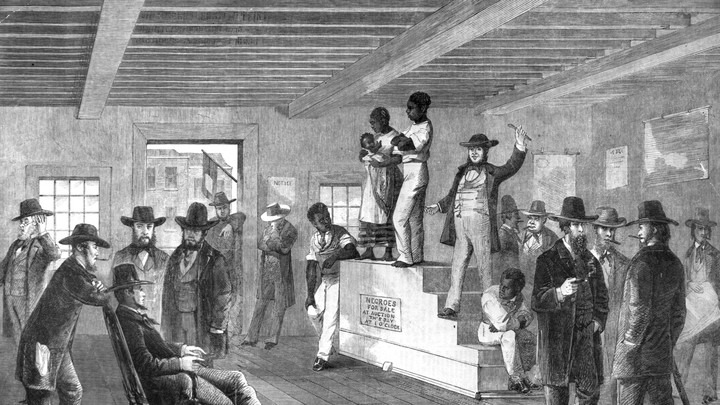
BETTMANN / GETTY
This article was updated at 7:35 p.m. ET on December 23, 2019
When the new york times magazine published its 1619 Project in August, people lined up on the street in New York City to get copies. Since then, the project—a historical analysis of how slavery shaped American political, social, and economic institutions—has spawned a podcast, a high-school curriculum, and an upcoming book. For Nikole Hannah-Jones, the reporter who conceived of the project, the response has been deeply gratifying.
To hear more feature stories, see our full list or get the Audm iPhone app.
“They had not seen this type of demand for a print product of The New York Times, they said, since 2008, when people wanted copies of Obama's historic presidency edition,” Hannah-Jones told me. “I know when I talk to people, they have said that they feel like they are understanding the architecture of their country in a way that they had not.”
U.S. history is often taught and popularly understood through the eyes of its great men, who are seen as either heroic or tragic figures in a global struggle for human freedom. The 1619 Project, named for the date of the first arrival of Africans on American soil, sought to place “the consequences of slavery and the contributions of black Americans at the very center of our national narrative.” Viewed from the perspective of those historically denied the rights enumerated in America’s founding documents, the story of the country’s great men necessarily looks very different.
The reaction to the project was not universally enthusiastic. Several weeks ago, the Princeton historian Sean Wilentz, who had criticized the 1619 Project’s “cynicism” in a lecture in November, began quietly circulating a letter objecting to the project, and some of Hannah-Jones’s work in particular. The letter acquired four signatories—James McPherson, Gordon Wood, Victoria Bynum, and James Oakes, all leading scholars in their field. They sent their letter to three top Times editors and the publisher, A. G. Sulzberger, on December 4. A version of that letter was published on Friday, along with a detailed rebuttal from Jake Silverstein, the editor of the Times Magazine.
The letter sent to the Times says, “We applaud all efforts to address the foundational centrality of slavery and racism to our history,” but then veers into harsh criticism of the 1619 Project. The letter refers to “matters of verifiable fact” that “cannot be described as interpretation or ‘framing’” and says the project reflected “a displacement of historical understanding by ideology.” Wilentz and his fellow signatories didn’t just dispute the Times Magazine’s interpretation of past events, but demanded corrections.
In the age of social-media invective, a strongly worded letter might not seem particularly significant. But given the stature of the historians involved, the letter is a serious challenge to the credibility of the 1619 Project, which has drawn its share not just of admirers but also critics.
Nevertheless, some historians who declined to sign the letter wondered whether the letter was intended less to resolve factual disputes than to discredit laymen who had challenged an interpretation of American national identity that is cherished by liberals and conservatives alike.
“I think had any of the scholars who signed the letter contacted me or contacted the Timeswith concerns [before sending the letter], we would've taken those concerns very seriously,” Hannah-Jones said. “And instead there was kind of a campaign to kind of get people to sign on to a letter that was attempting really to discredit the entire project without having had a conversation.”
Underlying each of the disagreements in the letter is not just a matter of historical fact but a conflict about whether Americans, from the Founders to the present day, are committed to the ideals they claim to revere. And while some of the critiques can be answered with historical fact, others are questions of interpretation grounded in perspective and experience.
In fact, the harshness of the Wilentz letter may obscure the extent to which its authors and the creators of the 1619 Project share a broad historical vision. Both sides agree, as many of the project’s right-wing critics do not, that slavery’s legacy still shapes American life—an argument that is less radical than it may appear at first glance. If you think anti-black racism still shapes American society, then you are in agreement with the thrust of the 1619 Project, though not necessarily with all of its individual arguments.
The clash between the Times authors and their historian critics represents a fundamental disagreement over the trajectory of American society. Was America founded as a slavocracy, and are current racial inequities the natural outgrowth of that? Or was America conceived in liberty, a nation haltingly redeeming itself through its founding principles? These are not simple questions to answer, because the nation’s pro-slavery and anti-slavery tendencies are so closely intertwined.
The letter is rooted in a vision of American history as a slow, uncertain march toward a more perfect union. The 1619 Project, and Hannah-Jones’s introductory essay in particular, offer a darker vision of the nation, in which Americans have made less progress than they think, and in which black people continue to struggle indefinitely for rights they may never fully realize. Inherent in that vision is a kind of pessimism, not about black struggle but about the sincerity and viability of white anti-racism. It is a harsh verdict, and one of the reasons the 1619 Project has provoked pointed criticism alongside praise.
Americans need to believe that, as Martin Luther King Jr. said, the arc of history bends toward justice. And they are rarely kind to those who question whether it does.
Most americans still learn very little about the lives of the enslaved, or how the struggle over slavery shaped a young nation. Last year, the Southern Poverty Law Center found that few American high-school students know that slavery was the cause of the Civil War, that the Constitution protected slavery without explicitly mentioning it, or that ending slavery required a constitutional amendment.
“The biggest obstacle to teaching slavery effectively in America is the deep, abiding American need to conceive of and understand our history as ‘progress,’ as the story of a people and a nation that always sought the improvement of mankind, the advancement of liberty and justice, the broadening of pursuits of happiness for all,” the Yale historian David Blight wrote in the introduction to the report. “While there are many real threads to this story—about immigration, about our creeds and ideologies, and about race and emancipation and civil rights, there is also the broad, untidy underside.”
In conjunction with the Pulitzer Center, the Times has produced educational materials based on the 1619 Project for students—one of the reasons Wilentz told me he and his colleagues wrote the letter. But the materials are intended to enhance traditional curricula, not replace them. “I think that there is a misunderstanding that this curriculum is meant to replace all of U.S. history,” Silverstein told me. “It's being used as supplementary material for teaching American history." Given the state of American education on slavery, some kind of adjustment is sorely needed.
Published 400 years after the first Africans were brought to in Virginia, the project asked readers to consider “what it would mean to regard 1619 as our nation’s birth year.” The special issue of the Times Magazine included essays from the Princeton historian Kevin Kruse, who argued that sprawl in Atlanta is a consequence of segregation and white flight; the Times columnist Jamelle Bouie, who posited that American countermajoritarianismwas shaped by pro-slavery politicians seeking to preserve the peculiar institution; and the journalist Linda Villarosa, who traced racist stereotypes about higher pain tolerance in black people from the 18th century to the present day. The articles that drew the most attention and criticism, though, were Hannah-Jones’s introductory essay chronicling black Americans’ struggle to “make democracy real” and the sociologist Matthew Desmond’s essay linking the crueler aspects of American capitalism to the labor practices that arose under slavery.
The letter’s signatories recognize the problem the Times aimed to remedy, Wilentz told me. “Each of us, all of us, think that the idea of the 1619 Project is fantastic. I mean, it's just urgently needed. The idea of bringing to light not only scholarship but all sorts of things that have to do with the centrality of slavery and of racism to American history is a wonderful idea,” he said. In a subsequent interview, he said, “Far from an attempt to discredit the 1619 Project, our letter is intended to help it.”
The letter disputes a passage in Hannah-Jones’s introductory essay, which lauds the contributions of black people to making America a full democracy and says that “one of the primary reasons the colonists decided to declare their independence from Britain was because they wanted to protect the institution of slavery” as abolitionist sentiment began rising in Britain.
This argument is explosive. From abolition to the civil-rights movement, activists have reached back to the rhetoric and documents of the founding era to present their claims to equal citizenship as consonant with the American tradition. The Wilentz letter contends that the 1619 Project’s argument concedes too much to slavery’s defenders, likening it to South Carolina Senator John C. Calhoun’s assertion that “there is not a word of truth” in the Declaration of Independence’s famous phrase that “all men are created equal.” Where Wilentz and his colleagues see the rising anti-slavery movement in the colonies and its influence on the Revolution as a radical break from millennia in which human slavery was accepted around the world, Hannah-Jones’ essay outlines how the ideology of white supremacy that sustained slavery still endures today.
“To teach children that the American Revolution was fought in part to secure slavery would be giving a fundamental misunderstanding not only of what the American Revolution was all about but what America stood for and has stood for since the Founding,” Wilentz told me. Anti-slavery ideology was a “very new thing in the world in the 18th century,” he said, and “there was more anti-slavery activity in the colonies than in Britain.”
Hannah-Jones hasn’t budged from her conviction that slavery helped fuel the Revolution. “I do still back up that claim,” she told me last week—before Silverstein’s rebuttal was published—although she says she phrased it too strongly in her essay, in a way that might mislead readers into thinking that support for slavery was universal. “I think someone reading that would assume that this was the case: all 13 colonies and most people involved. And I accept that criticism, for sure.” She said that as the 1619 Project is expanded into a history curriculum and published in book form, the text will be changed to make sure claims are properly contextualized.
On this question, the critics of the 1619 Project are on firm ground. Although some southern slave owners likely were fighting the British to preserve slavery, as Silversteinwrites in his rebuttal, the Revolution was kindled in New England, where prewar anti-slavery sentiment was strongest. Early patriots like James Otis, John Adams, and Thomas Paine were opposed to slavery, and the Revolution helped fuel abolitionism in the North.
Historians who are in neither Wilentz’s camp nor the 1619 Project’s say both have a point. “I do not agree that the American Revolution was just a slaveholders' rebellion,” Manisha Sinha, a history professor at the University of Connecticut and the author of The Slave's Cause: A History of Abolition, told me.* “But also understand that the original Constitution did give some ironclad protections to slavery without mentioning it.”
The most radical thread in the 1619 Project is not its contention that slavery’s legacy continues to shape American institutions; it’s the authors’ pessimism that a majority of white people will abandon racism and work with black Americans toward a more perfect union. Every essay tracing racial injustice from slavery to the present day speaks to the endurance of racial caste. And it is this profound pessimism about white America that many of the 1619 Project’s critics find most galling.
Newt Gingrich called the 1619 Project a “lie,” arguing that “there were several hundred thousand white Americans who died in the Civil War in order to free the slaves." In City Journalthe historian Allen Guelzo dismissed the Times Magazine project as a “conspiracy theory” developed from the “chair of ultimate cultural privilege in America, because in no human society has an enslaved people suddenly found itself vaulted into positions of such privilege, and with the consent—even the approbation—of those who were once the enslavers.” The conservative pundit Erick Erickson went so far as to accuse the Times of adopting “the Neo-Confederate world view” that the “South actually won the Civil War by weaving itself into the fabric of post war society so it can then discredit the entire American enterprise.” Erickson’s bizarre sleight of hand turns the 1619 Project’s criticism of ongoing racial injustice into a brief for white supremacy.
The project’s pessimism has drawn criticism from the left as well as the right. Hannah-Jones’s contention that “anti-black racism runs in the very DNA of this country” drew a rebuke from James Oakes, one of the Wilentz letter’s signatories. In an interview with the World Socialist Web Site, Oakes said, “The function of those tropes is to deny change over time … The worst thing about it is that it leads to political paralysis. It’s always been here. There’s nothing we can do to get out of it. If it’s the DNA, there’s nothing you can do. What do you do? Alter your DNA?”
These are objections not to misstatements of historical fact, but to the argument that anti-black racism is a more intractable problem than most Americans are willing to admit. A major theme of the 1619 Project is that the progress that has been made has been fragile and reversible—and has been achieved in spite of the nation’s true founding principles, which are not the lofty ideals few Americans genuinely believe in. Chances are, what you think of the 1619 Project depends on whether you believe someone might reasonably come to such a despairing conclusion—whether you agree with it or not.
Wilentz reached out to a larger group of historians, but ultimately sent a letter signed by five historians who had publicly criticized the 1619 Project in interviews with the World Socialist Web Site. He told me that the idea of trying to rally a larger group was “misconceived,” citing the holiday season and the end of the semester, among other factors. (A different letter written by Wilentz, calling for the impeachment of President Donald Trump, quickly amassed hundreds of signatures last week.) The refusal of other historians to sign on, despite their misgivings about some claims made by the 1619 Project, speaks to a divide over whether the letter was focused on correcting specific factual inaccuracies or aimed at discrediting the project more broadly.
Sinha saw an early version of the letter that was circulated among a larger group of historians. But, despite her disagreement with some of the assertions in the 1619 Project, she said she wouldn’t have signed it if she had been asked to. “There are legitimate critiques that one can engage in discussion with, but for them to just kind of dismiss the entire project in that manner, I thought, was really unwise,” she said. “It was a worthy thing to actually shine a light on a subject that the average person on the street doesn't know much about.”
Although the letter writers deny that their objections are merely matters of “interpretation or ‘framing,’” the question of whether black Americans have fought their freedom struggles “largely alone,” as Hannah-Jones put it in her essay, is subject to vigorous debate. Viewed through the lens of major historical events—from anti-slavery Quakers organizing boycotts of goods produced through slave labor, to abolitionists springing fugitive slaves from prison, to union workers massing at the March on Washington—the struggle for black freedom has been an interracial struggle. Frederick Douglass had William Garrison; W. E. B. Du Bois had Moorfield Storey; Martin Luther King Jr. had Stanley Levison.
“The fight for black freedom is a universal fight; it's a fight for everyone. In the end, it affected the fight for women's rights—everything. That's the glory of it,” Wilentz told me. “To minimize that in any way is, I think, bad for understanding the radical tradition in America.”
But looking back to the long stretches of night before the light of dawn broke—the centuries of slavery and the century of Jim Crow that followed—“largely alone” seems more than defensible. Douglass had Garrison, but the onetime Maryland slave had to go north to find him. The millions who continued to labor in bondage until 1865 struggled, survived, and resisted far from the welcoming arms of northern abolitionists.
“I think one would be very hard-pressed to look at the factual record from 1619 to the present of the black freedom movement and come away with any conclusion other than that most of the time, black people did not have a lot of allies in that movement,” Hannah-Jones told me. “It is not saying that black people only fought alone. It is saying that most of the time we did.”
Nell Irvin Painter, a professor emeritus of history at Princeton who was asked to sign the letter, had objected to the 1619 Project’s portrayal of the arrival of African laborers in 1619 as slaves. The 1619 Project was not history “as I would write it,” Painter told me. But she still declined to sign the Wilentz letter.
“I felt that if I signed on to that, I would be signing on to the white guy's attack of something that has given a lot of black journalists and writers a chance to speak up in a really big way. So I support the 1619 Project as kind of a cultural event,” Painter said. “For Sean and his colleagues, true history is how they would write it. And I feel like he was asking me to choose sides, and my side is 1619's side, not his side, in a world in which there are only those two sides.”
This was a recurrent theme among historians I spoke with who had seen the letter but declined to sign it. While they may have agreed with some of the factual objections in the letter or had other reservations of their own, several told me they thought the letter was an unnecessary escalation.
“The tone to me rather suggested a deep-seated concern about the project. And by that I mean the version of history the project offered. The deep-seated concern is that placing the enslavement of black people and white supremacy at the forefront of a project somehow diminishes American history,” Thavolia Glymph, a history professor at Duke who was asked to sign the letter, told me. “Maybe some of their factual criticisms are correct. But they've set a tone that makes it hard to deal with that.”
“I don't think they think they're trying to discredit the project,” Painter said. “They think they're trying to fix the project, the way that only they know how.”
Historical interpretations are often contested, and those debates often reflect the perspective of the participants. To this day, the pro-Confederate “Lost Cause” intepretation of history shapes the mistaken perception that slavery was not the catalyst for the Civil War. For decades, a group of white historians known as the Dunning School, after the Columbia University historian William Archibald Dunning, portrayed Reconstruction as a tragic period of, in his words, the “scandalous misrule of the carpet-baggers and negroes,” brought on by the misguided enfranchisement of black men. As the historian Eric Foner has written, the Dunning School and its interpretation of Reconstruction helped provide moral and historical cover for the Jim Crow system.
In Black Reconstruction in America, W. E. B. Du Bois challenged the consensus of “white historians” who “ascribed the faults and failures of Reconstruction to Negro ignorance and corruption,” and offered what is now considered a more reliable account of the era as an imperfect but noble effort to build a multiracial democracy in the South.
To Wilentz, the failures of earlier scholarship don’t illustrate the danger of a monochromatic group of historians writing about the American past, but rather the risk that ideologues can hijack the narrative. “[It was] when the southern racists took over the historical profession that things changed, and W. E. B. Du Bois fought a very, very courageous fight against all of that,” Wilentz told me. The Dunning School, he said, was “not a white point of view; it’s a southern, racist point of view.”
In the letter, Wilentz portrays the authors of the 1619 Project as ideologues as well. He implies—apparently based on a combative but ambiguous exchange between Hannah-Jones and the writer Wesley Yang on Twitter—that she had discounted objections raised by “white historians” since publication.
Hannah-Jones told me she was misinterpreted. “I rely heavily on the scholarship of historians no matter what race, and I would never discount the work of any historian because that person is white or any other race,” she told me. “I did respond to someone who was saying white scholars were afraid, and I think my point was that history is not objective. And that people who write history are not simply objective arbiters of facts, and that white scholars are no more objective than any other scholars, and that they can object to the framing and we can object to their framing as well.”
When I asked Wilentz about Hannah-Jones’s clarification, he was dismissive. “Fact and objectivity are the foundation of both honest journalism and honest history. And so to dismiss it, to say, ‘No, I'm not really talking about whites’—well, she did, and then she takes it back in those tweets and then says it's about the inability of anybody to write objective history. That's objectionable too,” Wilentz told me.
Both Du Bois and the Dunning School saw themselves as having reached the truth by objective means. But as a target of the Dunning School’s ideology, Du Bois understood the motives and blind spots of Dunning School scholars far better than they themselves did.  
“We shall never have a science of history until we have in our colleges men who regard the truth as more important than the defense of the white race,” Du Bois wrote, “and who will not deliberately encourage students to gather thesis material in order to support a prejudice or buttress a lie.”
The problem, as Du Bois argued, is that much of American history has been written by scholars offering ideological claims in place of rigorous historical analysis. But which claims are ideological, and which ones are objective, is not always easy to discern.

*An earlier version of this article contained an incorrect title for historian Manisha Sinha's book.
We want to hear what you think about this article. Submit a letter to the editor or write to letters@theatlantic.com.

Marx: A Summary

A Brief Biography of Karl Marx

The Father of Communism influenced world events

Karl Marx
Sean Gallup/Getty Images
Karl Marx (May 5, 1818–March 14, 1883), a Prussian political economist, journalist, and activist, and author of the seminal works, "The Communist Manifesto" and "Das Kapital," influenced generations of political leaders and socioeconomic thinkers. Also known as the Father of Communism, Marx's ideas gave rise to furious, bloody revolutions, ushered in the toppling of centuries-old governments, and serve as the foundation for political systems that still rule over more than 20 percent of the world's population—or one in five people on the planet. "The Columbia History of the World" called Marx's writings "one of the most remarkable and original syntheses in the history of human intellect." 

Personal Life and Education 

Marx was born in Trier, Prussia (present-day Germany) on May 5, 1818, to Heinrich Marx and Henrietta Pressberg. Marx's parents were Jewish, and he came from a long line of rabbis on both sides of his family. However, his father converted to Lutheranism to evade antisemitism prior to Marx's birth.
Marx was educated at home by his father until high school, and in 1835 at the age of 17, enrolled at Bonn University in Germany, where he studied law at his father's request. Marx, however, was much more interested in philosophy and literature.
Following that first year at the university, Marx became engaged to Jenny von Westphalen, an educated baroness. They would later marry in 1843. In 1836, Marx enrolled at the University of Berlin, where he soon felt at home when he joined a circle of brilliant and extreme thinkers who were challenging existing institutions and ideas, including religion, philosophy, ethics, and politics. Marx graduated with his doctoral degree in 1841.

Career and Exile 

After school, Marx turned to writing and journalism to support himself. In 1842 he became the editor of the liberal Cologne newspaper "Rheinische Zeitung," but the Berlin government banned it from publication the following year. Marx left Germany—never to return—and spent two years in Paris, where he first met his collaborator, Friedrich Engels.
However, chased out of France by those in power who opposed his ideas, Marx moved to Brussels, in 1845, where he founded the German Workers’ Party and was active in the Communist League. There, Marx networked with other leftist intellectuals and activists and—together with Engels—wrote his most famous work, "The Communist Manifesto." Published in 1848, it contained the famous line: "Workers of the world unite. You have nothing to lose but your chains." After being exiled from Belgium, Marx finally settled in London where he lived as a stateless exile for the rest of his life.
Marx worked in journalism and wrote for both German and English language publications. From 1852 to 1862, he was a correspondent for the "New York Daily Tribune," writing a total of 355 articles. He also continued writing and formulating his theories about the nature of society and how he believed it could be improved, as well as actively campaigning for socialism.
He spent the rest of his life working on a three-volume tome, "Das Kapital," which saw its first volume published in 1867. In this work, Marx aimed to explain the economic impact of capitalist society, where a small group, which he called the bourgeoisie, owned the means of production and used their power to exploit the proletariat, the working class that actually produced the goods that enriched the capitalist tsars. Engels edited and published the second and third volumes of "Das Kapital" shortly after Marx's death.

Death and Legacy 

While Marx remained a relatively unknown figure in his own lifetime, his ideas and the ideology of Marxism began to exert a major influence on socialist movements shortly after his death. He succumbed to cancer on March 14, 1883, and was buried in Highgate Cemetery in London.
Marx's theories about society, economics, and politics, which are collectively known as Marxism, argue that all society progresses through the dialectic of class struggle. He was critical of the current socio-economic form of society, capitalism, which he called the dictatorship of the bourgeoisie, believing it to be run by the wealthy middle and upper classes purely for their own benefit, and predicted that it would inevitably produce internal tensions which would lead to its self-destruction and replacement by a new system, socialism.
Under socialism, he argued that society would be governed by the working class in what he called the "dictatorship of the proletariat." He believed that socialism would eventually be replaced by a stateless, classless society called communism.

Continuing Influence 

Whether Marx intended for the proletariat to rise up and foment revolution or whether he felt that the ideals of communism, ruled by an egalitarian proletariat, would simply outlast capitalism, is debated to this day. But, several successful revolutions did occur, propelled by groups that adopted communism—including those in Russia, 1917-1919, and China, 1945-1948. Flags and banners depicting Vladimir Lenin, the leader of the Russian Revolution, together with Marx, were long displayed in the Soviet Union. The same was true in China, where similar flags showing the leader of that country's revolution, Mao Zedong, together with Marx were also prominently displayed.
Marx has been described as one of the most influential figures in human history, and in a 1999 BBC poll was voted the "thinker of the millennium" by people from around the world. The memorial at his grave is always covered by tokens of appreciation from his fans. His tombstone is inscribed with words that echo those from "The Communist Manifesto," which seemingly predicted the influence Marx would have on world politics and economics: "Workers of all lands unite.”

Monday, May 4, 2020

Baseball at the Met

Baseball games are on hold until further notice, but fans can delve into the history of America’s favorite pastime via a surprising source—MetMuseum.org. The Metropolitan Museum owns thirty thousand vintage baseball cards, and fifteen thousand of them are online (including the four above, from 1933). They were donated by Jefferson R. Burdick, a New York electrician who died in 1963. Although it’s believed that Burdick never attended a game, he invented a catalogue system that’s still used by collectors today.

Rousseau and Solitude

What Rousseau Knew about Solitude

By 
 

ARTS & CULTURE

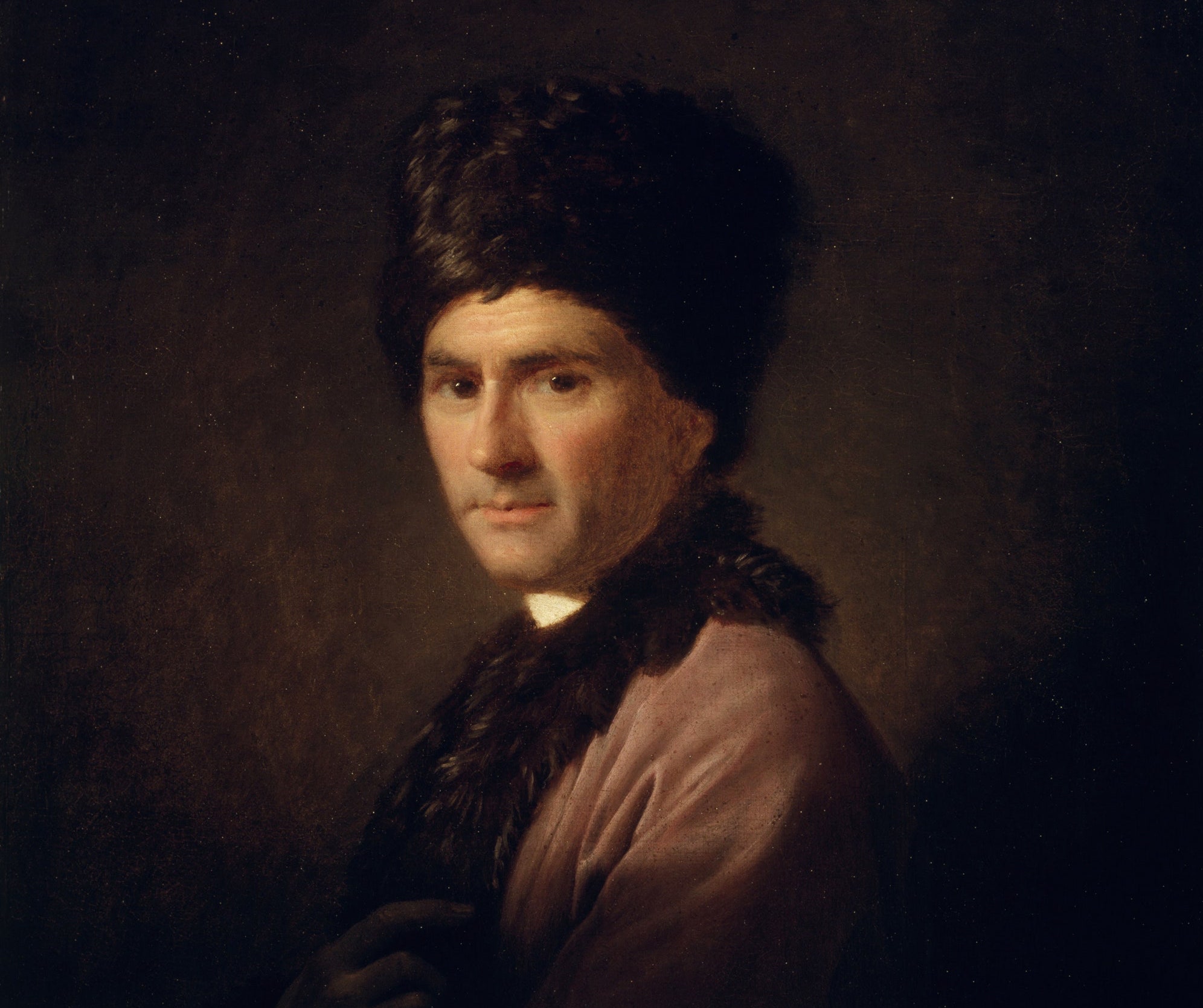
ALLAN RAMSAY, JEAN-JACQUES ROUSSEAU, 1766
In his last unfinished work, Reveries of the Solitary Walker, composed in the two years before his death in 1778, Jean-Jacques Rousseau set forth his vision for a writing life lived beyond the confines of community: “So now I am alone in the world, with no brother, neighbour or friend, nor any company left me but my own… [D]etached as I am from them and from the whole world, what am I? This must now be the object of my inquiry.”
After a scandal erupted in 1762 about the unorthodox religion in one of his books, Rousseau spent the next eight years in exile from Paris, wandering around Switzerland, England, and the French provinces. Having previously occupied a place at the center of civilized society—secretary to the French ambassador in Venice, friend of the philosopher Diderot, protected by rich patrons, “acclaimed, made much of, and welcomed with open arms”—Rousseau became gripped by the paranoid belief that he was an object of universal derision. “The most sociable and loving of men has with one accord been cast out by all the rest. With all the ingenuity of hate they have sought out the cruellest torture for my sensitive soul, and have violently broken all the threads that bound me to them.”
By the time he returned to Paris in 1770, Rousseau was one of the most famous men in Europe, known popularly by his first name and revered by many of his contemporaries. In spite of this celebrity, he chose to live quietly with his companion Thérèse in a modest flat near the Palais-Royal, occupying his time with music, botany, and country walks.
“Alone for the rest of my life”—in Rousseau’s eyes, female companionship did not obviate his own special class of solitude—“since it is only in myself that I find consolation, hope and peace of mind, my only remaining duty is towards myself and this is all I desire… Let me give myself over entirely to the pleasure of conversing with my soul, since this is the only pleasure that men cannot take away from me.”
Claiming to be no longer concerned about his reputation—“the desire to be better known to men has died in my heart”—Rousseau decided that his next project would be a simple one: he would walk, he would think, he would write down the thoughts that came to him. His Reveries would be nothing less than a faithful record of his friendless perambulations and the daydreams which occupied them. “I will give free rein to my thoughts and let my ideas follow their natural course, unrestricted and unconfined. These hours of solitude and meditation are the only ones in the day when I am completely myself and my own master, with nothing to distract or hinder me, the only ones when I can truly say that I am what nature meant me to be.”
In Rousseau’s scheme of things, solitude was the natural human state. By stepping outside of society, by distancing oneself from other voices, one was facilitating a return to oneself. But being with oneself is one thing; writing about the state of being with oneself, another. There are ten walks in the Reveries (“First Walk,” “Second Walk,” et cetera), and although some of them may well record the thoughts that occurred to Rousseau as he ambled around Paris, what they amount to are carefully crafted reflections on his life and earlier writing. The Reveries are not the spontaneous jottings of a dreamer, nor do they attempt to mount an illusion of such spontaneity. Rather, they are the work of a stationary body—a bent back, a cramped wrist, a strained eye, an aching temple—as it worked to broaden and deepen certain fleeting images, particular flashes of insight, into a sustained, intelligible vision.
“I shall content myself with keeping a record of my readings without trying to reduce them to a system. My enterprise is like Montaigne’s, but my motive is entirely different, for he wrote his essays only for others to read, whereas I am writing down my reveries for myself alone. If, as I hope, I retain the same disposition of mind in my old extreme old age, when the time of my departure draws near, I shall recall in reading them the pleasure I have in writing them and by thus reviving times past I shall as it were double the space of my existence.”
I feel it is safe to contradict Rousseau on this: such a sentence—so elaborately constructed, so fine—was not written for the author’s sole benefit. It was not scribbled into his diary and put away. Not enjoyed in private before being burned in his fire. Rather it was turned around. Broken up. Pieced into shape. Tinkered with and worried over. With the expectation, the presumption even, that it would be published and consumed by others. Rousseau’s demands on his sentences were great, as were his demands on his imagined audience. Unable to realize his ideal of true friendship between men, despairing of human incapacity for social harmony, he retreated to his natural state, communed with himself in nature—and what he found there, unvanquished, as vital as ever, was his longing for society. The Reveries are the result of Rousseau’s discovery that the physical state of detachment from community does not erase community from the mind; that, on the contrary, detachment inflates the importance of community in one’s thinking about the self, and fuels the desire to make oneself known to community, even if only to convey one’s condemnation of it.
This is not to say that nature (as opposed to human society) plays an insignificant role in Reveries. On several occasions, Rousseau describes the feelings inspired in him by the landscapes he encounters. He feels happiness and tranquillity when walking through open fields. He expresses delight on noticing specific rare plants. In “Second Walk,” on seeing a star-filled sky, he experiences nothing less than a moment of rapture: “I was conscious of nothing else. In this instant I was being born again, and it seemed as if all I perceived was filled with my frail existence. Entirely taken up by the present, I could remember nothing; I had no distinct notion of myself as a person, I did not know who I was, nor where I was… I felt through my whole being such a wonderful calm, that whenever I recall this feeling I can find nothing to compare with it in all the pleasures that stir our lives.”
Likewise, Rousseau does not fail to produce long passages of philosophizing. Much of “Fourth Walk,” for instance, is devoted to a discussion of truth and falsity. And in “Sixth Walk” he tackles the question of causality in human actions.
But underneath the calm layered over the melancholy, coming after the ecstasy, threaded through the philosophical reasoning, is anxiety. In articulating his new solitude, Rousseau cannot help returning, over and over again, to the old community that he claims to have left behind: “Lonely mediation, the study of nature and the contemplation of the universe lead the solitary to aspire continually to the maker of all things and to seek with a pleasing disquiet for the purpose of all he sees and the cause of all he feels. When my destiny cast me back into the torrent of this world, I found nothing there which could satisfy my heart for a single moment. Regret for the sweet liberty I had lost followed me everywhere and threw a veil of indifference or distaste over everything around me which might have brought me fame and fortune.”
Rousseau’s expressed distaste for fame and fortune masks an obsession with those whom he believes possess the authority to apportion such fame and fortune. His disregard for the opinion of others is actually a susceptibility to those opinions, a susceptibility of an acuteness that today would be called neurotic. Looking at himself through the eyes of society, he is “a monster,” “a poisoner,” “an assassin,” “a horror of the human race,” “a laughingstock.” He imagines passersby spitting on him. He pictures his contemporaries burying him alive. Rumors about him are, he believes, circulating in the highest echelons: “I heard even the King himself and the Queen were talking about it as if there was no doubt about it.” There is simply no one left in society who does not harbor “some secret animosity” toward him, who does not “take part in the universal conspiracy” against him.
Responding to these imagined attacks, in the course of his protestations of innocence, Rousseau makes a second discovery. Human judgments, he realizes, are made not about a thing but about one’s perception of a thing: “[I]nstead of me they will never see anyone but the Jean-Jacques they have created and fashioned for themselves so that they can hate me to their heart’s content. I should be wrong then to be upset by the image they have of me; I ought to take no real interest in it, since it is not me that they are seeing.”
This is Rousseau at his most ingenious. How right he is. Anyone professing to be judging him would, it is true, be judging a figment of their own minds, which they mistake for him. How could they be judging the real Rousseau when it is impossible to subsume a material man, with all his contents, into the immaterial world of thoughts? Close your eyes, torturers, and see where your Rousseau has gone! Yet here Rousseau himself has a blind spot. He fails to see that what is the case for others must also be the case for himself. Rousseau, too, in his judgments of society, has fashioned for himself a figment, which he chooses to hate in the most exquisite mode possible: disdain. “I have regained my peace and tranquillity and lead a quiet and happy life in the midst of them, laughing at the incredible tortures my persecutors are constantly inflicting on themselves while I live in peace, busy with my flowers, stamens and such childish things, and never giving them a moment’s thought… My contemporaries will always be as nothing in my eyes… I feel too much above them to hate them.”
Here Rousseau—man of letters, dedicated to the uncovering of privately reasoned truths to counteract the fraudulent assumptions of society—is being disingenuous. To say one is not thinking of a thing is, in fact, to think about that thing. To call one’s enemies nothing is to call them something. To pity oneself, to assign for oneself the role of victim—“when I reach places where there is no trace of men I breathe freely, as if I were in a refuge where their hate could no longer pursue me”—far from being a diminishment of oneself, is the back route, the concealed pass to the self’s most bountiful feeding grounds.
For Rousseau, solitude is the promise of immunity from the hatred of others. Reveries is his attempt to build a quarantine out of words. Piled around himself are his judgments of society, which he believes society’s own judgments cannot penetrate. But then these self-made walls end up closing in on him, oppressing him just as the society’s walls had once done. In his enclosure, cut off from his tormentors, the one who must be made to suffer is himself. “God is just; his will is that I should suffer, and he knows my innocence… Let men and fate do their worst, we must learn to suffer in silence, everything will find its proper place in the end and sooner or later my turn will come.”
Enclosed in his self-isolation, Rousseau sets himself the task of conceiving a pure kind of writing, one protected from all contact with society. A writing independent of received opinions. A writing free of “hair-splitting metaphysical subtleties” and “the sophistries of the eloquent,” A writing “adopted by my reason, confirmed by my heart and bearing the seal of my conscience uninfluenced by passion.” A writing made by and meant for himself alone. And in this, Rousseau fails. Not because he does not try hard enough; not because he is not brilliant enough, but rather because the task he sets himself is impossible. His writing, like all writing, must by necessity come contaminated by the writing of others, and it will always already be thus.
Where does writing come from? The answer—for Rousseau, for me, for you, for us—is other writing. This is the problem that Rousseau is really fleeing from; his failure to ever really shake this problem off is what, more than any slander society can fling at him, accounts for his suffering.
Like Rousseau, it might appear to us that our writing comes from a realm of experience entirely separate from words on a page: from the world “out there” or from our experience “in here.” But this is an illusion. What happens in life—what we do, what happens to us, what we hear about, what we witness, and how we experience all of that within—does not come to us in a pure state in the present but is mediated through our minds, which orders and interprets the information (which by now has passed into the past) according to stories it has previously constructed to judge and to explain such information. What stories are we telling about the world and our inner experience? They are the world and our inner experience, as our mind knows them. Whatever these stories are, when we come to write them down—as fiction or as nonfiction—we begin to see that we are no longer dealing with “the outer world” or “inner experience,” but have entered negotiations with the way these stories have already been told, with what has already been written (which is how we gain our understanding of the world in the first place).
It is by reading about what has happened to us as a text—images, events, body language, emotions—that we build our life stories. And it is by reading how others have interpreted those texts of their own that we learn how to write.
There is no mystery to creation. To create is to respond. The question is not, What am I writing about?, but rather, What am I responding to? No writing exists that is not a response to something in the past. This is as true for writing set in the so-called present and the so-called future as it is for writing set decades or centuries ago. There is no writing that is not an attempted act of communication: it is alone among art forms in its primary desire to contain transmissible meaning; meaning that, once transmitted, will engender further meaning. What we learn from Rousseau is that, in the act of writing, we are responding not to a thing but to our belief about a thing. A description of a thing is, at base, a statement of belief. And all statements of belief—even those that appear to be deeply personal, like “I love you”—are restatements of the beliefs of others (which is not to say we do not feel love, but that what we name as love, we learn from stories).
Which is all to say: writing, as a pursuit, is less daunting than Rousseau makes it out to be. By letting go of the idea that our writing must be absolutely ours, that it must come exclusively from us, untouched by outside influences, we come closer to seeing writing for what it is, and we stop being so afraid of it.
For really it is quite simple. If we can think of something, it already exists. Other people, in other places, at other times have passed it to us, and now it is ours. How do we know it is ours? Because we are thinking it. And from this thought springs another, and that is ours, too. Join the two thoughts together. Turn them around. Break them up. Splice them. Then we have begun.
We do not need to invent anything. All we have to do is find where to begin, and then to speak, embellishing nothing, denying nothing and without the intent to manipulate anyone. How good the result turns out to be will depend, not only on how much writing we have read, and how closely we have read it, but also how skillfully and confidently we have made that writing our own.
Rousseau writes: “Nothing that comes from the outside can be prolonged within me.” Yet anything that enters his writing from the inside must also have come from the outside (for he was not born with it), and anything that enters his writing from the outside must also have come from the inside (for, in order to understand the writing of others, we seek their reflection within ourselves).
This year—2020—the term “self-isolation” has expanded its meaning for writers: from a voluntary separation intended to protect our writing minds from the distractions of community, to a government-ordered separation for the purpose of protecting the physical health of the community. In the normal course of events, when we, as writers, are kept from our desks, we often dream of being at our desks; now that we have been confined to our bedrooms and studios and sheds, how do we feel in ourselves? Are we longing, all of a sudden, for the community that, just days ago, we had treated as an obstacle to our creativity, an annoyance to cancel out?
To be alone—even when we desire it—necessarily constitutes a loss. When we write, we write for ourselves in order that, one day, our selves might be read by others. This longing for contact, for human society, is apparent in every word we place on the page. As writers, we are in a state of constant agitation to get away, to nature, to silence, to that ideal place that will give us the space to hear ourselves and the time to write it all down. But, at the same time, we will never be able to overcome our longings for closeness, for communion. Contained within writing is a rebellion: against certain systems, against certain ideas, against certain people. And, at the same time, writing is a plea for belonging.
At this moment, I am picturing a woman declaiming poetry from her balcony. A child calling a telephone hotline to hear a bedtime story. A man in a face mask and plastic gloves delivering a book to my neighbor’s door, leaving it on the mat and ringing the doorbell and waiting there, a safe two steps away, until my neighbor appears in her dressing gown and picks it up: hundreds of pages of someone else’s writing sterile under a plastic wrapping.
Now—the wrapping off, the cover opened—that writing is hers; she will recognize much of it; what appears new or strange to her will merely be those things she didn’t know she knew.
When we publish our writing, we are not sending something away from its home; rather, we are sending something back from whence it came. Once we have rehoused it in someone else’s hands; once we have been told it is bad, and once we have been told it is good; once we have gained the attention we have always wanted, and once we have pretended never to have wanted such attention; once all of that is done, and we are satisfied and unsatisfied both, we will be ready, again, to isolate ourselves, of our own volition, as we attempt to commune through words with others.

Gavin McCrea is the author of Mrs. Engels. His second novel, The Sisters Mao, will be published in Spring 2021.