Tuesday, July 29, 2025


Will “Everyone be Saved? (Everyone??)

July 29, 2025

Bart Ehrman

There has been an extraordinary range of views in Christianity about who will be “saved,” whether people have any say in the matter, what it requires, whether salvation can be lost, and … most everything else connected with this central teaching of the religion.  It may seem odd that disagreements among Christian thinkers would involve the very core message, rather than other issues of less significance and centrality, but, well, there it is.

In my previous post I pointed to passages in the letter to the Hebrews that seem pretty clearly to indicate that a person could well lose their salvation.  At the extreme other end of the theological spectrum was/is the view that in fact everyone will be saved.

That’s a view more commonly thought to reside on the margins of Christendom, but it’s always been around – and is getting stronger now than ever – and can easily be traced, again, back to the New Testament, all the way back to its most revered author, the apostle Paul.

It can be debated if Paul genuinely believed in universal salvation, but there certainly are some passages that seem like it.

In his letter to the Romans, for example, Paul contrasts the judgment that came to be inflicted on the entire human race because of the sin of the first man, Adam, with the salvation to come with equal universal force through the righteous act of redemption of the second Adam, Christ.


  • “And so, as condemnation came to all people through the transgression of one person, so too the righteousness that leads to life comes to all people through the righteous act of one person” (Romans 5:18). Here righteousness and life come not to some but to all.


  • He also later indicates that God imprisoned all people in lives of disobedience “so that he might show mercy to all” (Romans 11:32). Once again “all”: as many as are disobedient are saved.


  • Or, as Paul says in the book of Philippians, when Christ was exalted at his resurrection, God gave him the divine name that is above every name, so that at the name of Jesus, in the end, “every knee will bow, of those in heaven, and on the earth, and under the earth” (Philippians 2:10). Not some knees, but every knee.


  • Indeed, as Paul says in 1 Corinthians 15, at the end of time, “all things” will be subject to the Lordship of Christ, who will then subject all things to God himself, “so that God may be all in all” (1 Corinthians 15:28). Everything, then, will return to submission to God. Surely that means all living creatures, including sinners, no?


That was certainly the view of the greatest theologian of the Christian church of the first three centuries, Origen of Alexandria (circa 185 ). Origen was massively learned and extraordinarily prolific, a one-man publishing industry who produced a fantastic number of treatises, commentaries, and homilies….

The most systematic expression of his thought comes in a work called On First Principles. One of his thoughts was that, in the end, everyone will submit to God’s sovereignty and be saved. That includes the most wicked of humans. And the demons. Even the devil. God will literally be “all in all.”

The backdrop for Origen’s view of the end of all things (universal salvation) comes in his understanding of the beginning of all things. In the first book of On First Principles, Origen explains how all sentient beings originally came into existence. In eternity past, before the world began, God created an enormous number of souls, whose purpose was to contemplate and adore him forever. True adoration, of course, requires freedom of the will: beings need to choose to adore God if their worship is a true honor. That means all souls must also have had the capacity to choose not to worship God—that is, to do evil. None of these created souls was inherently evil, however, and none—not even the soul that was to become the devil—“was incapable of good” ().

As it happened, virtually all the souls failed in their task. Only one soul, the soul of Christ, determinedly remained connected with God without flinching.  All other souls fell away from the contemplation of God. Some fell in a very big way—none more than the devil. Others fell somewhat less and became demons. Others fell into human bodies. Yet others became brute animals or even plants.

This very bad situation played itself out over the course of many ages in the history of the world. Ultimately, though, Origen maintained that since God is sovereign over all, his sovereignty will be recognized by all. Otherwise he is not really the Lord God Almighty but only relatively mighty and partially sovereign.

Some humans here in this fallen realm realize they need to return to God and so do so in this life by faith in Christ, God’s means of restoration.  They then are saved at death.  Others don’t do that, and so … and so God will bring them back for another chance.  Origen was one of the very few Christians who argued for reincarnation.  His logic for it was theological:  God wants all people to be saved; but people have the free will to choose God or not; if they choose not, then they are given another chance to choose again (reincarnated); if they don’t choose correctly then, they are brought back again… and it goes on that way for age after age after age, until finally, everyone, “gets it.”  It will be of their own free will, but it will result in the will of God.

As Origen says in one place: “We believe that the goodness of God through Christ will restore his entire creation to one end, even his enemies being conquered and subdued” (On First Principles 1.6.1 ). In support of his view, Origen quotes the words of Paul: that at the end God will place all of Christ’s enemies under his feet in “subjection to him” (1 Corinthians 15:25). In Origen’s understanding, “the word ‘subjection’ when used of our subjection to Christ, implies the salvation . . .of those who are subject” (On First Principles 1.6.1 ).

There were other early Christian authors who held to the idea of universal salvation, including a number of prominent theologians whom he later influenced (and before he was declared a “heretic” for his views, especially his idea that even the devil in the end would be saved).  All of them thought their views were supported by Scripture, and especially by the writings of Paul.
Sunday, July 27, 2025

 I get emotionally involved in the so-called Culture Wars when it involves interpretations of American History, of which I am a conscientious student. David Brooks is a case in point. I would love to debate him mano y mano. He is as phony as a Confederate dollar bill.


Rabbit holes used to be hard to find as I recall. Now they're everywhere. Watch where you step.

 David Cay Johnston

26m 
Fox News and other Trump propaganda outlets are working extra hard this weekend to persuade Americans that Kremlin interference in our elections is a hoax.
You don't need to read the extensive documentation of th Kremlin's serious campaign to make sure Trump would reach the White House to know that this is not Journalism, but dissembling.
All you need to know is that in July 2015, a month after Trump came down the Trump Tower escalator, a Russian emissary sent an email to Don Jr. declaring that the Kremlin wanted to help Trump get to the White House.
Soon after, that emissary and a Kremlin team met with the top of team Trump at the Trump Organization offices.
For a year, Don Jr. and the rest of the team lied and denied about this.
When The New York Times got copies of the emails, Don Jr. fessed up, but with a ridiculous cover story.
But here's the crucial thing: if any foreign government offers you help in an American election, there is only one thing that a patriot would do: call the FBI and ask for counterintelligence.
No such call was ever made and the lying and denying continues a decade later.

Thursday, July 24, 2025

 I like to say that I am an 18th Century person, a person out of time and place. A quote from this sterling book from David McCullough explains why.

". . . . . so many people in the 18th Century felt that the world of the mind was to be found in books, that there was nothing a person could not learn from them." P. 130

Nicholas Basbsnes - Every Book Its Reader

 In a pluralistic society, people will differ on extremely important things — including eternal matters — but disagreement should not be equated with disdain. The fact that others disagree with you is not proof that they possess low character, or that they’re inherently prejudiced, or that they can’t be trusted, or that they should enjoy fewer rights and privileges than you do. They are equal in the eyes of the law and should enjoy equal opportunity in the American marketplace.


-David French in the NY Times

Tuesday, July 22, 2025


The Letter to the Hebrews: In a Nutshell


Bart Ehrman
July 22, 2025

I now return to my long “Nutshell” thread, explaining each book of the New Testament in brief terms, with one post laying out its major themes and emphases; another discussing what we can know about who wrote it, when, and why; another that provides suggestions for further reading; and at least one (and sometimes more) on other aspects of the book that are very much worth bearing in mind.

Eventually we will collect all these and issue them together (in some format or other – to be decided).  For now, if you want to check out earlier posts in the series, simply do a word search on the blog for “Nutshell.”

We have finished the Gospels, Acts, and the Pauline epistles, and now move on to the “Catholic” or “General” epistles.  In this context “catholic” does not refer to the Roman Catholic church (or any other “Catholic” church), but means simply “universal.”  The idea, rightly or wrongly, is that rather than being addressed to a specific congregation, these books were written to be read by all followers of Jesus. Actually, that is “wrong,” as you’ll see over the next series of posts, since many of these books were clearly meant for one particular community.  But we still call them “catholic” or “general” to differentiate them from the ones that claim to be written by Paul to specific churches.

I begin with the largest of them and one of the most intriguing, even if it is widely under-read and under-studied, the letter to the Hebrews.  As we will see, even though the book was traditionally ascribed to Paul, it does not claim to be written by him and almost certainly was not.

I begin by providing a one-sentence, 50-word summary of the book.

The anonymous letter to the Hebrews urges followers of Jesus not to abandon their faith by turning, or returning, to Judaism, because God has made a new covenant through Christ that is superior in every respect to the Jewish religion, and anyone who abandons their faith will lose their salvation.

I can now provide a fuller summary of the major themes and the book, some of it drawn from my fuller discussion in The New Testament: A Historical Introduction to the Early Christian Writings (Oxford University Press).

******************************

As I will be explaining in the next post, even though this book has traditionally been called the Letter to the Hebrews, there are compelling reasons for thinking the audience was principally (or entirely) made up of gentile believers in Jesus, rather than Jewish Christians (or non-Christians).  What is clear is that it is a group of Jesus’s followers who have experienced some persecution for their Christian faith, possibly (although not certainly) for reasons similar to those I’ve talked before on the blog, that is, for refusing to worship state gods without having the Jewish roots that would make this refusal acceptable to local state officials.  The author is urging his readers/hearers to remain true to their Christian commitments: God will reward them in the end, when Jesus returns in judgment, and if they apostasize they will face his wrath.  That would not be a good thing:  “It is a fearful thing to fall into the hands of the living God” (Hebrews 10:31).

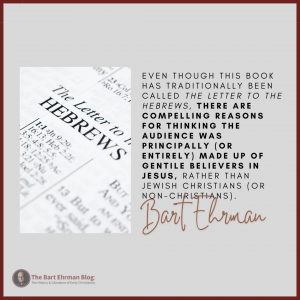
even though this book has traditionally been called the Letter to the Hebrews, there are compelling reasons for thinking the audience was principally (or entirely) made up of gentile believers in Jesus, rather than Jewish Christians (or non-Christians).

In order to show that turning to Judaism actually (and somewhat ironically) means turning away from the Jewish God, the author insists that the God of the Old Testament gave Jews only a provisional religion that he has now, according to plan, superseded in with the coming of Christ.  The old covenant (with the Jews) is now obsolete, and the new covenant, provided through the incarnation, death, and resurrection of Jesus is the only way to be right with God, enjoy his eternal blessings, and avoid his coming wrath (Hebrews 8:13).

To make this point, the author argues that Jewish law, as found in Scripture, was partial and imperfect, unable to accomplish the task of putting people into a right standing before God. The inadequacy of the old covenant, he claims, was recognized even by the Old Testament prophets themselves, who predicted that God would establish a new covenant to do what the old one could not. This new covenant was foreshadowed in the legislation of Moses and came to reality only in the work of Jesus. The old has now passed away, and believers must cling to the new (Hebrews 8).

The author explicitly refers to the persecutions of the followers of Jesus, and urges them to stay in the faith (Heb 10:26-39); their sufferings are a kind of “discipline” sent from God (just as parents discipline their children), and if they stay faithful, they will be rewarded in the end (Heb 12:3-13).  Since the author is afraid they may “fall away,” and since the great bulk of the book is devoted to show the superiority of the Christian faith to the now by-passed and “obsolete” Jewish tradition, it appears that he is urging them not to convert away from Christianity to non-Christian Judaism to escape persecution (as opposed to returning to paganism).

To abandon Christ for Judaism, in his judgment, would be a serious mistake. To do so would be to prefer the foreshadowing of God’s salvation to salvation itself and to opt for the imperfect and flawed religion of the Jewish Scriptures rather than its perfect and complete fulfillment in Christ. For this author, Christ does indeed stand in continuity with the religion of the Jews as set forth in their sacred writings; but he is superior to that religion in every way, and those who reject the salvation that he alone can provide are in danger of falling under the wrath of God.

Thus the superiority of Christ and of the salvation he brings to everything found in Judaism is the constant refrain sounded throughout this homily. Here are some of the major points that the author stresses to that end:

Christ Is Superior to the Old Testament Prophets (Heb 1:1–3). The Jewish prophets were God’s spokespersons in former times, but now he has spoken through his own Son, the perfect image of God himself.

Christ Is Superior to the Angels (Heb 1:4–112:5–18). The angels mentioned in the Old Testament are God’s messengers par excellence, but Christ is his very Son, exalted to a position of power next to God’s heavenly throne. Angels are ministers for those destined for salvation, but Christ is the Son of God whose suffering actually brought this salvation.

Christ Is Superior to Moses (Heb 3:1–6). Moses was a servant in “God’s house,” but Jesus is the Son of the house.

Christ Is Superior to Joshua (Heb 4:1–11). Joshua gave the people of Israel peace (or “rest”) after the Promised Land had been conquered; but as the Scriptures themselves indicate, the people of Israel could not fully enjoy that peace (or “enter into their rest”) because they were disobedient. Christ brings a more perfect peace.

Christ Is Superior to the Jewish Priesthood (Heb 4:14–5:10Heb 7:1–29). Like the Jewish high priests, Jesus was personally acquainted with human weaknesses that require a mediator before God; but unlike them, he was without sin and did not need to offer a sacrifice for himself before representing the people. He is superior to the priests descended from Levi because he is the one promised in the Scriptures as the priest from the line of Melchizedek (Ps 110:4), the mysterious figure whom Abraham, the ancestor of Levi, honored by paying one-tenth of his goods (Gen 14:17–20). For this reason, Levi himself, as represented by his ancestor, was inferior and subservient to Melchizedek and the descendants from his line. If the Levitical priests had been able to make the people of God perfect, God would not have had to promise to send a priest from the line of Melchizedek into the world. Moreover, Christ is superior to these other priests because they are many, but he is one—and unlike them, he needed to offer his sacrifice only once, not repeatedly.

Christ Is Minister of a Superior Covenant (Heb 8:1–13). God promised in the Scriptures to bring a new covenant (Jer 31:31–34), thereby showing that the old covenant with the Jews was outmoded and imperfect. Christ is the minister of this new covenant.

Christ Is Minister in a Superior Tabernacle (Heb 9:1–28). The earthly tabernacle, where Jewish sacrifices were originally performed, was constructed according to a heavenly model. Unlike the Jewish priests, Christ did not minister in the earthly replica; he brought his sacrifice to heaven, to the real sanctuary, into the presence of God himself.

Christ Provides a Superior Sacrifice (Heb 10:1–18). Christ’s sacrifice was perfect, unlike those that had to be offered year after year by the Jewish priests. His death brought complete forgiveness of sins; there is therefore no longer any need for sacrifice.

And so, the bottom line for this author:  He does not claim that Judaism was ever a false religion; it was what God provided to the Jews from antiquity.  But it was imperfect and was (intentionally) pointing forward to a new covenant, a new set of terms between God and his people, fulfilled in the coming of Jesus.  Judaism is a kind of foreshadowing of the greater reality to come.  Anyone who turns from the reality back to the shadow is rejecting God and Scripture itself, and they will lose their salvation and face the wrath of God that is soon to come (6:1-6; 10:26-31).

In future posts I will talk more about some of these topics, including who the author was, whom he was addressing, whether the book really teaches that it is possible for Christians to lose their salvation, and where the author is getting his ideas about “shadows” and “realities.

Monday, July 21, 2025

 By and large Americans are ignorant when it comes to understanding science, how it works, what it means, and the difference between science and pseudoscience. Ignorance abounds. The country will now suffer grievously with the current administration taking full advantage for political reasons.

 Trump’s executive order promises to ensure that “federal decisions are informed by the most credible, reliable, and impartial scientific evidence available.” In practice, however, it gives political appointees—most of whom are not scientists—the authority to define scientific integrity and then decide which evidence counts and how it should be interpreted. The president has said that these measures are necessary to restore trust in the nation’s scientific enterprise—which has indeed eroded since the last time he was in office. But these changes will likely only undermine trust further. Political officials no longer need to rigorously disprove existing findings; they can cast doubt on inconvenient evidence, or demand unattainable levels of certainty, to make those conclusions appear unsettled or unreliable.

In this way, the executive order opens the door to reshaping science to fit policy goals rather than allowing policy to be guided by the best available evidence. Its tactics echo the “doubt science” pioneered by the tobacco industry, which enabled cigarette manufacturers to market a deadly product for decades. But the tobacco industry could only have dreamed of having the immense power of the federal government. Applied to government, these tactics are ushering this country into a new era of doubt in science and enabling political appointees to block any regulatory action they want to, whether it’s approving a new drug or limiting harmful pollutants.
Historically, political appointees generally—though not always—deferred to career government scientists when assessing and reporting on the scientific evidence underlying policy decisions. But during Trump’s first term, these norms began to break down, and political officials asserted far greater control over all facets of science-intensive policy making, particularly in contentious areas such as climate science. In response, the Biden administration invested considerable effort in restoring scientific integrity and independence, building new procedures and frameworks to bolster the role of career scientists in federal decision making.
-David Michaels and WendyWagner in The Atlantic

Saturday, July 19, 2025


So this is the thing about stories like the Jeffrey Epstein saga: There’s always new stuff waiting to come out. The explosive story that The Wall Street Journal dropped Thursday evening about Donald Trump’s alleged note to Epstein in a “birthday book” compiled for the child molester in 2003 by Ghislaine Maxwell was bound to come out. And if other things are out there about Trump’s history with Epstein—as there almost certainly are—they’re bound to become public someday, too.

That’s the first reason Trump needs to be worried. Even if his name does not appear on some master list created by Epstein with a heading like “Good Friends of Mine Who Raped Underage Girls With Me,” it still has to be the case that there are emails, photographs, and other material that at the very least won’t look good. (I couldn’t help wondering what Maurene Comey, the sex crimes prosecutor in New York’s Southern District who was fired by Attorney General Pam Bondi on Wednesday, knows about Epstein and Trump.)

And here’s the second and more interesting reason. These cracks in the MAGA coalition right now are only that—cracks—but time may prove this week to have been a pivotal, even decisive, moment in MAGA history. 

-Michael Tomasky in The New Republic


The Death of Paul

July 19, 2025

Bart Ehrman 

I sometimes get asked (once just a few days ago) about what we can say about Paul’s death. We don’t have any historical records (i.e., historically reliable accounts), but there is one relatively early reference to it and an intriguing legend from about a century after the event, whenever and however it happened.

Here is what I say about it in my book Peter, Paul, and Mary Magdalene.


******************************

The Martyrdom of Paul

We do not have any contemporary accounts of Paul’s death, although traditions from several decades afterwards indicate that he was martyred.  The earliest reference comes in the letter from the church of Rome to the church of Corinth known as 1 Clement, written around 95 CE, some thirty years after Paul’s death.  This anonymous author refers to the “pillars” of the Christian faith who were persecuted for their faith, “even to death.”  He refers especially to the apostles Peter and Paul.  About Paul, he states:

Because of jealousy and strife Paul pointed the way to the prize for endurance.  Seven times he bore chains; he was sent into exile and stoned; he served as a herald in both the East and the West; and he received the noble reputation for his faith.  He taught righteousness to the whole world, and came to the limits of the West, bearing his witness before the rulers.  And so he was set free from this world and transported up to the holy place, having become the greatest example of endurance.

It appears that this author knows of a tradition that Paul accomplished the plan he himself mentions in his letter to the Romans, to go on to Spain, “the ends of the earth,” to proclaim the gospel there.  But eventually he was put on trial and, evidently, executed for his faith.

About a century after the writing of 1 Clement we get a narrative of what happened leading up to Paul’s martyrdom.  This comes in the Acts of Paul, and like most of the book’s narrative, it is based on legendary accounts rather than historical events.  Paul is said to have arrived in Rome and to have rented out a barn to meet with the Christians there.  Among those listening to Paul is a young man named Patroclus, who happens to be the cupbearer of Nero himself, one of his favorite servants.  Patroclus is sitting in the window on an upper floor.  After a while he begins to dose off, falls from the window, and dies. Word is rushed off to Nero. The emperor is not pleased.

In the meantime, Paul performs one of his patented miracles, going down to the corpse and restoring it to life.  When Patroclus later shows up for work at Nero’s palace, the emperor is terrified and astounded: “Patroclus, is this you?”  I thought you were dead!  Patroclus replies that he was dead, but that the “master of the universe, the Lord Jesus Christ,” has raised him from the dead.  Nero, rather than expressing his gratitude for the miracle, becomes immediately envious of the miracle-working ability of this Jesus, and suspicious of him as a potential usurper of his own power.  He interrogates Patroclus and learns that he considers Christ to be the king of all (isn’t the emperor supposed to be the king of all?).  In his rage, Nero sends Patroclus, and two other self-proclaimed Christians in the court, to prison to be tortured.

And this is what leads to the persecution of Christians at the hands of Nero.  He orders the followers of Christ to be rounded up and punished.  Only after wiser heads prevail does he agree that no one should be punished without a court trial.

Paul himself is arrested and brought before Nero, who threatens to execute him for his faith.  Paul, however, shows no trace of fear but rather a haughty self-assurance in the face of death.  He tells Nero that if he kills him, he will rise from the dead and appear to him alive afterwards.  Nothing can keep a good man down.

Nero orders his execution.  The executioners spend some time talking to Paul before they do the deed.  As might be expected in a story of this kind, he actually converts them before they perform their duty.  But at his death a miracle occurs: once Paul is beheaded, it is not blood that spurts from the wound but milk.  It is difficult to say what the milk is meant to signify.  It is, of course, a symbol of life, in that it is the food that sustains a newborn after birth.  So maybe it means that Paul is being born again into his new life with Christ in the other world.  Moreover, in his own letters, Paul himself speaks of nourishing his converts with the “milk” of his teaching (1 Cor. 3:2).  So maybe the milk spurting from his neck signifies the edifying message that his death will bring to others, that death is not the last word, for it can be followed by eternal life with the Lord.

In any event, Paul fulfills his vow to Nero.  To the emperor’s shock and dismay, the apostle appears to him after his execution, as full of life as can be.  The emperor does not repent in the story, but one could scarcely expect him to do so.  There is a limit, after all, to how far pious legend can distort the historical facts, and most people in the early church thought of Nero as an unrepentant despot till the time of his own death.

Thursday, July 17, 2025

 We Americans get into being told everyday how polarized we are, and it's true, but at the same time, we are not all politically bipolar. There are differences that nonetheless can blend the bipolarized elements of our political lives.

At Starbucks just talked to an 84 yr. man who grew up in London, graduated from Bristol University in electrical engineering, came to America after being adopted in England after his biological parents were killed in Hitler's bombing of London in WWII.

Dave spent 34 yrs. with General Electric as a field engineer, which means he had to fix electrical problems in the real world around the world. Fascinating stuff about which I know nothing.

Anyway, his political views transcend left and right, a fascinating mixture of both sides.

I learn not to prejudge people. Listen to them first. Draw people out and you can be exposed to different perspectives due to different education and life experiences. Disagreements can be there but understanding can lead to understanding, if you know what I mean.

Wednesday, July 16, 2025


Robert Browning

“Grow old along with me! The best is yet to be, the last of life, for which the first was made. Our times are in his hand who saith, 'A whole I planned, youth shows but half; Trust God: See all, nor be afraid!” 

― Robert Browning

 Airheads are not immediately discernible, but it doesn't take long to figure them out, usually no more than about 30 minutes. Smart people take longer to discern, but they are worth the wait.

Tuesday, July 15, 2025


Funny thing being my age.  Past adolescence, though sometimes debatable, past being a theoretical  young whipper snapper (I was once called), past being an up and comer if ever you ever was, past Middle Age, whatever that might mean, past moving toward retirement, now actually retired beyond caring about many things that occupied the mind for decades.  You don't have to worry about distracting your mind to get your mind off pressing thoughts since your mind is always in distracted mode.

At my age now you can get away with risqué comments in the right circles, oh, that's just Fred, you can make stuff up since no one is around to call you out, and you can spot phonies and conmen having seen so many over the years.  Best of all, you don't have to care any more about people and things you really don't have to care about anymore.  Easier to say now: not my problem.

Monday, July 14, 2025


Shared with Your friends
Friends
I've decided I'd rather NOT know what's going on. That way, I can't be dragged into it, forced to do something about it, getting my hands dirty. Best to stay out it, uninvolved.
Shared with Your frienI've decided I'd rather NOT know what's going on. That way, I can't be dragged into it, forced to do something about it, getting my hands dirty. Best to stay out it, uninvolved.

Saturday, July 12, 2025

 Contemporary life has become trivial, boring, all small talk now, without any transcendent meaning, as we shuffle from one pointless conversation to another, shoving our cell phones into other people's faces. Which is why I check out, keeping my distance, waiting for intelligent interaction.

Friday, July 11, 2025

The Machine Stops by Oliver Sacks

 My favorite aunt, Auntie Len, when she was in her eighties, told me that she had not had too much difficulty adjusting to all the things that were new in her lifetime—jet planes, space travel, plastics, and so on—but that she could not accustom herself to the disappearance of the old. “Where have all the horses gone?” she would sometimes say. Born in 1892, she had grown up in a London full of carriages and horses.

I have similar feelings myself. A few years ago, I was walking with my niece Liz down Mill Lane, a road near the house in London where I grew up. I stopped at a railway bridge where I had loved leaning over the railings as a child. I watched various electric and diesel trains go by, and after a few minutes Liz, growing impatient, asked, “What are you waiting for?” I said that I was waiting for a steam train. Liz looked at me as if I were crazy.

“Uncle Oliver,” she said. “There haven’t been steam trains for more than forty years.”

I have not adjusted as well as my aunt did to some aspects of the new—perhaps because the rate of social change associated with technological advances has been so rapid and so profound. I cannot get used to seeing myriads of people in the street peering into little boxes or holding them in front of their faces, walking blithely in the path of moving traffic, totally out of touch with their surroundings. I am most alarmed by such distraction and inattention when I see young parents staring at their cell phones and ignoring their own babies as they walk or wheel them along. Such children, unable to attract their parents’ attention, must feel neglected, and they will surely show the effects of this in the years to come.

In his novel “Exit Ghost,” from 2007, Philip Roth speaks of how radically changed New York City appears to a reclusive writer who has been away from it for a decade. He is forced to overhear cell-phone conversations all around him, and he wonders, “What had happened in these ten years for there suddenly to be so much to say—so much so pressing that it couldn’t wait to be said? . . . I did not see how anyone could believe he was continuing to live a human existence by walking about talking into a phone for half his waking life.”

These gadgets, already ominous in 2007, have now immersed us in a virtual reality far denser, more absorbing, and even more dehumanizing. I am confronted every day with the complete disappearance of the old civilities. Social life, street life, and attention to people and things around one have largely disappeared, at least in big cities, where a majority of the population is now glued almost without pause to phones or other devices—jabbering, texting, playing games, turning more and more to virtual reality of every sort.

Everything is public now, potentially: one’s thoughts, one’s photos, one’s movements, one’s purchases. There is no privacy and apparently little desire for it in a world devoted to non-stop use of social media. Every minute, every second, has to be spent with one’s device clutched in one’s hand. Those trapped in this virtual world are never alone, never able to concentrate and appreciate in their own way, silently. They have given up, to a great extent, the amenities and achievements of civilization: solitude and leisure, the sanction to be oneself, truly absorbed, whether in contemplating a work of art, a scientific theory, a sunset, or the face of one’s beloved.

Much of this, remarkably, was envisaged by E. M. Forster in his 1909 story “The Machine Stops,” in which he imagined a future where people live underground in isolated cells, never seeing one another and communicating only by audio and visual devices. In this world, original thought and direct observation are discouraged—“Beware of first-hand ideas!” people are told. Humanity has been overtaken by “the Machine,” which provides all comforts and meets all needs—except the need for human contact. One young man, Kuno, pleads with his mother via a Skype-like technology, “I want to see you not through the Machine. . . . I want to speak to you not through the wearisome Machine.

These threats, of course, concern me, but at a distance—I worry more about the subtle, pervasive draining out of meaning, of intimate contact, from our society and our culture. When I was eighteen, I read Hume for the first time, and I was horrified by the vision he expressed in his eighteenth-century work “A Treatise of Human Nature,” in which he wrote that mankind is “nothing but a bundle or collection of different perceptions, which succeed each other with an inconceivable rapidity, and are in a perpetual flux and movement.” As a neurologist, I have seen many patients rendered amnesic by destruction of the memory systems in their brains, and I cannot help feeling that these people, having lost any sense of a past or a future and being caught in a flutter of ephemeral, ever-changing sensations, have in some way been reduced from human beings to Humean ones.


A few years ago, I was invited to join a panel discussion about information and communication in the twenty-first century. One of the panelists, an Internet pioneer, said proudly that his young daughter surfed the Web twelve hours a day and had access to a breadth and range of information that no one from a previous generation could have imagined. I asked whether she had read any of Jane Austen’s novels, or any classic novel. When he said that she hadn’t, I wondered aloud whether she would then have a solid understanding of human nature or of society, and suggested that while she might be stocked with wide-ranging information, that was different from knowledge. Half the audience cheered; the other half booed.

Much of this, remarkably, was envisaged by E. M. Forster in his 1909 story “The Machine Stops,” in which he imagined a future where people live underground in isolated cells, never seeing one another and communicating only by audio and visual devices. In this world, original thought and direct observation are discouraged—“Beware of first-hand ideas!” people are told. Humanity has been overtaken by “the Machine,” which provides all comforts and meets all needs—except the need for human contact. One young man, Kuno, pleads with his mother via a Skype-like technology, “I want to see you not through the Machine. . . . I want to speak to you not through the wearisome Machine.”


As one’s death draws near, one may take comfort in the feeling that life will go on—if not for oneself then for one’s children, or for what one has created. Here, at least, one can invest hope, though there may be no hope for oneself physically and (for those of us who are not believers) no sense of any “spiritual” survival after bodily death.

But it may not be enough to create, to contribute, to have influenced others if one feels, as I do now, that the very culture in which one was nourished, and to which one has given one’s best in return, is itself threatened. Though I am supported and stimulated by my friends, by readers around the world, by memories of my life, and by the joy that writing gives me, I have, as many of us must have, deep fears about the well-being and even survival of our world.

Such fears have been expressed at the highest intellectual and moral levels. Martin Rees, the Astronomer Royal and a former president of the Royal Society, is not a man given to apocalyptic thinking, but in 2003 he published a book called “Our Final Hour,” subtitled “A Scientist’s Warning: How Terror, Error, and Environmental Disaster Threaten Humankind’s Future in This Century—on Earth and Beyond.” More recently, Pope Francis published his remarkable encyclical “Laudato Si’, ” a deep consideration not only of human-induced climate change and widespread ecological disaster but of the desperate state of the poor and the growing threats of consumerism and misuse of technology. Traditional wars have now been joined by extremism, terrorism, genocide, and, in some cases, the deliberate destruction of our human heritage, of history and culture itself.


These threats, of course, concern me, but at a distance—I worry more about the subtle, pervasive draining out of meaning, of intimate contact, from our society and our culture. When I was eighteen, I read Hume for the first time, and I was horrified by the vision he expressed in his eighteenth-century work “A Treatise of Human Nature,” in which he wrote that mankind is “nothing but a bundle or collection of different perceptions, which succeed each other with an inconceivable rapidity, and are in a perpetual flux and movement.” As a neurologist, I have seen many patients rendered amnesic by destruction of the memory systems in their brains, and I cannot help feeling that these people, having lost any sense of a past or a future and being caught in a flutter of ephemeral, ever-changing sensations, have in some way been reduced from human beings to Humean ones.