WeAreLiterite

Books/Literacy/Politics/Current Events

Saturday, June 29, 2019

Logical Progression


The Republican Party cast its lot with the white backlash to the civil rights movement beginning with Barry Goldwater in 1964. What has happened since is simply a straight lined logical progression since then, picking up also with the no-nothingness, anti-intellectualism, xenophobia, anti-immigrantism, and plutocracy that is such a big part of our country's history. It all makes sense if you see the logical progression.
By Fred Hudson - June 29, 2019 No comments:
Email ThisBlogThis!Share to XShare to FacebookShare to Pinterest

Robert Caro - Working - Book Review

Robert Caro is esteemed biographer of Robert Moses and Lyndon Johnson.  As he is at work on his 5th and final LBJ volume he publishes this little book talking about how works.

Caro grew up in Manhattan.  He is a thorough New Yorker.  His mother sent him to the Horace Mann school, which I assume is an elite school.  He majored in English at Princeton.  It is interesting to me that he is not a trained historian.

Caro started as an investigative reporter for Newsday.  He became interested in New York real estate developer Robert Moses who built bridges, buildings, highways, and  amusement parks, you name it in NYC and Long Island.  Moses dominated New York city from the 60's into the 90's.

Caro published his 1200 page biography in 1974 to great acclaim.  I shall not read it because I cannot relate to NYC real estate development.  Caro's attraction to Moses is his fascinating with political power and how it can be used.  Moses was never elected to any New York position, yet he seemed to have carte blanch over what he wanted to do to the NYC landscape.  His accomplishments are all over the city.

The fascination with political power led to Lyndon Johnson.  Caro published his first LBJ volume in 1982 after beginning his research in 1978.  He has continued to research Johnson to this day in his 80's working on the 5th volume of his LBJ series.

Before publishing his first Johnson book, Caro and his wife spent three years in the Texas hill country which begins about 40 miles west of Austin.  This is amazing.  He wanted to experience first hand the world that produced Lyndon Johnson.  He points out how empty and forlorn the Hill country was during LBJ's formative years

LBJ was embarrassed by his father, who, though a state legislator for a while, ended up going bankrupt and making the Johnson family a subject of ridicule.  Johnson was motivated to not be like his father.

Caro loves going thru historical documents seeking the facts.  He talks of accessing the LBJ files in Dallas at the LBJ library.  Millions of documents so he and his assistant, his wife, had to be selective.

His Johnson doc search answered a big question.  When LBJ entered Congress he was just another freshman congressman.  Shortly thereafter he became know and sought after.  Caro discovered that Johnson had a funding source with a company in Texas called Brown and Foot, which funded him the rest of his political career.  Johnson had the source send money to other Democratic candidates which made LBj known in the Congress as a source of campaign cash.  This was his first claim to political power.  Caro only discovered this by painstakingly going thru documents in LBJ's millions of documents.  A great example of a great historical research.

"So there was the proof that Lyndon Johnson had received money from Brown & Foot  in October, 1940 (and that it had brought him into contact with 'The Boss,' Johnson's name for President Franklin Roosevelt."  P. 91

LBJ brought electricity to the Texas Hill Country.  He was a populist from the beginning.

The segregationists thought he was one of them from 1937 to 1957.  Then came Johnson's efforts in the mild Civil Rights Act of 1957.  Then the monumental Civil Rights Act of '64, Medicare, and the Voting Rights Act.  Johnson fooled the segregations to the end when he was in a position to to make things happen.

Wee it not for Lyndon Johnson, this great legislation would never have happened.  Pres. Kennedy would never have gotten it done.

After 10 years in the House, Johnson was elected to the US Senate by 87 votes over a man named Coke Stevenson.  The winning votes surfaced late from a rigged box in south Texas.  Johnson stole the election and it was upheld by the Supreme Court thanks to Hugo Black.  History turned on a stolen election.  Caro provides the proof.  P. 113

Reading this book makes me realize that I never could have been an historian doing research.


By Fred Hudson - June 29, 2019 No comments:
Email ThisBlogThis!Share to XShare to FacebookShare to Pinterest

Thursday, June 27, 2019

Census Block

Supreme Court blocks census citizenship question for now

The court said the Trump administration had provided a “contrived” reason for wanting the information from households and that the Commerce Department must provide a clearer explanation.
-WaPost
By Fred Hudson - June 27, 2019 No comments:
Email ThisBlogThis!Share to XShare to FacebookShare to Pinterest

Wednesday, June 26, 2019

So Far Biden is the Pragmatic Choice

An unpopular opinion but one I stand by. Black voters will likely continue to back Joe Biden despite his egregious Jim Crow misstep. Why? They are pragmatic, not puritanical. This is a lesson for purity test Democrats who will turn on each other and let the Trump jackals feast.
Unlike many white Democratic voters who feel free to indulge in purity tests as they search for a perfect candidate, Black America is pragmatic. To that end, black voters know that removing Donald Trump is the most important goal, much larger than any narrow set of interests. Like any other group, however, black voters are not a hive mind. As Hillary Clinton learned in 2016, black folks' enthusiasm for a given candidate is not fixed. Biden should learn that lesson early, rather than taking the support of black voters for granted and regretting such an error in political calculus later on.
It is still very early in the 2020 presidential race. This week's Democratic debates in Miami offer an opportunity for the candidates to educate the public about their proposals. During these early debates candidates with low name recognition will snipe at Biden, Warren and Sanders. Biden will fight off the latter two candidates in order to maintain the air of inevitability which surrounds his candidacy.
As the Democratic field gradually sheds its bloat and a nominee is selected, Democrats — the leaders, their media, activists, and the rank-and-file — should not lose focus on their real enemy. Donald Trump and the Republican Party are united in service of fascism. Trump's voters enthusiastically support him. Today's conservative movement is a fundamentalist political religion. Its members want nothing more than total victory over the Democrats, and seek to demolish anyone who dissents from their radically backward, anti-intellectual, quasi-theocratic, racist, sexist, plutocratic and anti-democracy agenda. If the Democrats succumb to factionalism Donald Trump will win again in 2020 — and do so easily.
-Chauncey Devaga
By Fred Hudson - June 26, 2019 No comments:
Email ThisBlogThis!Share to XShare to FacebookShare to Pinterest

Monday, June 24, 2019

America is Ruining Itself

Jared Diamond: Here are the four ways America is ruining itself right now

Author of "Guns, Germs and Steel" on his new book "Upheaval," and how the U.S. can arrest its decline into idiocy


4
 
2
CHAUNCEY DEVEGA
JUNE 24, 2019 11:00PM (UTC)
Jared Diamond is not afraid of big ideas. He has tackled such subjects as evolutionary psychology, the reasons why the West rose to global dominance, the lessons to be learned from "traditional societies" and the relationship between environmental change and the decline of ancient civilizations. and why ancient societies fell into decline.
Diamond has been elected to the American Academy of Arts and Sciences, the American Philosophical Society, and the National Academy of Sciences. He has been awarded a MacArthur Foundation Fellowship as well as the National Medal of Science. His bestselling book "Guns, Germs and Steel" won the Pulitzer Prize.
Diamond is currently a professor of geography at the University of California, Los Angeles. His new book "Upheaval: Turning Points for Nations in Crisis" examines how nations successfully adapt to change — or do not, and then fall into a spiral of failure and rapid decline.
How do countries choose to succeed or fail? How do Trumpism, political polarization and other types of dysfunction imperil America's leadership role in the world? How can countries most successfully manage social and political change? What are some pitfalls to avoid? Could America soon become a failed democracy, like Chile or Indonesia? Is immigration a net positive or negative for the United States? How does dishonesty lead to a nation's collapse? How does the concept of "national identity" influence a nation's success or failure in difficult times? Is the United States in decline — and will China inevitably become this century's dominant next "superpower?"
I sought to address these questions and others in my recent conversation with Jared Diamond. This interview has been edited for length and clarity. My conversation with Jared Diamond can also be listened to through the player below.
00:0000:00
When you look at the world now, what problems concern you most?
Those big problems would include nuclear risk, climate change, sustainable resource use and inequality around the world.
In terms of America's leadership class, what are you most concerned about? 
inRead invented by Teads
I'm not concerned just about the elites. I'm concerned about the whole spectrum of the United States, the polarization within the electorate as well as geographic polarization, income polarization, political polarization, and the polarization of our legislators.
How does a country's "national character" fit into whether or how a given society survives a time of crisis?
Instead of talking about national character, the phrase that I use in my work and thinking is "national identity." I gradually realized that national identity for different countries depends on different things. For example, I've just come back from several weeks in Italy, where I was teaching at Rome's Social Science University. Italians have a national identity. But what they are proud about is not what Americans are proud about. Italians are proud about their style, their history of the Roman Empire, their cuisine, their friendliness, their social relationships with other Italians and their great art, of course.
Whereas for people from Finland, their national identity depends upon their unique language and having survived war against the Soviet Union. In the United States, our national identity depends upon our having conquered a continent and our being the most powerful country in the world. In Germany, national identity used to depend upon military feats which are now regarded as evil. German national identity now depends upon some features of German national character, namely the role of the community where in many cases it takes precedence over the role of the individual in society. Germans have great pride in their art and music.
inRead invented by Teads
How do countries respond to a crisis in national identity and meaning? Donald Trump and his movement are one such crisis afflicting the United States in this moment.
Slowly. My new book examines national crises from the perspective of personal crises in identity. When we change our personal identities, we can work through it more quickly because it involves just one person, us. National identities inevitably get changed more slowly because it requires arriving at a consensus for a whole country.
For example, in the book I discuss the slow change in national identity for Australia, which took place over several decades from the time I first visited Australia in 1964. Since then, Australians have gradually been discarding what had been their national identity. This had been based on: "We, Australians being loyal British citizens, we are the British outpost near Asia." Well, that identity gradually got discarded as a result of events in 1941 and 1942 in World War II, then Britain's application to the European Union, and Australia's increasing trade with Asia. This process took decades and decades.
Similarly, with the United States we are changing our vision of the country's national identity. It's going to take us time, so it will happen slowly. I do not think it is going to take the country several decades as it did Australia, but it certainly is going to take more than a year or two.
In what ways should a country navigate such times of change in order to be successful? How can the United States manage this in a healthy way?
A starting point would be "We need to be honest." There is a big deficit in honesty in the United States at present in talking about our country's problems.
A very specific example: a lack of honesty about immigration. There are these arguments about putting up a wall on the Mexican border. Well, the fact is that the great majority of people who are in the United States as so-called illegal immigrants have not come across the Mexican border. Instead, they've come to the United States on legal visas and then they've overstayed them. Therefore, the discussion about the wall is tangential. In addition, if we are concerned about people coming across the Mexican border, the preferred ways to get across the Mexican border are to wade across the Rio Grande or to go through tunnels. These proposals about Trump's wall are a prime example of dishonesty and ignoring the facts.
What are other examples of things that the United States and its leaders and people are dishonest about?
We need to be honest about what is good about the United States and what needs to be changed. Things that are good include that we are still the most powerful and richest country in the world. America has wonderful geography. The United States is protected on two sides by oceans and on the other two sides by non-threatening neighbors. We have the richest farmland in the world. We have the best institutions of higher education in the world. We have a long history of freedom, relatively speaking. There are gaps in our freedom, of course, but compared to other countries, the United States has a track record of freedom. Those are things that we as a people can be proud of.
We can also be proud of the crises that we as a people have overcome in the past, such as the Civil War. I grew up in World War II, and we survived that. As a country, the United States survived the arguments over the civil rights movement. There is so much that we Americans can be proud of. We do not need to talk about making America great again. America is already great. There are not new things that have to be added to make America. America's already great. There are mistakes that we're making, though, and we'd better sort those out.
Of course you can't predict the future. But what are some system shocks that you believe could cause great change and disruption in the United States in the near term?
Possible sources of unexpected big shocks, of course, would include another terrorist attack. Still another would be a really big massacre within the United States. Getting 59 people killed or 11 people killed doesn't attract attention anymore in America. Maybe getting 530 people killed, not by a World Trade Center-like attack, but by some gunman within the United States. If the 530 people killed were schoolchildren, that might attract attention. A big weather shock would convince even diehard disbelievers in climate change that there really is a problem.
I'm concerned that the United States is no longer dreaming big any more. The country has become so insular and narrow-minded, turned inward. Is that a common trait for societies in crisis?
It's true that during the 1960s we had the big goal of going to the Moon and we achieved that. There is a widespread view, particularly in conservative circles in the United States, that for government to do something is "socialism" and that "socialism" is bad. But the fact is that ever since the first central government arose 5,400 years ago, government can do things that cannot be done properly or well by private interests. Private interests do not do something with their own resources, generally, that do not bring them direct benefits. Instead, things that produce diffuse benefits — such as school systems or national health systems or national support for scientific research — are what government is for. Unfortunately there is an increasingly widespread view in the United States today against the role of government in providing those benefits and services.
What are some lessons from history about how the United States can make good decisions about this moment of change?
I would start off with the worst problem in the United States today — the breakdown of political compromise. I was living in Chile a few years before the military coup d'état [in 1973] when Chileans were proud of their democracy. They didn't foresee that Chilean democracy would be finished within seven years and they would have a military dictatorship which smashed world records for sadism.
A great and ambitious plan for America would be to raise seriously the dangers of a breakdown in political compromise, which has the potential to ruin America as it did Chile and Indonesia. We must work hard and make sure that such an outcome does not happen here.
Donald Trump and many of his allies and supporters want to change immigration policies to keep nonwhites from coming into the country. Immigration is a net positive for the United States, and those kinds of backwards and reactionary policies will damage the country's economy. Many experts point to Japan as a country whose immigration policy has hurt its economy. Do you think that's a fair comparison?
I would say that there is nothing that we Americans can learn from Japan with regards to immigration policy. Instead, as you say, immigration involves pluses and minuses. Each country has to come to its own weighing of those pluses and minuses. Japan and Australia have taken opposite views about that.
In Japan, homogeneity of the population and shared values are big economic sacrifices. Their national identity through their homogeneity is so important that the Japanese are willing to suffer all the losses they experience by not having immigrants. Australia has paid immigrants to come in, and within recent decades has changed its immigration policies to accept immigrants from all over the world.
In the case of the United States, we are at the opposite extreme from Japan. We're a country based on diversity. The United States has accepted immigrants from all over the world. There is nothing we can learn from Japan except that the Japanese have a different point of view which is undoubtedly not the American point of view.
What do we get out of immigrants? We have skilled immigrants and, so-called unskilled immigrants. The United States has the highest percentage of skilled immigrants of any country. A measure of that is that among American Nobel Prize winners, the majority are either first-generation immigrants or the children of first-generation immigrants. That is because to win the Nobel prize, you have to be bold, you have to take risks, you have to be young and healthy, you have to do things that other people lack the courage to do. Well, that's also what it takes to be an immigrant.
As for what we get from our unskilled immigrants: Here in Los Angeles, the construction crews are Spanish-speaking people from south of the border. The taxi drivers in Washington, D.C., the last time that I was there, were mostly Ethiopian or Somali. The taxi drivers in Los Angeles are now mostly from the Middle East. The United States gets good use out of our skilled immigrants and our unskilled immigrants.
What are your concerns about globalization?
Globalization is a fact. There's very little that we can do to control it. Definitions are important. Globalization includes increased communication. Globalization also means more movement of people around the world from poor countries to rich countries. That is actually a dynamic that we can do something about. There would be less incentive for people to leave poor countries if we made poor countries richer. For a small amount of money, one can make big improvement in the economies of poor countries, and that then means less drive for immigration. It also means more satisfaction and therefore less support for terrorists. Those are things that we can actually do about the aspects of globalization that are of concern in the United States and the West.
Why is your work so controversial in some circles? Your scholarship is highly respected by some while being hated by others — to the point where you sometimes need to have security at your talks.
Among academics, particularly left-wing anthropologists, there are those who hate me. There are two reasons. One is jealousy. My books are successful. They do not write successful books because they don't try to — and if they try to, they don't know how to write successful books. So that's one piece of it. A second reason that some academics dislike my books is that they equate geography with what is called "geographic determinism." That is not something that I argue for. Instead, they misread my work or because they haven't actually read "Guns, Germs and Steel," these critics think that mentioning geography means geographic determinism. Geography determines some things we do and not others. Those are the two main reasons why a vocal minority of people hate my work.
One of the dominant narratives at present is that the United States is in decline and that this is the true end of the American century. In this reading of history, the future belongs to China. Do you agree with that argument and conclusion?
Such a narrative is complete nonsense. The United States is not in decline. The only thing that could cause the United States to decline would be the bad policies of the United States. There is no way that China is going to catch up with the United States unless we ruin ourselves.
What advice would you give to America's leaders to help them make good decisions that sustain the country's dominant position?
Ruining ourselves is something the United States is doing now in four ways. One is political polarization. A second is restrictions on voting, because democracy is a good thing. Democracy is, as Winston Churchill said, "the worst form of government except for all others that have been tried." With restrictions on voting, we are undermining our democracy. We have reduced socioeconomic mobility in America so that it is now lower than in any other major democracy. We are reducing government investment for the public good. Those four things are the ways in which we are undermining ourselves as a country right now. All America has to do to stay on top of the world is to stop doing those four things.
CHAUNCEY DEVEGA

Chauncey DeVega is a politics staff writer for Salon. His essays can also be found at Chaunceydevega.com. He also hosts a weekly podcast, The Chauncey DeVega Show. Chauncey can be followed on Twitter and Facebook.
By Fred Hudson - June 24, 2019 No comments:
Email ThisBlogThis!Share to XShare to FacebookShare to Pinterest

Biden Time


  • Popular
  • Latest
  • Sections

    • Politics
    • Culture
    • Technology
    • Ideas
    • Science
    • Books
    • Family
    • Business
    • Global
    • Health
    • Education
    • Letters
    • The Masthead
    • Our Towns
    • Photo
    • Podcasts
    • The Atlantic Crossword
    • Video
    • Events
    • Writers
    • Projects
  • Magazine

    • Current issue 
    • All issues 
    • Manage subscription 
    • Give a Gift 
    • Subscribe 
    • Subscribe
    • Sign In


POLITICS

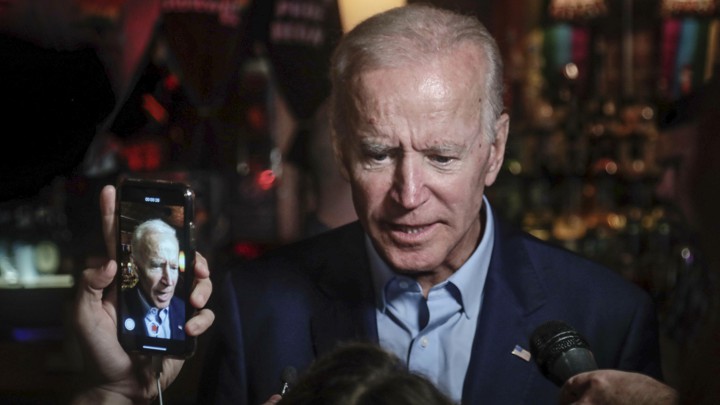
Joe Biden’s Endless Search for the Middle on Race

Newspaper archives are full of the former vice president’s efforts to explain his thinking on civil rights.
EDWARD-ISAAC DOVERE
JUN 21, 2019 

BEBETO MATTHEWS / AP


  • Share
  • Tweet
  • Email

From the beginning of his career in public life, Joe Biden’s instinct has been to recoil from those he considers the hard-charging activists in his party, and to find ways to understand those he knows his own allies would detest.
Biden thinks that’s his special insight into politics, that he’s a bridge builder—but it’s meant building bridges to people others think don’t deserve any kind of bridge. He seems to think that approach is especially useful over issues of race. There are archives full of comments, in newspaper accounts and videos, of Biden trying to explain his thinking on the matter. But given how much the conversation over race has changed in the past 50 years, that’s left him with a lot of remarks and relationships that can look out of sync in 2019, even as the 76-year-old former vice president says he’s still the same guy he always was. The comments reinforce a vulnerability—one his opponents have already jumped on.


Get the latest issue now.
Subscribe and receive an entire year of The Atlantic’s illuminating reporting and expert analysis, starting today. 
Subscribe 

Issue cover image
The thread is there in his first big interview before his inaugural Senate run: “I have some friends on the far left, and they can justify to me the murder of a white deaf mute for a nickel by five colored guys. They say the black men had been oppressed and so on. But they can’t justify some Alabama farmers tar and feathering an old colored woman,” Biden said in November 1970, just as he was coming onto the political scene. He had just won his first election to the New Castle County Council, and he was featured in a major profile in the Wilmington, Delaware, News Journal with a splashy headline: “Joe Biden: Hope for Democratic Party in ’72?”


MORE STORIES

  • The Moderate Men Waiting for Biden to Fall

    EDWARD-ISAAC DOVERE
  • Joe Biden Has the Most to Lose at the Debates

    EDWARD-ISAAC DOVERE
  • Joe Biden’s Bet That 2016 Didn’t Change Everything

    EDWARD-ISAAC DOVERE
  • Trump’s Allies Want to Clintonize Joe Biden

    EDWARD-ISAAC DOVERE


“I suspect the ACLU would leap to defend the five black guys,” Biden continued in the interview. “But no one would go down to help the ‘rednecks.’ They are both products of an environment. The truth is somewhere between the two poles. And rednecks are usually people with very real concerns, people who lack the education and skills to express themselves quietly and articulately.”
That was the thinking Biden seemed to be reflecting on Tuesday night at a New York City fundraiser when he recalled working with two of the most famous segregationists in the Senate. Pushing back on Democrats who’ve called for a take-no-prisoners approach to dealing with congressional Republicans, he noted that Senator James Eastland of Mississippi “never called me ‘boy’—he always called me ‘son.’” Henry Talmadge of Georgia, meanwhile, was “one of the meanest guys I ever knew,” Biden said.
“Well, guess what? At least there was some civility,” Biden added. “We got things done.”

Biden has reacted with frustration to the blowup, with most of his most prominent 2020 rivals, and a number of other prominent liberals, aghast that he could wistfully invoke names like Eastland, often known as “the voice of the white South.” That frustration has created another layer of issues: After Senator Cory Booker of New Jersey called on Biden to apologize, Biden’s deputy campaign manager, Kate Bedingfield, struggled to explain, in an appearance on CNN Friday morning, why Biden had said Booker should apologize to him instead.
Read: The old Senate is hardwired into Joe Biden
Biden says he has nothing to apologize for and that his record speaks for itself. “I’ve been involved with civil rights my whole career—period, period, period,” Biden said on Wednesday evening, citing specifically his work extending the Voting Rights Act. That’s the defense from his campaign: His adviser Symone Sanders tweeted Wednesday afternoon that Biden “literally ran for office against an incumbent at 29 because of the civil rights movement.” Yesterday, she told me that Biden had run “because he disagreed with the segregationist senators in office at the time.” Biden didn’t seem to talk much about that particular motivation during his first Senate campaign, though a story the segregationist Senator John Stennis of Mississippi told late in life, which was recounted in a 2007 Delta Democrat-Times article, provides some backup. When Stennis asked Biden in 1973, according to the article, “‘Why did you get into politics?’ Biden looked him in the eye and said, ‘Civil rights.’”
Biden has struggled to explain himself on race and civil rights for decades, and for decades, liberals have been suspicious of those explanations—though perhaps never more so than now, with Biden campaigning on restoring the good ol’ days and many in his party arguing that those days weren’t as good as he remembers. (His campaign press secretary declined to comment on the candidate’s previous statements in his career.)


Once he arrived in the Senate in the early 1970s, Biden prioritized the fight against busing to integrate public schools, pushing for an amendment that he said would expose liberal doubts about the practice. In a Philadelphia Inquirerarticle in 1975, Biden said, “I think I’ve made it possible for liberals to come out of the closet.” When he was running for reelection in 1978, the Wilmington Morning News wrote that “the only substantive legislation bearing Biden’s name to reach the nation’s law books is the Biden-Eagleton Amendment, which has shut down efforts by the Department of Health, Education, and Welfare to achieve busing for school desegregation.”
Biden had placed himself firmly on one side of one of the fiercest fights about race of the 1970s (a position a spokesperson said in March he still stands by). He spoke often about how he did not believe in the theory behind busing—that there was a greater good achieved by that method of forcing integration. As he put it in a November 1976 speech, according to the News Journal, “black kids don’t want to come to your school any more than you want to go to their school.”
Biden argued that he was just pursuing common-sense solutions when he pushed back on liberals’ support for busing, along with racial quotas in schools. But he was making unsavory allies along the way. When he became chair of the Senate Judiciary Committee in 1980—a position for which Eastland had backed him—Biden said he wouldn’t fight over busing with Strom Thurmond, the South Carolina senator and famous segregationist who’d become a friend. But, he told the News Journal in 1980, “if Strom Thurmond is serious about eliminating the Voting Rights Act, I’m going to fight it. I’ll be visible in that fight.”
News accounts at the time suggest that Biden was not integrally involved in crafting the reauthorization of the VRA. One referred to him as playing “second fiddle” in the process. But they do credit him with arranging a meeting between civil-rights activists and then–Senate Majority Leader Bob Dole, in a move that helped get the bill passed and onto then-President Ronald Reagan’s desk.
Biden believes actions like these demonstrate his true character. He supported making Martin Luther King Jr.’s birthday a national holiday, calling the leader “the social conscience of this nation.” And he opposed Jeff Sessions’s 1986 nomination to a federal judgeship over his comments calling groups like the NAACP un-American.
“People have tremendous difficulty accepting how could I be for civil rights and against busing,” Biden told the Morning News in August 1986. He said he was just being practical, seeking compromise. “I’ve always viewed my role, what I’ve done best in the Senate, as one of the guys who kept the pendulum in the middle,” Biden said.
That February, Biden had given a similar nonideological pitch in Birmingham, Alabama, as he prepared for his 1988 presidential run. Introduced by then-Senator Howell Heflin of Alabama, who said Biden had “enthralled” attendees at Stennis’s birthday party three years earlier because he “understands the South,” Biden gave a version of his stump speech, though he tinkered with the section focused on race. He told the crowd that he felt like the time for apologies was past. “A black man has a better chance in Birmingham than in Philadelphia or New York,” he said, according to a report in the Morning News from that evening.


In other settings back then, Biden reflected angrily on the Jim Crow South, even as he inflated his own history with the civil-rights movement. He told the New Jersey state Democratic convention in 1983, “When I was 17, I participated in sit-ins to desegregate restaurants and movie houses.
“My stomach turned upon hearing the voices of [Orval] Faubus and [George] Wallace,” Biden continued, referring to the segregationist governors of Arkansas and Alabama, respectively. “My soul raged on seeing Bull Connor and his dogs.”
Read: Biden’s gaffe exposed the crack in his coalition
By September 1987, his campaign press secretary clarified to The New York Times that Biden “did participate in action to desegregate one restaurant and one movie theater.” Or as Biden once explained at a 1987 news conference, he’d been concerned about civil rights as a teenager, but he “was not out marching.” He’d “worked at an all-black swimming pool on the east side of Wilmington,” Biden said, and “was a suburbanite kid who got a dose of what was happening to black Americans.”  
The middle is where and how Biden always thinks of himself. “I was never an activist,” Biden once said. “I didn’t march on Selma. Vietnam wasn’t a big issue in my college days. I was a middle-class kid in a sports coat.” Biden graduated from the University of Delaware in 1965, before the anti-war protests peaked. He enrolled in Syracuse University for law school, graduating in 1968, but he explained at the 1987 presser, using similar language, how he remained apart from what was happening in the streets. “By the time the war movement was at its peak ... I was married, I was in law school, I wore sports coats … I’m not big on flak jackets and tie-dyed shirts. And you know, that’s not me,” he said.
Yet for all the talk about civil rights, Biden never lost his personal fondness for the segregationists he worked with in the Senate. A decade before he delivered his now famous eulogy at Thurmond’s funeral—in which he called the old Dixiecrat “a product of his time”—Biden spoke at the senator’s 90th birthday party in Washington, D.C., in March 1993. Standing in a tuxedo, Biden compared Thurmond to the Confederate general Robert E. Lee: “an opponent without hate, a friend without treachery, a statesman without pretense, a soldier without cruelty and a neighbor without hypocrisy.” He talked, too, about Stonewall Jackson. Quoting the Confederate soldier James Power Smith writing about the general he served under, Biden said, “He was an avalanche from an unexpected quarter, a thunderbolt from the sky, and yet he was in character and will, more like a stone wall than any man that I have ever met.
“That seems to me to sum up Strom Thurmond: He is like a thunderbolt from the sky,” Biden continued. “He is a man who lives by his principles and a man who has gotten all of us to understand what they are.”


Biden used to like that line about a “thunderbolt from the sky”; he’d used a variation of it at a birthday party for Stennis in 1985. Stennis had also once compared Biden to Jackson. In his 2007 book, Promises to Keep, Biden recalled how nervous he was giving his first speech on the Senate floor, and how Stennis had sent him a typewritten note afterward: “I watched you today as you took the floor. You stood tall—like a stone wall. Like Stonewall Jackson.”
Over the years, Biden has changed how he’s spoken about his own place in the fight for civil rights. He talks often now about standing on the train platform in Wilmington on January 20, 2009, waiting to meet Obama so they could ride to their inauguration together, and thinking about the riots that he had seen in that same neighborhood during the 1960s. He was involved in another reauthorization of the Voting Rights Act in 1982, and in 2012 he famously jumped ahead of Obama on endorsing gay marriage, forcing the president’s hand on the issue.
In March 2016, watching Donald Trump march forward through the Republican primaries, Biden started speaking out against the institutional racism he said was evident in laws that had restricted voting rights and access to credit. “We all kind of knew it, but we didn’t quite talk about it,” he said then at a Naval Observatory reception for Black History Month. Last year, he was even given the Freedom Award by the National Civil Rights Museum.
So on Wednesday night, at his second fundraiser of the evening, Biden tried to offer more context to his controversial comments earlier in the week. “We had to put up with the likes of Jim Eastland and Hermy Talmadge and all those segregationists and all of that,” he said. “We, in fact, detested what they stood for in terms of segregation and all the rest.”
The Stonewall Biden wants people to associate him with these days is the one he visited earlier this week in New York, a few hours before the comments that brought on the trouble: the Stonewall Inn in Greenwich Village, site of the 1969 riots that transformed the gay-rights movement.  
“The ultimate civil-rights argument today is, how can you be constitutionally able to marry and be able to be fired in three dozen states when you walk in?” Biden said. “Imagine the courage it took 50 years ago to stand up and say ‘I’m gay,’ ‘I’m trans,’ ‘I’m whatever,’ ‘I’m a lesbian’ … The public’s way ahead of the politicians on this. They were way ahead on marriage, and they are way ahead on the basic rights that every American should have.”
That’s where Biden says he is now. But that’s more than he ever seemed to say about civil rights for years after he started out.
By Fred Hudson - June 24, 2019 No comments:
Email ThisBlogThis!Share to XShare to FacebookShare to Pinterest
Newer Posts Older Posts Home
Subscribe to: Comments (Atom)

Report Abuse

Blog Archive

  • ►  2025 (487)
    • ►  December (5)
    • ►  November (25)
    • ►  October (53)
    • ►  September (43)
    • ►  August (30)
    • ►  July (29)
    • ►  June (44)
    • ►  May (55)
    • ►  April (47)
    • ►  March (46)
    • ►  February (56)
    • ►  January (54)
  • ►  2024 (346)
    • ►  December (36)
    • ►  November (45)
    • ►  October (31)
    • ►  September (52)
    • ►  August (43)
    • ►  July (12)
    • ►  June (22)
    • ►  May (25)
    • ►  April (19)
    • ►  March (47)
    • ►  February (11)
    • ►  January (3)
  • ►  2023 (327)
    • ►  December (5)
    • ►  November (27)
    • ►  October (27)
    • ►  September (29)
    • ►  August (33)
    • ►  July (32)
    • ►  June (26)
    • ►  May (9)
    • ►  April (31)
    • ►  March (34)
    • ►  February (39)
    • ►  January (35)
  • ►  2022 (379)
    • ►  December (31)
    • ►  November (26)
    • ►  October (36)
    • ►  September (29)
    • ►  August (46)
    • ►  July (13)
    • ►  June (36)
    • ►  May (46)
    • ►  April (28)
    • ►  March (50)
    • ►  February (16)
    • ►  January (22)
  • ►  2021 (336)
    • ►  December (28)
    • ►  November (35)
    • ►  October (22)
    • ►  September (25)
    • ►  August (13)
    • ►  July (37)
    • ►  June (32)
    • ►  May (22)
    • ►  April (25)
    • ►  March (19)
    • ►  February (28)
    • ►  January (50)
  • ►  2020 (361)
    • ►  December (36)
    • ►  November (26)
    • ►  October (20)
    • ►  September (22)
    • ►  August (15)
    • ►  July (17)
    • ►  June (26)
    • ►  May (28)
    • ►  April (34)
    • ►  March (34)
    • ►  February (56)
    • ►  January (47)
  • ▼  2019 (420)
    • ►  December (42)
    • ►  November (30)
    • ►  October (26)
    • ►  September (23)
    • ►  August (18)
    • ►  July (36)
    • ▼  June (26)
      • Logical Progression
      • Robert Caro - Working - Book Review
      • Census Block
      • So Far Biden is the Pragmatic Choice
      • America is Ruining Itself
      • Biden Time
      • Jill Lepore - The Case for the Nation - Book Review
      • Comparing the Two Political Parties
      • The Lull
      • About Truth and Facts
      • Supreme Court Folly
      • Logan's Road House
      • Sisyphus
      • Randy the Repair Man
      • I'll Pass
      • Will Review
      • Will on Trump/Nixon
      • Republicans
      • The Decline of Historical Thinking
      • On The Federalist
      • Doublethink
      • Rereading "The Shallows" by Nicholas Carr
      • D-Day
      • Walt Whitman's America was a mess. So is ours ...
      • Historian Eric Hobsbawm
      • Review of New Jill Lepore Book
    • ►  May (47)
    • ►  April (42)
    • ►  March (42)
    • ►  February (46)
    • ►  January (42)
  • ►  2018 (409)
    • ►  December (34)
    • ►  November (53)
    • ►  October (41)
    • ►  September (38)
    • ►  August (36)
    • ►  July (34)
    • ►  June (35)
    • ►  May (34)
    • ►  April (23)
    • ►  March (32)
    • ►  February (18)
    • ►  January (31)
  • ►  2017 (385)
    • ►  December (32)
    • ►  November (23)
    • ►  October (36)
    • ►  September (31)
    • ►  August (36)
    • ►  July (29)
    • ►  June (36)
    • ►  May (41)
    • ►  April (29)
    • ►  March (28)
    • ►  February (25)
    • ►  January (39)
  • ►  2016 (412)
    • ►  December (27)
    • ►  November (37)
    • ►  October (35)
    • ►  September (34)
    • ►  August (46)
    • ►  July (42)
    • ►  June (32)
    • ►  May (33)
    • ►  April (27)
    • ►  March (28)
    • ►  February (31)
    • ►  January (40)
  • ►  2015 (395)
    • ►  December (29)
    • ►  November (38)
    • ►  October (32)
    • ►  September (34)
    • ►  August (34)
    • ►  July (31)
    • ►  June (43)
    • ►  May (37)
    • ►  April (32)
    • ►  March (40)
    • ►  February (23)
    • ►  January (22)
  • ►  2014 (393)
    • ►  December (28)
    • ►  November (40)
    • ►  October (35)
    • ►  September (39)
    • ►  August (32)
    • ►  July (36)
    • ►  June (33)
    • ►  May (36)
    • ►  April (34)
    • ►  March (29)
    • ►  February (23)
    • ►  January (28)
  • ►  2013 (391)
    • ►  December (31)
    • ►  November (27)
    • ►  October (44)
    • ►  September (33)
    • ►  August (34)
    • ►  July (34)
    • ►  June (37)
    • ►  May (34)
    • ►  April (34)
    • ►  March (31)
    • ►  February (20)
    • ►  January (32)
  • ►  2012 (379)
    • ►  December (22)
    • ►  November (54)
    • ►  October (42)
    • ►  September (35)
    • ►  August (26)
    • ►  July (28)
    • ►  June (36)
    • ►  May (36)
    • ►  April (19)
    • ►  March (34)
    • ►  February (22)
    • ►  January (25)
  • ►  2011 (380)
    • ►  December (37)
    • ►  November (31)
    • ►  October (30)
    • ►  September (33)
    • ►  August (32)
    • ►  July (37)
    • ►  June (29)
    • ►  May (33)
    • ►  April (39)
    • ►  March (23)
    • ►  February (28)
    • ►  January (28)
  • ►  2010 (329)
    • ►  December (55)
    • ►  November (34)
    • ►  October (33)
    • ►  September (32)
    • ►  August (23)
    • ►  July (21)
    • ►  June (17)
    • ►  May (22)
    • ►  April (13)
    • ►  March (30)
    • ►  February (30)
    • ►  January (19)
  • ►  2009 (369)
    • ►  December (21)
    • ►  November (39)
    • ►  October (29)
    • ►  September (41)
    • ►  August (31)
    • ►  July (37)
    • ►  June (23)
    • ►  May (27)
    • ►  April (30)
    • ►  March (28)
    • ►  February (34)
    • ►  January (29)
  • ►  2008 (128)
    • ►  December (19)
    • ►  November (32)
    • ►  October (32)
    • ►  September (8)
    • ►  August (4)
    • ►  July (12)
    • ►  June (7)
    • ►  May (4)
    • ►  April (1)
    • ►  March (3)
    • ►  February (5)
    • ►  January (1)
  • ►  2007 (77)
    • ►  December (4)
    • ►  November (7)
    • ►  October (7)
    • ►  September (11)
    • ►  August (7)
    • ►  July (11)
    • ►  June (5)
    • ►  May (11)
    • ►  April (12)
    • ►  March (2)
Simple theme. Powered by Blogger.