Tuesday, July 7, 2020

Let Them Eat Tweets

LET THEM EAT TWEETS
How the Right Rules in an Age of Extreme Inequality
By Jacob S. Hacker and Paul Pierson
This book makes its appearance in the thick of a golden age of political journalism. Each Oval Office tantrum has been recounted in graphic detail, every booking at the Trump Hotel given close scrutiny. Never have we known more about inner-sanctum happenings in the White House or about the corruption that can pervade power. Yet such a gusher of scoops makes this a good moment to counterprogram with a solid work of political science.
One might expect inside-the-room reportage to be more melodramatic than a careful study of structural forces. But with “Let Them Eat Tweets,” the political scientists Jacob S. Hacker and Paul Pierson have constructed a portrait of the Trumpian moment that, in the book’s professorial way, is as terrifying as those Page 1 accounts of presidential ravings. They meticulously show how the president isn’t a singular presence, but a thoroughly representative one.
Hacker and Pierson are two of the most reliable and reliably creative thinkers in their discipline. Over the past 15 years, they have collaborated on a series of important books (especially “Off-Center: The Republican Revolution and Erosion of American Democracy”) that have charted inequality’s distorting influence on politics. (Several of their essays were published in The New Republic when I was editor.) This book reads like a culmination of their work, since the presidency of Donald Trump is the culmination of the trend they have so closely studied.
ADVERTISEMENT
Continue reading the main story
In essence, “Let Them Eat Tweets” revisits the title question of Thomas Frank’s classic “What’s the Matter With Kansas?” Sixteen years after the publication of Frank’s book, the question he raised remains the most important one in American politics: namely, how has the Republican Party achieved so many victories when its economic policies are so unpopular? Or as Frank posed it: How has the Republican Party persuaded so many working-class voters to support a plutocratic agenda that they often don’t especially like, and that often undermines their own livelihoods?
Hacker and Pierson’s answer to this question isn’t revelatory, but it is persuasively and meticulously argued. They begin with a central conundrum of trans-Atlantic politics, what they call the “conservative dilemma.” From their 19th-century inception, political parties of the right have faced an electoral disadvantage since, for the most part, they emerged as vessels for the wealthy, a definitionally small coterie. Their growth seemed further constrained by the fact that they could never match their opponents’ enticing promises of government largess because their wealthy backers steadfastly refused to pay higher taxes.
This state of weakness forced an unpleasant choice on any conservative party: Plutocrats could reconcile themselves to the center by agreeing to tax hikes and governmental expansion. Or they could attempt to win ugly by stoking resentments. According to Hacker and Pierson, the British Tories are an example of a party that has flourished over the centuries by gracefully shifting to the middle (although I doubt the coal miners of the Margaret Thatcher years would agree with this description). And then there were the German aristocrats and industrialists who, in the 1930s, sought to salvage their power by aligning with the darkest of forces.
Wisely, the two authors don’t dwell on any incendiary parallels between the present-day Republican Party and Germanic antecedents, but they demonstrate how the wealthiest Americans have devised an antidemocratic politics that does echo Germany’s grim past. Greed is the root of the problem. Never content with the last tax cut or the last burst of deregulation, American plutocrats keep pushing for more. With each success, their economic agenda becomes more radical and less salable. To compensate for its unpopularity, the Republicans must resort to ever greater doses of toxic emotionalism.
For a long stretch, the wealthy controlled the party. When George W. Bush stared at a well-heeled audience in 2000, he quipped, “Some people call you the elites; I call you my base.” But that elite ultimately owed its smashing policy successes to the handiwork of evangelicals and the National Rifle Association, who were able to mobilize large numbers of voters. And from the start, Hacker and Pierson show, these groups riled their followers with racism. In the late 1970s, evangelicals surged as a political force after the government ordered the desegregation of private Christian academies. Meanwhile, the N.R.A. titillated its membership with images of urban criminals.
ADVERTISEMENT
Continue reading the main story
This racism often hid behind code words, and Hacker and Pierson admit that their previous books underrated its importance. But with the arrival of Trump, as the Republicans struggled with their diminishing numbers, that racism has emerged in full view. As the authors put it, “The ‘dog whistle’ invoking racialized themes has given way to the bullhorn.”
In the spring of 2016, the moneyed backers of the Republican Party proclaimed their horror at Trump’s emergence as a presidential contender. But whatever genuine anguish they may have felt was quickly suppressed. They had already acclimated themselves to the populist rage that prevailed in their party. This rage would occasionally destroy the careers of their favorite politicians, like the congressional leaders Eric Cantor and Paul Ryan. But such ritualistic sacrifices — and a little distasteful rhetoric — were nothing compared with the lucrative rewards that the populists supplied them in the form of tax cuts.
None of this analysis will astound a reader of journalists like Paul Krugman, Jane Mayer or Jonathan Chait. But there’s value in a calm overview that relentlessly traces the biggest themes of the era.
This academic detachment lends credibility to the authors’ grim prophecy. The Republican populists and plutocrats may be defeated at the polls, but that won’t stop their continued success. Everything about the alliance’s tactics — its reliance on voter suppression and gerrymandering; its ability to grind out victories in the Senate and in the courts, which it has so thoroughly stacked — suggests its resilience. When an elite begins to abandon democracy, both in its rhetoric and tactics, Election Day becomes just another box on the calendar.
Franklin Foer is a staff writer at The Atlantic and the author of “World Without Mind.”
LET THEM EAT TWEETS
How the Right Rules in an Age of Extreme Inequality
By Jacob S. Hacker and Paul Pierson
288 pp. Liveright. $26.95
Monday, July 6, 2020

Our Psychological Morass

SHUTTERSTOCK / NIH / THE ATLANTIC
Reopening is a mess. Photographs of crowds jostling outside bars, patrons returning to casinos, and a tightly packed, largely maskless audience listening to President Donald Trump’s speech at Mount Rushmore all show the U.S. careening back to pre-coronavirus norms. Meanwhile, those of us watching at home are like the audience of a horror movie, yelling “Get out of there!” at our screens. As despair rises, the temptation to shame people who fail at social distancing becomes difficult to resist.
But Americans’ disgust should be aimed at governments and institutions, not at one another. Individuals are being asked to decide for themselves what chances they should take, but a century of research on human cognition shows that people are bad at assessing risk in complex situations. During a disease outbreak, vague guidance and ambivalent behavioral norms will lead to thoroughly flawed thinking. If a business is open but you would be foolish to visit it, that is a failure of leadership.
Since March, Americans have lived under a simple instruction: Stay home. Now, even as case counts spike in states such as Arizona, Florida, and Texas, many other states continue to ease restrictions on businesses, and suddenly the burden is on individuals to engage in some of the most frustrating and confounding cost-benefit analyses of their life. Pandemic decision making implicates at least two complex cognitive tasks: moral reasoning and risk evaluation.
My academic subspecialty is the psychology of judgment and decision making. The foundational experiment in this discipline began with the prompt: “Imagine that the United States is preparing for an outbreak of an unusual Asian disease.” (The glibly xenophobic use of “Asian” as a shortcut to inducing fear and confusion is a subject for another article.) The experiment asked participants to choose between two public-health policies: In option A, one-third of the population survives for sure, but no one else makes it; in option B, there is a one-third chance that all survive, but a two-thirds chance that none do. For some participants, these options were described in terms of how many lives would be saved; for others, how many would die. Participants consistently chose option A, which offered certainty, if they were thinking in terms of potential gains (saving lives) but option B, which involved more risk, if they were thinking about potential losses (dying). A weighty decision was swayed dramatically by the semantic framing. (This observation earned one of the experimenters the Nobel Prize for economics.)
The cognitive-science canon is replete with uncanny predictions relevant to the coronavirus era. Researchers have studied the human tendency to discount preventable harms that arise from nature and to overreact to harms that arise from human action. The literature predicts that people will take comfort when a coronavirus fatality is attributed to “underlying conditions”—for instance, a patient’s age or chronic maladies—that they do not share, and they will be tempted by the quick dopamine hit associated with shaming those who fail at social distancing. Cognitive scientists even have experiments to explain the “declining marginal disutility” that people associate with others’ deaths—the feeling that the difference between no deaths and one death is really bad, but the difference between 110,000 and 111,000 deaths is negligible. Evocatively termed “psychophysical numbing,” this confounding juxtaposition of the mathematical and the existential is where Americans live now.
As states gradually reopen, seemingly simple judgments are likely to grow more fraught. What does six feet between people look like? The literature suggests that I am more confident I’m six feet away from a friend than from a stranger, that I’m more likely to blame people not of my race for standing too close, that I overestimate my compliancewith public-health guidance but underestimate yours. Humans have difficulty calculating exponents, which is particularly crucial to understanding the speed of disease spread. They struggle to estimate the correct answer to a problem without drifting toward the answer that best serves their own interest. With more freedom of movement, Americans also have more opportunities to make judgments of others—who always seem to be doing it wrong. How can people be sitting in groups, chatting, at an outdoor bar? Who would take their kid to swim in a public pool? Are you inviting those people inside your house?
Even when shamers have the risk calculus right, social-distancing shaming is still useless or even harmful to society. Each judgment is a chance not just to get the math wrong, but to let indignation outstrip empathy. Living in a dense, diverse city, I know that I place moral and practical value on playgrounds, parks, and, indeed, protest marches that I might have viewed as indulgences were I still living in my hometown in rural Maine. Individual citizens—citizens facing a range of permissible options, receiving confusing public-health messaging, triaging competing ethical commitments—are not the best targets of our practical and moral concern. Even within academic psychology, scholars are prone to focusing on individuals who make suboptimal choices—workers who do not save, or employees who choose bad retirement investments. In the pandemic, this urge is a red herring; it is too easy to focus on people making bad choices rather than on people havingbad choices. People should practice humility regarding the former and voice outrage about the latter.
At the least, government agencies must promulgate clear, explicit norms and rules to facilitate cooperative choices. Most people congregating in tight spaces are telling themselves a story about why what they are doing is okay. Such stories flourish under confusing or ambivalent norms. People are not irrevocably chaotic decision makers; the level of clarity in human thinking depends on how hard a problem is. I know with certainty whether I’m staying home, but the confidence interval around “I am being careful” is really wide. Concrete guidance makes challenges easier to resolve. If masks work, states and communities should require them unequivocally. Cognitive biases are the reason to mark off six-foot spaces on the supermarket floor or circles in the grass at a park.
For social-distancing shaming to be a valuable public-health tool, average citizens should reserve it for overt defiance of clear official directives—failure to wear a mask when one is required—rather than mere cases of flawed judgment. In the meantime, money and power are located in public and private institutions that have access to public-health experts and the ability to propose specific behavioral norms. The bad judgments that really deserve shaming include the failure to facilitate testing, failure to protect essential workers, failure to release larger numbers of prisoners from facilities that have become COVID-19 hot spots, and failure to create the material conditions that permit strict isolation. America’s half-hearted reopening is a psychological morass, a setup for defeat that will be easy to blame on irresponsible individuals while culpable institutions evade scrutiny.
We want to hear what you think about this article. Submit a letter to the editor or write to letters@theatlantic.com.

Sunday, July 5, 2020

Tennessee Williams - A Streetcar Named Desire - Notes

Famed Elysian Fields in New Orleans.

Stanley (bellowing):
Hey, there!  Stella, baby!
P. 4

Blanche (with faint hysterical humor):
They told me to take a street-car named Desire, and then transfer to one called Cemeteries and ride six blocks and get off at--- Elysian Fields!
P. 6

Blanche (faintly to herself):
I've got to keep hold of myself.
P 10

Blanche:
Oh, I spy!  I spy!
P. 11

Stanley:
What's all this monkey doings?
P. 29

Stella:
Stan, we've---lost Bell Reve.
P. 30

Stanley:
How about that?  Let's have a few more details on that subjeck.
P.31

Blanche:
Yes.  (During the pause, she looks up at the sky)  There's so much---so much confusion in the world . . . . Thank you for being kind!   I need kindness now.
P. 69

Blanche:
Oh, let me think, if only my mind would function!
P. 75

Blanche:
It's a Barnum and Bailey world, Just as phony as it can be---
P. 122

Blanche:
Not so terribly long!  Possess your soul in patience!
P. 123

Blanche:
I won't be taken for granted.
P. 134

Blanche:
There is some obscure meaning in this but I fail to catch it.
P. 144

Mitch:
You're not clean enough to bring in the house with my mother.
P. 150

Stanley (grinning amiably):
The baby won't come before morning so they told me to go home and get a little shut-eye.
P. 152

Eunice:
I always did say that men are callous things with no feelings, but this does beat anything.  Making pigs of yourselves.
P. 164

Eunice:
Don't ever believe it.  Life has got to go on.  No matter what happens, you've got to keep going.
P. 166

Blanche:
Yes, it will do!  I'm anxious to get out of here---this place is a trap.
P. 169

Blanche:
Whoever you are---I have always depended on the kindness of strangers.
P. 178

Steve:
The game is 7-card stud.
P. 179


Saturday, July 4, 2020

HCR on West From Appomattox

Not sure if this is of interest-- I don't read on a Kindle myself-- but someone just pointed out to me that today Amazon has discounted my West From Appomattox to $2.99. This book walks through the creation of the American middle class around an ideology of independence. It's a really smart book-- my smartest until the most recent-- but I think it's a bit dense, personally. Still, lots of good stories in it. It was intended to resurrect the Myth and Symbols school of American Studies. No one ever noticed that was the point, but because of that there is a lot on literature, art, and culture (including the radical origins of the game Monopoly).
A fun fact on the writing: the book was patterned on a romance novel. I wanted a way to tell 35 years of history as a narrative, and couldn't find a way to do that. Turns out the answer is to follow a few characters throughout the whole period, just as romance novelists do. So, after becoming obsessed with learning all I could about the techniques of romance novel writing, that's what I did. My characters are real, of course: Julia Ward Howe, Booker T. Washington, Jesse James, and so on. (They had to stay alive throughout the whole period or die in some significant fashion.)
Another fun fact: the other people who carried an idea through a long period of time very powerfully were the writers of the Lord of the Rings films. Their writers' version of the director's cut was so useful to me, I thanked them (by their initials) in the acknowledgements.

Independent Grievance


DUNCAN1890 / GETTY / THE ATLANTIC
“We hold these truths to be self evident.” Say these words, and many Americans will be able to recite what follows: “that all men are created equal, that they are endowed by their Creator with certain unalienable Rights, that among these are Life, Liberty and the pursuit of Happiness.” The opening words of the Declaration of Independence—and easily its most remembered part—are widely celebrated as signifying the beginning of an exceptional American history, one characterized, despite setbacks, by a progressive expansion of rights.
The closing words of the Declaration are far less known. The last of a list of 27 grievances against King George III, they read as follows: “He has excited domestic insurrections amongst us, and has endeavored to bring on the inhabitants of our frontiers, the merciless Indian savages whose known rule of warfare, is an undistinguished destruction of all ages, sexes, and conditions.” These words call attention to hard truths about America’s founding that have often been brushed aside.
The 27th grievance raises two issues. The first, the king’s incitement of “domestic insurrections,” refers to slave revolts and reveals a hard truth recently brought to the public’s attention by The New York Times Magazine’s 1619 Project: Some of those who sought independence aimed to protect the institution of slavery. This was particularly true for Virginia slave owners, who were deeply disturbed by a proclamation issued in November 1775 by Virginia Governor Lord Dunmore, which promised enslaved people held by revolutionaries freedom in exchange for joining the British army. Virginians and other southerners feared that it would provoke widespread slave revolts. Edward Rutledge, who later became the governor of South Carolina, declared that Dunmore’s proclamation would do more than any other effort to “work an eternal separation between Great Britain and the Colonies,” and George Washington called Dunmore “that arch-traitor to the rights of humanity.”
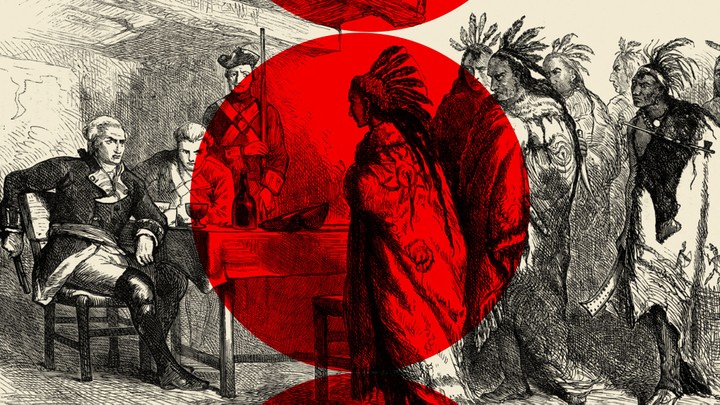
A second hard truth exposed by the 27th grievance—and its racist depiction of Native Americans as “merciless Indian savages”—has generated much less public discussion. In indicting the king for unleashing Indians on the “inhabitants of our frontiers,” the Declaration was not referring to a specific event but rather to the recent escalation of violence, which was caused by colonists invading Native lands west of the Appalachian Mountains. In response, a confederation of Senecas, Shawnees, Delawares, Ottawas, Cherokees, and other Native nations exercised a right of self-defense and attacked new colonial settlements. Although the Native nations had British support, they were acting on their own and not at the instigation of the Crown. Nonetheless, Thomas Jefferson, the Declaration’s primary drafter, hoped that by fanning the flames of settlers’ anti-Indian racism and implicating George III, he could ignite a general conflagration against the British in the West. In this way, the 27th grievance helped lay the foundation for an American nationalism that would demonize the continent’s indigenous people, especially when they resisted American aggressions.
Although the reference to the “merciless Indian savages” appealed to the “inhabitants of our frontiers,” Jefferson and others who signed the Declaration had their own reasons for detesting British policies relating to Native Americans and their lands. More than a decade earlier, in order to end a costly war to suppress an indigenous resistance movement led by the Ottawa war leader Pontiac, the king issued the Proclamation of 1763, which recognized indigenous ownership of lands west of the Appalachian mountains’ crest and prevented colonists from settling there. At first glance, ordinary settlers might be expected to  have been the proclamation’s major opponents. Some settlers did object, but the most potent source of opposition came from colonial elites, especially in Virginia and Pennsylvania, who had invested in companies with claims to lands west of the boundary set by the proclamation. Unless those lands could be legally settled, land companies could not gain secure title to their claims. Investors would be left with nothing but the debts they had incurred to bet on getting rich.
In 1767, George Washington, one of the era’s most passionate land speculators, predicted that the proclamation “must fall … in a few years.” British imperial officials made some adjustments to the 1763 boundary, but despite Washington’s hopes, and those of other speculators such as Thomas Jefferson, British policy continued to restrict colonists’ perceived liberty to obtain indigenous lands. Colonists found the 1774 Quebec Act—one of the Intolerable Acts—particularly odious. Not only did the Quebec Act grant legal protection to Catholicism, a religion Protestants despised, but it extended Quebec’s boundary south to the Ohio River and blocked settlement in the Ohio Valley. At the First Continental Congress, Richard Lee, a delegate from Virginia, called the Quebec Act the “worst grievance” of them all. Two years later, when Virginia broke with Great Britain, its state constitution claimed lands west of the Mississippi River, thus nullifying the Proclamation of 1763 and the Quebec Act.
Even as colonists declared their independence from Britain, indigenous people were preparing to defend their own freedom. Long experience had led Native Americans to believe that colonists intended not only to take their lands, but to kill them all. In the summer of 1776, an unnamed Shawnee, part of a delegation of Mohawks, Shawnees, Ottawas, and Delawares, urged Cherokees to join a confederation to resist the colonists, warning that the “Virginians,” as he referred to all colonists, possessed “an intention to extirpate … the red people.” Similarly, after the Revolutionary War broke out, the Mohawk leader Joseph Brant declared that it was the intention of another group of colonists—the “Bostonians”—to “exterminate” the Mohawks and other members of the Six Nations (Haudenosaunee) confederacy. The term genocide did not yet exist, but their words conveyed the same idea. Native people were terrified that unshackled colonists would kill them wholesale.
This indigenous perspective returns us to the 27th grievance. Jefferson’s denigration of “merciless Indian savages” signaled that the war for independence from Great Britain would also be a brutal war to seize indigenous lands. From 1776 to 1783, U.S. troops and colonial militias destroyed more than 70 Cherokee towns, 50 Haudenosaunee towns, and at least 10 multiethnic towns in the Ohio Valley, killing several hundred people (including civilians) and subjecting refugees to starvation, disease, and death. In the decades to come, U.S. presidents, Washington and Jefferson included, would call for the extermination of Native Americans who fought against dispossession. Several U.S. armies would try to do precisely that.
The 1619 Project has made an enormous contribution to public understanding of slavery, often referred to as America’s “original sin.” Although critics of the 1619 Project have tried to minimize slavery’s importance, its centrality to the creation of America—and its disturbing legacies—is well established in the scholarly literature and becoming clear to the public. Even so, the 27th grievance reveals that the original sin at America’s founding was twofold. America was built by the labor of enslaved people. It was also built on stolen lands and the genocide of indigenous peoples. To understand where this country is now and to imagine a truly just future, America needs to reckon with both of these hard truths