Humans Have Crossed a New Threshold in Space
Voyager 1 is far from home—and still has much farther to go.
For 4.5 billion years, Earth’s relationship with the cosmos involved only stuff falling onto our planet from space. Back when Earth was just a small pile of rocks, it grew thanks to torrents of additional rocks raining down upon it. Later, the water of our oceans was likely delivered by comets and asteroids, which also dispensed starter packs of organic molecules that may have been essential to getting life going.
And then, just recently, Earth reversed the flow. About 70 years ago, humans packed small boxes of electronics—the first satellites—into rockets and blasted them into orbit. Now we’ve stuffed Earth’s orbit to the gills and visited every planet in the solar system with our robot emissaries. We’ve even sent out probes that will one day travel beyond the sun’s reach.
This morning, around a quarter past 5, one of those probes crossed a milestone at that frontier, passing one light-day of distance from its home world. Voyager 1 had already traveled farther from Earth than had any other human artifact. But its light-day journey is a reminder that living beings on this planet are capable of not only escaping its boundaries but also reaching back out to the universe that made life here possible.
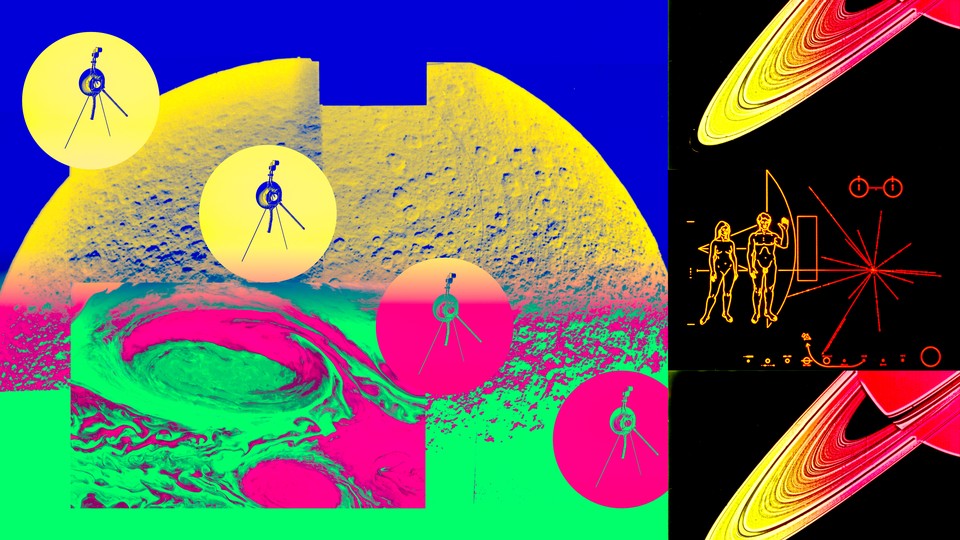
Voyager 1 took nearly 50 years to cover that distance, which is about 16 billion miles. NASA launched the craft and its twin, Voyager 2, in 1977 to complete a “Grand Tour” of the outer solar system, which was at that point largely unexplored. The images the Voyager probes sent back of Jupiter, Saturn, Uranus, and Neptune were groundbreaking. But getting the Voyagers out that far meant that they could never come back and would instead embark on an endless journey into interstellar space. In case anyone ever came across the lonely crafts, each one carried the “Golden Record,” a metal LP inscribed with sounds from Earth, including greetings in 55 languages and Chuck Berry’s “Johnny B. Goode.”
Outside the solar system, where the Voyager probes are headed, astronomers measure distance in terms of how far light—the fastest thing in the universe—travels in a given interval. The distance to other stars, for example, is measured in light-years, each of which is almost 6 trillion miles. The mind withers before such numbers; a light-year represents more than 200 million flights around the Earth. Here, however, is the real kicker: One light-year doesn’t get you to even our next-door neighbor, cosmically speaking. The closest star, Alpha Centauri, is about four-and-a-half light-years away. Most other suns in the vast city of stars we call the Milky Way are hundreds, thousands, or even hundreds of thousands of light-years from our own.
Scientists and science writers sometimes say that Voyager 1 (which travels slightly ahead of Voyager 2) is the first space probe to leave the solar system, but by the strictest measure, one light-day is still well within the boundaries of Earth’s home. Back in 2012, Voyager 1 crossed the heliopause, the boundary between the so-called solar wind of particles streaming off the sun’s surface and the interstellar gas atoms the solar system is flying through. It’s an important boundary, but not really the end of the solar system. That honor rests with the Oort cloud, a shell of frozen comet hearts that defines the true outer wards of the sun’s gravitational empire. Depending on how you measure it, the Oort cloud begins at about 20 light-days from Earth and extends to almost 600 light-days at its outer reaches. In this context, Voyager 1 has barely made it to the front door of our cosmic house.
But focusing on distance alone obscures the real significance of Voyager 1’s journey. Consider that, ever since the very first organism appeared some 3.5 billion to 4 billion years ago, every cell on Earth has come from another cell before it. Life on our planet forms an unbroken lineage, one cell passing its vitality and know-how on to the next. We humans like to congratulate ourselves on how smart we are. We’ve probed the atom, discovered the blueprint for life, built machines that can escape not only Earth’s gravitational tyranny but, eventually, the sun’s too. But we owe it all to the many nameless microscopic blobs, crawling sea things, and giant, furry whatevers that came before us, each of which owed its own existence to ancient space debris.
That means that every threshold Voyager 1 crosses is not just a human achievement but also the multibillion-year project of the entire living planet. Reversing the downward flow of accretion onto Earth and offering in return a small outward push toward the stars can be seen as Earth’s biosphere calling out to the universe. If life is common out there among the oceans of starlight, then perhaps many of its instantiations have had their own version of this Voyager 1 milestone, sending symbols of their own hope and gratitude a light-day away. In that case, Voyager 1’s light-day journey could serve as a signal that Earth is ready to join the universe’s other communities of sentience and wisdom.
In the span of less than a century, humans have initiated what will hopefully be a long era of expansion outward. As a species and as representatives of Earth’s collective life, we have been driven to search for sentience beyond our home planet and to spread it beyond our own borders. It is, perhaps, the greatest thanks Earth can offer to the universe that has spent so many billions of years nurturing it.
* Illustration sources: Corbis / Getty ; Heritage Space / Heritage Images / Getty ; Oxford Science Archive / Print Collector / Getty ; Smith Collection / Gado / Getty.
No comments:
Post a Comment