The Thinkers Who Explain This Baffling Era
These philosophers are less arcane—and more relevant—than some readers might think.
This is an edition of the Books Briefing, our editors’ weekly guide to the best in books. Sign up for it here.
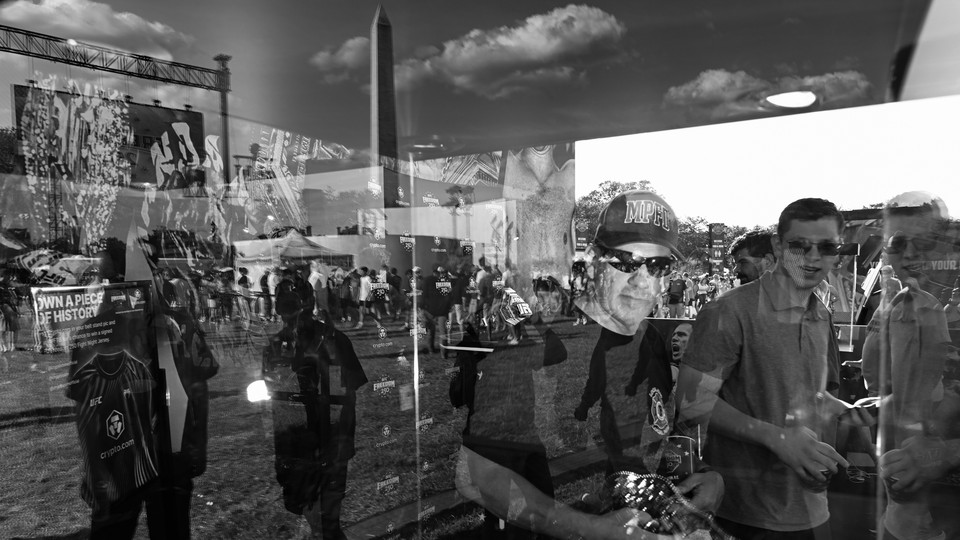
My favorite essays feel like surprising chemical reactions: Their materials combine into something novel and combustible. The French philosopher Roland Barthes’s 1957 essay “The World of Wrestling,” which examines the “amplification of the tragic masks” in professional (fake) grappling, certainly fits this category. So does an article in The Atlantic this week, in which the staff writer Gal Beckerman invokes Barthes’ essay to explain the symbolic importance of UFC 250, the gaudy display of blood sport that Donald Trump staged in front of the White House on Sunday. As Beckerman’s editor, I love the way he explains the news through the writings of philosophers, making an implicit case that they are less arcane—and more relevant—than some readers might think. So I decided to ask him to recommend a few more thinkers who might shed some light on the baffling era we’re living through.
First, here are four recent stories from The Atlantic’s Books section:
Boris Kachka: Has the UFC fight sent you back to other writers beyond Barthes?
Gal Beckerman: Yes. Philosophers, even those who produce some fairly dense theory, have asked the kinds of big questions that can help us make sense of two men covered in sweat and blood on the White House lawn. Another book that came to mind last weekend was Elias Canetti’s Crowds and Power, from 1960—particularly when I took in the scenes of tens of thousands of mostly men watching the fights from screens set up at the Ellipse. Canetti saw the impulse to join a crowd as part of a deeply human desire to dissolve individual boundaries, to both lose yourself and experience a kind of emotional release, a sense of power, that comes with feeling many times larger than just your isolated self.
Kachka: So Barthes analyzes the spectacle, and Canetti gets into the spectator’s head. Who helps you understand other forces behind Trump’s rise? What about, say, vaccine skepticism?
Beckerman: Bruno Latour, who died in 2022, was a sociologist of science who argued that what we think of as scientific truth is actually created through multiple subjective forces—such as funding and politics and personality. He meant to upend the idea of science as this pure process, and instead to understand it as a completely human one. I’m not sure that he anticipated Robert F. Kennedy Jr., but everyone can now understand Latour’s central point, which is that individuals influence the direction that science takes and the kinds of truths it produces. One of his more accessible and relevant books is The Pasteurization of France, which examines Louis Pasteur’s success in making germs a central focus of public health in the 19th century—not as a scientific triumph so much as the result of a subtle war, built on alliances with various interest groups.
Kachka: That must have been revelatory at a time when most people seemed to believe that science was infallible. But expertise has been downgraded—and more people are getting their information from podcasters and influencers. Who could help us understand this shift?
Beckerman: The shift that I’m most interested in is an enormous one: the coming end of the very long historical moment in which written culture has dominated the Western world. AI takes this a step further, because so many basic aspects of human thinking feel threatened by it. The best analogy we have to this kind of seismic change is the reverse—the long-ago move away from oral culture—and the best book I know on this topic is Walter J. Ong’s 1982 work Orality and Literacy. It’s a fascinating look at how the new technology of writing fundamentally restructured human consciousness, moving us into more abstract and analytical ways of thinking but also eroding the great capacity humans once had for memorizing and visualizing information. I don’t know what this new shift will do to our brains, but Ong’s work suggests that we may be headed toward a new experience of being human.
Kachka: Post-literacy and AI—now we’re moving into really big ideas. Who’s one writer who can give us a real galaxy-brain take on our brave new world?
Beckerman: I’ll take any opportunity to bring Hannah Arendt into the chat. Although she is mostly remembered as the philosopher who analyzed totalitarianism, she also wrote extensively about the strange limbo of modernity. She tried to express what it was like to have left behind traditional ways of life—religious, political, cultural—without yet having new models to replace them. On this theme, I’d recommend her 1961 essay collection, Between Past and Future. She was looking at what it meant to live during such a disorienting moment, from the perspective of education, authority, freedom, culture, truth, and politics. This should ring a bell. Such works don’t have the clear and obvious answers of self-help books, but they provide us something to think with, which is the most we can hope for as we muddle our way toward the future.
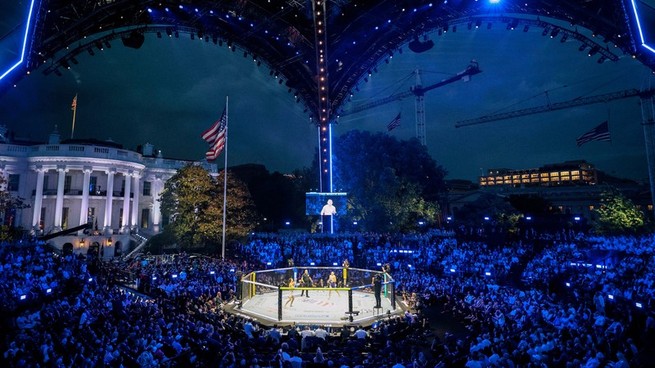
The Theory That Explains Trump’s UFC Fight
By Gal Beckerman
By staging a “spectacle of excess” on the White House lawn, the president expressed the violent essence of his worldview.
No comments:
Post a Comment