Wednesday, August 27, 2014

Not Just the South

It’s not just the South and Fox News: Liberals have a white privilege problem too

White privilege is a protection racket, the ultimate head start. The "liberal meritocracy" benefits from it too

It's not just the South and Fox News: Liberals have a white privilege problem tooClockwise, from top left: Joy Behar, Alec Baldwin, Stephen Colbert, Maureen Dowd, Jimmy Kimmel, Susan Sarandon, Ryan Seacrest, Bill Maher (Credit: Reuters/AP/Carlo Allegri/Mark Blinch/Alex Brandon/ABC News/Janet Van Ham/Jonathan Alcorn/Matt Sayles)
I spent 12 years of my life in St. Louis. I went to college there. Got married. Landed my first teaching job. Bought my first house. Between door-knocking for candidates and causes, driving around on ice cold nights in a homeless shelter van, and breaking bread in people’s homes and churches and synagogues, I came to know the metropolis well. I came to love and admire its many communities — including Ferguson: so tenacious, so full of hardworking families trying to stay afloat, trying to dismantle racial apartheid and make a better life for their children.
But each time I tried to write about Ferguson, I could only stare into the blank screen, dumbfounded. It wasn’t the killing of Michael Brown that left me speechless: tragically, the murder of black men by police is common. It wasn’t the riots that stumped me: Ferguson residents are rightfully fed up with being treated as second-class citizens. It wasn’t even the ludicrous spectacle of a hyper-militarized police response. I’ve been following that story for years.
No, what dumbfounded me was the outpouring of white anger and resentment. As police, pundits, politicians and their supporters sought control over the narrative of events in Ferguson, they drew from the deep well of moral panic and race hatred that in many ways define our contemporary political landscape. I am not talking about the moronic counter-protests by the Klan, or the impending race war hallucinated by capital-R Racists. I am talking about the insidious language of white privilege — the civil, polite, unconscious adoption by white people of racially normative viewpoints that give us comfort and help explain the world on our terms.
For those of us born with white skin, white privilege is the air we breathe; we don’t even have to think about it. It is like the fish that never notices the water in which it swims.  It is a glorious gift we have given to ourselves through the social order we have constructed, from top to bottom and bottom to top. It is the pillage of continents, the enslavement of people, the hatred of dark-skinned “others,” all somehow magically laundered by our commitments to democracy, self-reliance, individualism and the “post-racial, color-blind society.” It is our abject unwillingness to confront our history, to correct the deficits of our memory, to lean against the amnesia of a white story told.

advertisement

Meanwhile, white privilege is a grand protection racket. It has always paid substantial dividends, both in the short term and over generations, by restricting access to a valuable commodity — white skin. The wage we extract from racial difference keeps us committed to its perpetuation, even if we don’t know (or refuse to believe) that we are so committed. White privilege is a legacy, an inheritance, an account on which we can draw over and over and over again for any advantage, however small. It is the accumulation of racially protected, white-defended land, property, education, goods, institutions, mobility, rights and freedom. It is the ultimate head start. Rarely do we even know that we are drawing on these protected accounts, so ubiquitous and profound is the fund. Wave after wave of immigrants has had to learn this lesson, adopting white privilege and anti-black racism to fit properly into their new country.
But take away the air, and we gasp — we don’t know how to breathe in any other medium. In a paroxysm of fear and pain, we hyperventilate, clutching for a lifeline. Put millions of white people into the same scenario, and you get a great moral panic. In earlier times, the moral panic over race flowed from the raiments of a slave-based republic: the Democratic Party, the Confederacy, the Klan, sundown towns, lynchings and chain gangs. Today this moral panic is exemplified by the Tea Party, the GOP, right-wing media, gun toters at Wal-Mart and “patriots” like Cliven Bundy. And chain gangs. Race itself might have no basis in science, no purchase in differentiating humans genetically, but it is nevertheless a powerful cultural force. Race is the house of many rooms, built by white people for “the world and all those who dwell therein” (Psalms 24:1).
White privilege requires constant vigilance at the borders of identity, constant policing of difference. The frantic call among right-wing pundits to “secure the borders” by erecting walls has its psychic corollary in the maintenance of white supremacy. How could we possibly have a black president? Who are these strange people crossing our borders? How could anyone profess any other belief besides Christianity? Why do my tax dollars go to support those people (meaning dark-skinned residents of inner cities, not corporations and lobbyists and the military)? Meanwhile, we cling to the myth of the post-racial society, where suddenly, somehow we will be judged solely on the content of our character rather than the color of our skin. In this way, “not seeing race” becomes the peculiar privilege of white people who, perhaps unbeknownst to them, see race everywhere always.
White liberals try to blame “the South” or the ignorance of white working-class people for the persistence of racism. But there is plenty of ignorance to go around among white folks in all walks of life. In the 1950s, race-liberal politicians in the urban North proposed separate swimming days as a way to stave off white citizens’ fears of race mixing in public pools. In the 1960s, white liberals frequently upheld Dr. King as a civil rights hero while denigrating Malcolm X and the Black Panther Party. Racism knows no class boundaries, and benefits all whites, if not equally. Indeed, it can be particularly virulent among white elites, who have long used race as a way to divide and weaken working-class people, from Carnegie’s deployment of black laborers as strikebreakers to Lee Atwater’s Willie Horton strategy to the Koch brothers’ latest campaigns.
Pinpointing the South as the source of the problem is equally chimerical. The majority of hyper-segregated cities in the U.S. are in Northern states, and redlining and “white flight” proved as extensive in the North as in Dixie. To be sure, the Old Confederacy lingers like an undigested morsel, a failed state within our national borders, and will do so until we pull down the statues of traitors like Robert E. Lee and Nathan Bedford Forrest. Canny white politicians in the 1960s counted on race as an electoral motivator to take over the Republican Party via the so-called Southern Strategy. But the power of anti-black racism is not and never has been relegated to one region of the country — after all, great race-baiters like Nixon, Goldwater and Reagan hailed from Western states, while the South produced its share of courageous politicians.
Today’s GOP is the party of angry white men, not of the South. And racism is not confined to the GOP, however expert the party has become at exploiting race as an electoral dynamo. Rather, racism has long comprised a core pillar of the republic — as close as anything to the beating heart of our body politic.
In many ways, white privilege is more insidious than white supremacy. Both depend at root on the white power structure, but draw from that well in different ways. Advocates of white supremacy make no bones about their views, and approach the world with a modicum of clarity as to where they stand. They constitute the corporate lobby for whiteness as a racial political and economic interest. White privilege, on the other hand, rests on an edifice of special stupidity — a passive condition that literally stupefies the subject, inuring him or her against critical insight. It enables white people to assume the mantle of “color blindness” so as to perform the perfect legerdemain: making claims that do not seem to be explicitly about race, but are in fact about little else.
Thus, white privilege need not be overtly racist, and in fact is most potent when expressed through coded language cleansed of racial terms. It comes out into the world in phrases that seem reasonable to us white folk, but that obscure the immense freight of racism they carry — phrases like: “I’m not racist, but”; “my ancestors didn’t own slaves so I am not responsible”; “I didn’t get any breaks, I worked for everything I have”; and “what are they complaining about, things are so much better now.” Instead of “black neighborhood,” we say “high crime,” “dangerous” or “investment risk.” Instead of young black male, we say “thug” and “gangster.” White privilege leads us to repeat nostrums like “hey, Africans had slaves too”; “Republicans aren’t racists because the Democrats were the party of slavery”; and “what about black-on-black crime.” Such phrases are so utterly denuded of historical context as to be meaningless, yet they are repeated ad nauseam by right-wing bloggers and pundits.
White privilege enables us to pontificate on, and justify, the murder by police of black men who wear hoodies, smoke pot, sell “loosies,” shoplift or resist arrest. It enables us to ignore (or not even be capable of seeing) the glaring contradictions and double-standards that pervade the criminal justice system, from arrest to prosecution to sentencing — and even to media reporting on crime. White cokeheads get a slap on the wrist and some community service, while black crack users do 20 years at Joliet. George Zimmerman was standing his ground when he killed a black minor, while Marissa Alexander’s three warning shots against her abuser got her 20 years. White shoplifters after Hurricane Katrina are “survivors,” while black shoplifters are “looters.” White men who resist arrest typically get tackled or tasered. Black men resist arrest at their ultimate peril. Such double standards wrap white privilege in the comforting cloak of civility and reason, or what passes as such in our current non-conversation on race.
Still, at the deepest level, white privilege is an excruciatingly laborious fiction to uphold. It is exhausting, a heavy psychic penalty, a debenture drawn off the scales of justice. It makes us neurotic, fearful, angry, depressed and mean. It requires us to fully absorb the phantasm of race and to map moral and economic worth across gradations of skin color. Of course, black people suffer orders of magnitude greater trauma, physical pain and mental torment under the sign of white power. Nevertheless, it is the sickness at the heart of our body politic, and it floods our personal and social relations with an anxious bile. We white folk don’t know the source of this angst because we can’t see it. Most black people have no difficulty seeing it; whiteness envelops our bodies in a haze, and privilege flows from our lips like bitter honey.
In the end, I am convinced that white privilege blinds white people to our real interests, separates us from our best allies, and denies us grander aspirations. It hollows out life and hinders love. Most important, it victimizes people of color and forecloses opportunities for a greater common good. The fire this time is small. Some day it might burn large and bright — a hundred Fergusons, or a thousand. There is only so much give in our social fabric. People need to be heard, one way or another. It is time to reckon our privileges and to listen, to unplug from the Matrix of white supremacy. Time to breathe a different air.

Sunday, August 24, 2014

David McCullough - The Truman Biography (5)

What a great biography of a great man and a great President!  I enjoyed it as much the second time around as the first back in (I think) 1997.

So much happened during his Presidency.  The dropping of the atomic bombs on Japan is controversial to this day.  McCullough makes the case that Truman did the right thing under the circumstances.  You have to keep in mind the circumstances, the possibility of an all-out land invasion of Japan which would cost maybe 250,000 American lives and more Japanese lives.  The world is a dirty place in particular during wars.

The Truman Doctrine saving Greece and Turkey is accepted today as the right thing.  NATO and the GI Bill were momentous.  Seizing the steel mills was a mistake, one of Truman's few mistakes.  The so-called corruption during his latter years is hard for me to evaluate.  Truman's handling of the Berlin airlift is universally praised.

His intervention in Korea was the right thing to do.  As always happens, Americans at first tend to back military action but the people turn against it when it drags on and on.  Korea led to his low popularity ratings by the end of his Presidency.

Today HST is considered one of our greatest Presidents.  Truman and FDR saved Western Civilization.  Doubt it not!

Thursday, August 21, 2014

Race Over "Principled Conservatism"

Its racism, not “principled conservatism”: The South, civil rights, GOP myths — and the roots of Ferguson

True GOP believers insist their small government beliefs have nothing to do with race. They're deluding themselves

Its racism, not "principled conservatism": The South, civil rights, GOP myths -- and the roots of FergusonGeorge Wallace, Ronald Reagan, Richard Nixon (Credit: AP/Salon)
As events in Ferguson continue to dominate public political attention, it’s worthwhile to take a step back and take a long hard look at how we got here.  Why did the Democratic “Solid South” of old become such a stronghold of Republican strength?  Lyndon Johnson, one of the smartest Southern politicians ever, had no doubt in his mind — “There goes the South for a generation,” he reportedly said, after signing the Civil Rights Act in 1964.
But the South was already halfway out the door at the time. Missouri, with a fair amount of Southern culture in its veins, is nonetheless a border state, home to Harry Truman, whose enunciation of a civil rights agenda, followed by integration of the armed forces and strong civil rights platform in 1948, led to the walkout of the Dixiecrats, which cost him a dramatic 20 percent drop in the share of the Southern vote from where it had been in 1944. That launched a transitional era that is strangely lost to most who ponder such things today.
This lack of longer historical memory is part of what helps to support a popular brand of revisionism that claims the South turned Republican because the people there embraced “principled” “small-government” conservatism.  There are numerous problems with this explanation. First, if that’s why the South changed, then why didn’t the shift happen earlier? Second, if the change is explained by gradual economic development (as some such as Real Clear Politics senior analysis Sean Trende have argued), then why did Herbert Hoover do almost as well in 1928 as Dwight D. Eisenhower in 1952? And why did the Democratic share of the Southern vote drop precipitously by 20 percent in 1948, as noted above, the year the Democrats put a civil rights plank in their platform, and the Dixiecrats walked out?

advertisement

Third, what exactly is meant by “small-government conservatism”? And how does that square with the fact that Southern states almost universally get far more money from the federal government than they send in by way of taxes? And finally, how to explain the findings in a 2005 paper by Nicholas Valentino and David Sears, which found that “whites residing in the old Confederacy continue to display more racial antagonism and ideological conservatism than non-Southern whites,” and that “Racial conservatism has become linked more closely to presidential voting and party identification over time in the white South”?
But there’s also another problem with the “it’s-not-race-it’s-principled-small-government-conservatism” explanation — namely that race and small government conservatism are inextricably linked. This is not to say that all small government conservatives are racists. But it is to say that racial attitudes and attitudes toward robust government activism are strongly linked, statistically; the more positive (or negative) your attitudes toward activist government are, the more positive (or negative) your attitudes toward blacks are likely to be, and vice versa as well. Negative racial attitudes manifest both in terms of opposition to black political power, and in blaming blacks for their subordinate status. If this sounds like a damned-if-you-do/damned-if-you-don’t sort of situation, you’re right. That’s exactly what it is.
As I explained in a recent article, the earliest statistical evidence of this relationship came from one of the classic studies of American public opinion:
The year after the March on Washington, pioneer pollsters Lloyd Free and Hadley Cantril conducted surveys that were the basis for their 1967 book, The Political Beliefs of Americans; a Study of Public Opinion. They found that those opposed to five forms of federal spending were three times as likely as those who supported the spending to think that blacks should have “less influence” in politics. Since blacks only had five representatives of Congress at the time—just over 1%, compared to 11% of the population—the notion that they had too much influence was ludicrous on its face—and clearly racist. Yet, that’s precisely what 60% of those ‘small government conservatives’—people like Rand Paul and the Tea Partiers—believed.
Free and Cantril used three different measure of political orientation, one based on self-identification, one based on ideology (laissez-faire, individualist=“conservative”), and one operational, based on the degree of support for social spending. This involved five questions, dealing with federal aid to education, Medicare, the Federal housing program, the urban renewal program, and the government’s responsibility to do away with poverty.  The “Ideological Spectrum” was based on agreement or disagreement with the following statements:
  • The federal government is interfering too much in state and local matters.
  • The government has gone too far in regulating business and interfering with the free enterprise system.
  • Social problems here in this country could be solved more effectively if the government would only keep its hands off and let people in local communities handle their own problems in their own ways.
  • Generally speaking, any able-bodied person who really wants to work in this country can find a job and earn a living.
  • We should rely more on individual initiative and ability and not so much on governmental welfare programs.
Free and Cantril found that while half of all respondents qualified as ideological conservatives, two-thirds qualified as operational liberals, a condition they referred to as “mildly schizoid, with people believing in one set of principles abstractly while acting according to another set of principles in their political behavior.”  It’s not that everyone held contradictory views, of course, but the contrast in dominant modes was certainly a mass phenomenon, not just an individual quirk.  More precisely, almost a quarter of the respondents, 23 percent, were both ideological conservatives and operational liberals.  What’s more, this percentage doubled in the handful of Deep South states that Goldwater carried that year.  This is a point well worth digesting: The vanguard states in terms of realigning from Democrat to Republican were the ones with a sharply higher number of people who were ideological “small government” conservatives in principle, but who supported social spending in practice.  It’s only natural that these are the sorts of people whose views were likely to change dramatically based on the situation, but who then turn around and explain themselves in terms of unchanging “principles.”  After all, this is what they were already doing in 1964.
But that’s not the main point I want to make here. Because so many ideological conservatives were operational liberals in practice, it’s not a helpful way to look at who the true believers really are. The true believers are the ones who actually opposed government spending in practice.  They are the ones who didn’t just say they supported conservative principles in the abstract; they applied those principles to their spending priorities as well.  Hence, if you want to know who the principled conservatives really are, you don’t look at the expression of principles in the ideological spectrum, but at the support for social spending in the operational spectrum.  And this is where you see the sharp differences I described in the passage quoted above: 60 percent of those who were completely operationally conservative thought that blacks had too much political power in 1964, compared to 20 percent of those who were completely operationally liberal.  It couldn’t be clearer: Small government conservatives are much more opposed to black political power than those who support big government.
But that’s just one piece of evidence from 50 years ago.  What if it’s just a relic of a bygone era?  That’s certainly a distinct possibility. Which is why I’ve also looked at decades of polling data from the General Social Survey, which began collecting data every year or two in 1973, and is cited by social scientists more often than any other source, except for the U.S. Census. The data I’m about to present is cumulative data, spanning decades, but the broad shape of the data has not changed dramatically over the years, although there have been nuanced changes.  Instead of the five spending questions Free and Cantril asked, I used a battery of seven items: Social Security, welfare, “solving problems of big cities,” “improving nation’s educational system,” “improving and protecting nation’s health,” “improving the conditions of blacks,” and “improving and protecting environment.”  Two of these items can be expected to  be  directly influenced by attitudes toward blacks — welfare and “improving the conditions of blacks” — but since America’s welfare state does disproportionately benefit blacks in some ways, it would be unrealistic to exclude such questions. However, we’ll take a somewhat different look later, below.
There is no single GSS question that’s comparable to the question that Free and Cantril asked, but there are questions related to blacks’ ability to live their lives as they wish, which is arguably the most basic form of political power there is. Can blacks live and go wherever they want to? Or do they need the permission of whites?  There are at least three GSS questions that bear directly on this, and all tell a remarkably similar story: those who are less willing to let blacks live as they want to are also much more likely to be “small government conservatives,” while those who support black autonomy are much more supportive of big government.
The first question on this point (RacOpen) gave respondents the choice between two laws, one saying that homeowners can’t discriminate on who they sell to, the other saying that owners can decide, even if they do discriminate.  A second question (RacSeg) asked if white people have a right to keep blacks out of their neighborhoods if they want to, and blacks should respect that right. A third question (RacPush) asked if folks agreed or disagreed with the statement that blacks “shouldn’t push themselves where they’re not wanted.” All three questions revealed a similar pattern: Those who valued white feelings over black autonomy were roughly twice as likely to favor cutting social spending overall: 15.9  percent to 8.9 percent for RacOpen; 18.4 percent to 8.3 percent for RacSeg; and 17.6 percent to 7.3 percent for RacPush.  On the other hand, those who value black autonomy and would outlaw discrimination are about twice as likely to support increasing spending on six or seven items: 16.5 percent to 8.1 percent for RacOpen; 15.9 percent to 9.0 percent for RacSeg; and 16.4 percent to 9.1 percent for RacPush.
There was also one GSS question related to formal political power — but it was of limited usefulness. Even fairly early on, people were extremely reluctant to say they wouldn’t vote for a black president. Only around 10 percent would say that over the decades. So the samples are very unevenly split. But the basic pattern remains the same: 21.5 percent of those who wouldn’t vote for a black president are small government conservatives who would cut social spending program, compared to 11.2 percent of those who say they would vote for a black president.  Only 4.7 percent of those who wouldn’t vote for a black president would increase social spending on six or seven items, compared to 13.3 percent of those who say they would vote for a black president.
Attitudes toward black political power are clearly an important component of racial ideology in America. But perhaps even more basic is the view of basic worthiness. Do blacks continue to be poorer than white Americans because of external barriers holding them back, or because of their own inner deficiencies?  A two-factor attitude measure found that those giving all internal answers — saying that blacks didn’t face discrimination, but simply lacked the will to succeed — were much more likely to be small government conservatives: 17.3 percent of them supported decreasing government spending programs, compared to just 4.5 percent of those who gave all external explanations. In contrast, those giving all internal explanations were far less likely (5.4 percent) to support increased spending on six or seven items than those giving all external explanations (22.4 percent).
Now, as I already noted, the questions I used included two that were likely to directly reflect attitudes toward blacks. But what would happen if those were replaced with quite neutral spending questions — questions about spending on mass transit, and “highways and bridges”?  I won’t go through the whole battery of questions this time; it’s enough to just look at the question of whether internal or external factors are  to blame for blacks’ lower economic status. With this new battery of seven spending questions, 8.2 percent of those blaming blacks would reduce spending, compared to just 2.9 percent blaming external conditions, a smaller proportion for both, but a relatively comparable ratio between them. There was more significant convergence on the other end of the scale, but the differences were still quite noticeable: 12.2 percent of those blaming blacks would increase spending on six or seven items, compared to 18.5 percent of those blaming external conditions.
Taken all together, this seems to clearly show that some of the opposition to government spending is directly tied to spending that targets blacks, but that some of it does not; it is simply correlated with negative assessments of black worthiness.  But how general is this finding?
I’m not prepared to give a comprehensive answer, but I can give you a bit of a surprise: When it comes to spending that would help combat the impacts of global warming, attitudes toward black worthiness turn out to be quite important.  I created a three-item spending scale related to global warming — one question we’ve already seen, “improving and protecting environment,” one concerning spending on science, and one specifically on developing alternative energy.  For this three-item scale, the differences are just as dramatic as for the first  seven-item scale. 17.5 percent of those who blame blacks would cut spending overall, compared to just 5.8 percent of those who blame external conditions.  And 30.7 percent of those who  blame external conditions would increase spending on all three items, compared to  just 16.3 percent of those who blame blacks. Thus, even when it comes to fighting global warming, one’s attitudes toward blacks are a strong indicator of how much of a “principled conservative” one is likely to be.  Some “principles,” eh?
All the evidence I’ve given so far comes from comparing attitudes within the U.S. as a whole.  But it turns out that this sort of correlation is virtually universal in a way; people in general are more willing to spend government money on people they perceive to be more like them.  Some striking data in this regard was presented in a 2001 paper from the Brookings Institution, “Why Doesn’t the United States Have a European-Style Welfare State?” by Alesina, Alberto, Edward L. Glaeser, and Bruce Sacerdote (Brookings Papers on Economic Activity 2, 2001: 187-277).  The online introduction explains:
European countries are much more generous to the poor relative to the U.S. level of generosity. Economic models suggest that redistribution is a function of the variance and skewness of the pre–tax income distribution, the volatility of income (perhaps because of trade shocks), the social costs of taxation and the expected income mobility of the median voter. None of these factors appear to explain the differences between the U.S. and Europe. Instead, the differences appear to be the result of racial heterogeneity in the U.S. and American political institutions. Racial animosity in the US makes redistribution to the poor, who are disproportionately black, unappealing to many voters. American political institutions limited the growth of a socialist party, and more generally limited the political power of the poor.
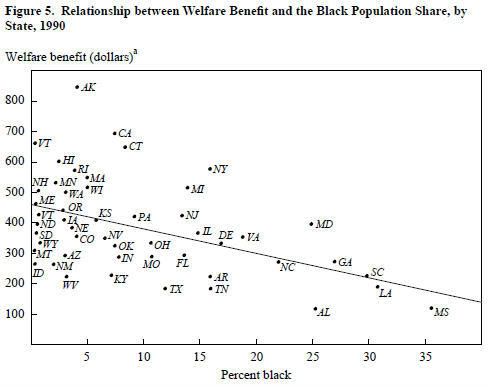
The paper itself is a sophisticated consideration of multiple factors and possible explanations, but I want to just focus on two charts the authors presented. Both involve comparisons between social spending and the presence of racial minorities. The first is a country-level comparison comparing social spending as a percentage of GDP with “racial fractionalization,” which the authors describe as “the probability of randomly drawing out of the country’s population two individuals that do not belong to the same racial group.” It showed a visible correlation between a larger presence of racial minorities and a lower level of social spending. The second chart is a state-level comparison between the size of welfare benefits and the percent black. It shows a similar correlation.
In the years since this paper was published, a broader literature has appeared. A 2011 survey of that literature “Ethnic Diversity, Public Spending, and Individual Support for the Welfare State” concluded that the evidence was “mixed,” though “many studies do show evidence of a negative association.” It also speculated that future research would probably reveal that “the relationship is most likely non-linear: ethnic diversity will matter most near a ‘tipping point’ at which ethnic minorities are perceived as posing a political or economic threat to the native majority.”  It also needs to be stressed that racial antipathy is just one factor to be considered. Just because one empathizes more readily with those one sees as coming from a similar racial or ethnic group does not necessarily mean one is hostile to other groups. Generally speaking, the more genuinely self-confident and happy people are with their place in the world, the more open they are to welcoming others. So in-group identification and out-group hostility are two related, but distinguishable phenomena.  But the GSS questions explored above should leave little doubt that racial antipathy is part of the mix supporting the politics of “small government” “principled” conservatism.
Let’s not forget a bit of history recounted by Taylor Branch last year, just before the 50th anniversary of the March on Washington, which I referred to in my earlier article mentioned above. As Branch recalls, George Wallace led the way in disavowing racism, shifting hard to a brand of  “principled conservatism” that he pretty much invented as he went along. He did this within months of the march, which so thoroughly discredited his former segregationist stand:
By the end of 1963, with segregation losing its stable respectability, he [Wallace] dropped the word altogether from a fresh stump speech denouncing “big government” by “pointy-headed bureaucrats,” tyrannical judges, and “tax, tax, spend, spend” legislators. He spurned racial discourse, calling it favoritism, and insisted with aplomb that he had never denigrated any person or group in his fight for local control.
So, there’s nothing new in the claim that “principled conservatism” has nothing to do with race.  If you want to be a true believer, it’s the very first lie that you have to believe.

Wednesday, August 20, 2014

David McCullough - The Truman Biography (4)

"He tended to live a day at a time and do the best he could each day as it came along," George Elsey remembered.  "Maybe it was the farmer in him.  You go out and do the day's work."

p. 862

On Ferguson

Reparations for Ferguson

Total police control over black bodies has echoes in American history. 

Mark Kauzlarich/Reuters
A few weeks ago I received an anxious text from my wife informing me that a group of young men were fighting outside of our apartment building. We've spent most of our adult lives in New York, and most of that time in New York living in Harlem. I love Harlem for the same reason I love all the hoods I have lived in. I walk outside in my same uniform, which is to say my same jeans, my same fitted, my same hoodie, and feel myself washing away, disappearing into the boulevard, into the black and (presently) the brown, and becoming human.
There have been young people fighting outside my window for as long as I can remember. I was no older than five sitting on the steps of my parents' home on Woodbrook Avenue watching the older boys knock shoulders in the street—"bucking" as we called it then—daring each other to fire off. From that point on I knew that among my people fisticuffs had their own ritual and script. The script was in effect that evening: show cause (some niggas jumped me in the park), mouth off (I ain't no punk), escalate (wait right her son, I'm bout to get my shit).
My wife wanted to know what she should do. She was not worried about her own safety—boys like this are primarily a threat to each other. What my wife wanted was someone who could save them young men from themselves, some power which would disperse the boys in a fashion that would not escalate things, some power. No such power exists. I told my wife to stay inside and do nothing. I did not tell her to call the police. If you have watched the events of this past week, you may have some idea why.
Among the many relevant facts for any African-American negotiating their relationship with the police the following stands out: The police departments of America are endowed by the state with dominion over your body. This summer in Ferguson and Staten Island we have seen that dominion employed to the maximum ends—destruction of the body. This is neither new nor extraordinary. It does not matter if the destruction of your body was an overreaction. It does not matter if the destruction of your body resulted from a misunderstanding. It does not matter if the destruction of your body springs from foolish policy. Sell cigarettes without proper authority and your body can be destroyed. Resent the people trying to entrap your body and it can be be destroyed. Protect the home of your mother and your body can be destroyed. Visit the home of your young daughter and your body will be destroyed. The destroyers of your body will rarely be held accountable. Mostly they will receive pensions.
It will not do to point out the rarity of the destruction of your body by the people whom you pay to protect it. As Gene Demby has noted, destruction is merely the superlative form of a dominion whose prerogatives include friskings, detainings, beatings, and humiliations. All of this is common to black people. All of this is old for black people. No one is held accountable. The body of Michael Brown was left in the middle of the street for four hours. It can not be expected that anyone will be held accountable.
We are being told that Michael Brown attacked an armed man and tried to take his gun. The people who are telling us this hail from that universe where choke-holds are warm-fuzzies, where boys discard their skittles yelling, "You're gonna die tonight," and possess the power to summon and banish shotguns from the ether. These are the necessary myths of our country, and without them we are subject to the awful specter of history, and that is just too much for us to bear.
James Poulos is trying admirably to get at this, noting that we fear Lincoln's awesome prophecy. But even Poulos can't quite escape:
We know that America is exceptional in one key respect—we came to democracy without much bloodshed. Around the world, from Hungary and Russia to Iraq and Nigeria, we see the dream of peaceful democratization dragged again and again to what the philosopher Hegel called the slaughter-bench of history. Racial strife and murderous governments, not liberty and democracy, are the rule in history, the established pattern. We know that, mercifully, democratization scourged us only once in ferociously modern style: during the Civil War.
The last sentence here nullifies the first. Some 600,000 Americans—2.5 percent of the American population—died in the Civil War. What came before this was a long bloody war—enslavement—against black families, black communities and black bodies. What came after was a terrorist regime which ruled an entire swath of this country by fire and rope. That regime was not overthrown until an era well within the living memory of many Americans. Taken all together, the body count that led us to our present tenuous democratic moment does not elevate us above the community of nations, but installs us uncomfortably within its ranks. And that is terrifying because it shows us to be neither providential nor exceptional, and only special in the subjective sense that our families are special—because they are ours.
My family lives in Harlem. My wife did not call the police. An older head told the angry boys that they needed to take it somewhere else, which they did. Black people are not above calling the police—but often we do so fully understanding that we are introducing an element that is unaccountable to us. We introduce the police into our communities, the way you might introduce a predator into the food chain. This is not the singular, special fault of the police. The police are but the tip of the sword wielded by American society itself. Something bigger than Stand Your Ground, the drug war, mass incarceration or any other policy is haunting us. And as long we cower from it, the events of this week are as certain as math. The question is not "if," but "when."

Tuesday, August 19, 2014

Not Tea Partiers


No, the Founders Were Not Tea Partiers

By


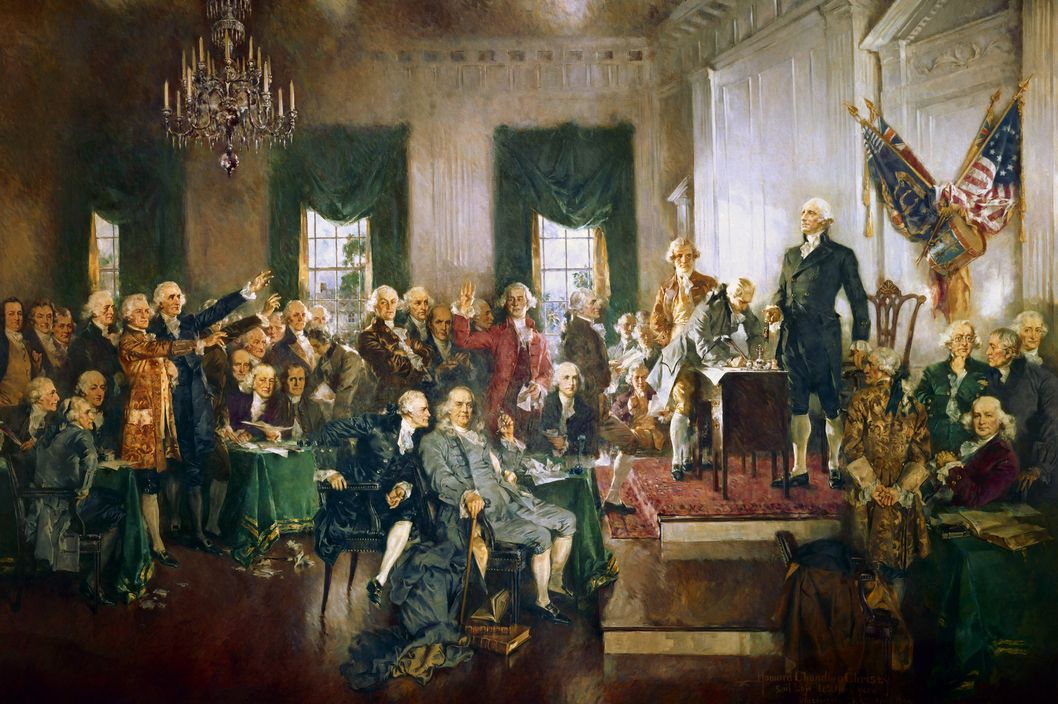
The Founders as we like to remember them. Photo: Howard Chandler Christy/Wikimedia Commons
A longstanding conceit of conservative thought, which has returned with new force during the Obama years, is that conservatism is the authentic heir to the vision of the Founders. (See, for example, Paul Ryan's recent op-ed, which offhandedly describes his own polices, in contrast with President Obama's, as consistent with "the Founders' vision.") One can see this in a dispute between liberal writer Jonathan Cohn, who complains that the Senate gives disproportionate power to rural, conservative voters, and conservative Philip Klein, who rebukes Cohn by instructing him that the Founders Wanted It This Way:
In Federalist No. 62, Madison addressed the structure of the Senate specifically, writing that “the equal vote allowed to each State is at once a constitutional recognition of the portion of sovereignty remaining in the individual States, and an instrument for preserving that residuary sovereignty. So far the equality ought to be no less acceptable to the large than to the small States; since they are not less solicitous to guard, by every possible expedient, against an improper consolidation of the States into one simple republic.”
He went on to explain, “Another advantage accruing from this ingredient in the constitution of the Senate is, the additional impediment it must prove against improper acts of legislation.”
In other words, the Founders made it intentionally difficult to pass major legislation at the national level that would trample over the desires of smaller states.
It is true that the Founders agreed to create a Senate that gave every state equal voting rights regardless of population. It is not true that Madison — or Alexander Hamilton, whom Klein also quotes — wanted it this way. Madison, Hamilton, and most of the figures we regard as the Founders despised the idea of one state, one vote. They put it in the Constitution for the same reason they put in the three-fifths clause — because they were politicians, and they had to accept a noxious compromise or the whole deal would have fallen apart.
As Robert Dahl explains (excerpt via a review by Hendrik Hertzberg, who has nurtured a fantastic obsession with this issue), they argued fervently against one state, one vote during the actual negotiations:
Madison had been the Constitutional Convention's most passionate advocate of giving the big states more senators than the small ones. Hamilton had been almost as adamant. “As states are a collection of individual men,” he harangued his fellow-delegates, “which ought we to respect most, the rights of the people composing them, or of the artificial beings resulting from the composition? Nothing could be more preposterous or absurd than to sacrifice the former to the latter. It has been said that if the smaller states renounce their equality, they renounce at the same time their liberty. The truth is it is a contest for power, not for liberty. Will the men composing the small states be less free than those composing the larger?”
Figures like Madison and Hamilton negotiated the best deal they could make, then they set out to sell it to the public, correctly calculating that a compromised Constitution was better than none. The Federalist Papers were an exercise in spin — spin in service of a worthy cause, but spin nonetheless.


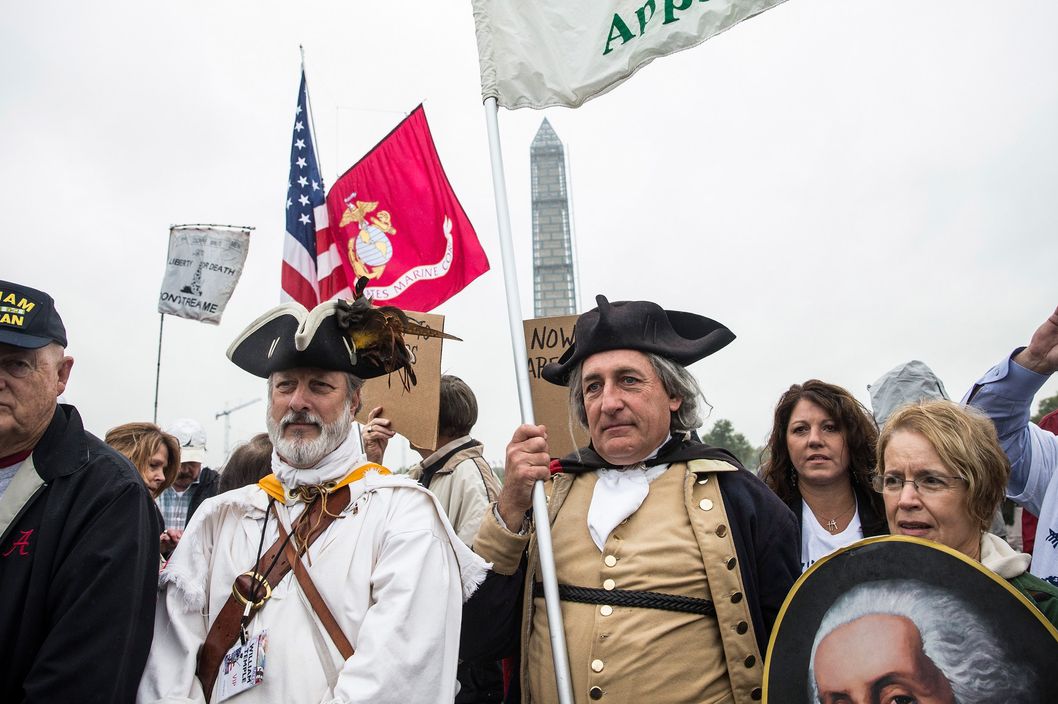
Definitely not the Founders. Photo: Andrew Burton/2013 Getty Images
There is, of course, a more broadly applicable lesson here. At any given moment in time, it always appears to be the case that our politicians are unprincipled sleazeballs, in sad contrast to their upstanding, principled forebears. But statesman are merely dead politicians. The Emancipation Proclamation only liberated slaves held in rebel territory, while leaving in bondage those in neutral states. Lincoln wrote a newspaper op-ed declaring, “If I could save the Union without freeing any slave I would do it, and if I could save it by freeing all the slaves I would do it; and if I could save it by freeing some and leaving others alone I would also do that.” This, too, was spin — Lincoln needed to hold the support of a crucial bloc of northerners who were willing to fight for Union but not for abolition. He settled for partial emancipation because that was the extent of his power at the time. When the opportunity came to abolish slavery everywhere, Lincoln seized it.
Madison’s compromise has held in part because his defense of the compromise has been erroneously translated through pop history as genuine conviction, and in part because advocates of proportional representation lack the votes to reform the Senate, just as they did in the 18th century. But we should be clear that the critics of the malapportioned Senate, not its defenders, are Madison’s true ideological heirs. Madison and his allies were practical politicians. This is another characteristic separating them from the tea party.
Update: Klein replies:
it's the U.S. Constitution that represents the ultimate collective byproduct of the the Founders' work, and the end result is what's relevant in discussions about their vision. The parts of the Federalist Papers that I quoted in my column represented attempts by Madison and Hamilton to reassure states that if they agreed to join the union, their interests would be protected under the Constitution's actual design. Whatever system Madison or Hamilton would have preferred if they got their way on everything is less relevant.
There are three points to make here.
1. Klein is now making a somewhat different argument than his original version, which presented one-state, one-vote as the inspired vision of Madison and Hamilton. That was the aspect of Klein’s column that was the central source of my objection. To be fair to Klein, he was repeating a common fallacy -- assuming the byproduct of the Constitutional Convention (and the ensuing apologetics of the Federalist Papers) represented a kind of divine vision, and using the prestige of the Founders to present critics of the Constitutional structure as out of step with Madison, when in fact they share Madison’s beliefs.
2. It is true that, in order to reassure small states, the Founders agreed to give them an upper chamber that would give their citizens disproportionate representation. But everything that can be said about this compromise can likewise be said about the three-fifths compromise. Slave states demanded disportionate representation as a condition of ratifying the Constitution just as small states did. Madison and the people we think of as the Founders didn’t like that compromise any more than they liked the Senate compromise. Being pragmatic politicians, they defended it in the Federalist papers.
It may be practically impossible for small-d democrats to reform the Senate today, just as it was practically impossible to alter the three-fifths compromise. But Klein isn’t just making a practical argument -- he’s making a moral one, too. He’s suggesting that a bargain, once agreed to, holds moral force for future generations, apparently for perpetuity. If we were holding this discussion before 1865 (or if slavery had not been abolished) would the three-fifths compromise still have moral force? Or -- as I would maintain -- should future generations regard it as a politically necessary concession to existing power arrangements they have every right to revise?
3. Even if we do regard the original compromise between small and large states as fair, it’s significant that, since 1789, the terms of the deal have shifted massively in favor of the small states. When the Constitution was ratified, the largest state had 12 times the population of the smallest. Today, as Hertzberg points out, the largest state has 68 times the population of the smallest.
Founders like Madison and Hamilton were willing, in violation of their values, to accept a 12-1 discrepancy in political representation in order to win acceptance of a Constitution. Would they have accepted a 68-1 discrepancy? We don’t know. In any case, the deal we have now looks quite different than the one Madison and Hamilton struck. In most ways, the United States has grown more democratic since its inception. In the disproportionate power to residents of the smallest states, it has grown less so.


The Fake Perlstein Controversey


Was an Accusation of Plagiarism Really a Political Attack?

This story is included with an NYT Opinion subscription.
Learn more »
There aren’t too many worse things you can suggest about an author than that his or her work is plagiarized. It’s the book-world equivalent of spreading the word that a financial adviser has cooked the books or that the parish priest has designs on the altar boys. By its nature, even the suggestion is tarnishing.
So, after The Times recently published an article that included a plagiarism claim against Rick Perlstein, the author of a new political biography, “The Invisible Bridge: The Fall of Nixon and the Rise of Reagan,” I fielded a number of outraged complaints.
Those who wrote objected, in part, to the article’s second paragraph which described the reaction to the book: “It has drawn strong reviews from prominent book critics, and sharp criticism from some scholars and commentators who accuse Mr. Perlstein of sloppy scholarship, improper attribution and plagiarism.”
The article went on to describe “the most serious accusations” as coming from Craig Shirley, the author of “Reagan’s Revolution,” published in 2004. The article made reference to accusations of “19 instances of duplicated language.” And later to charges from Mr. Shirley of “50 instances where his work was used without credit.” It then provided Mr. Perlstein’s and his publisher’s denials of plagiarism and their defense of his scholarship. They “noted that Mr. Perlstein cited Mr. Shirley’s book 125 times” on the website where he posted his endnotes, citations and links. The article also prominently mentioned the praise for the Perlstein book so far. (One such positive review, written by the former Times columnist Frank Rich who writes for New York magazine, was on the cover of The Times’s Book Review earlier this month.)

The author and New Yorker writer Jeffrey Toobin pointed out in an email that “an accusation of plagiarism is an extremely serious matter. Such accusations can ruin careers. The accusation here does not even rise to the level of flimsy.” Noting that “Perlstein is a left-leaning historian” and that “Shirley is a right-leaning writer and consultant,” Mr. Toobin called the claim “a political attack on Perlstein dressed up as a journalistic ethics controversy.”   He wrote: “As Shirley himself acknowledges, Perlstein paraphrased Shirley’s words and then cited his work. That is not plagiarism; that is responsible behavior by Perlstein. Perlstein did what historians are supposed to do.”
Felix Salmon, the media writer and editor, described the matter as “an entirely fake ‘controversy,’ ginned up wholly by wing nuts who think that Reagan is God and that any left-wing criticism of him, no matter how scholarly and intelligent, is tantamount to blasphemy.”
“The article clearly damages Perlstein,” Mr. Salmon wrote to me. “The New York Times is basically a co-conspirator here, in a concerted Swift-boating of Rick Perlstein. For shame.”
Mr. Perlstein has also written to me, largely to send me links to other articles that have been written about the matter.
One, by a linguist at the University of Pennsylvania, Mark Liberman, concludes that Mr. Perlstein used a practice he finds generally acceptable: “patch writing” — that is, using “idea-combinations and associated word choices,” preferably with specific attribution but sometimes without. He calls this “within the normal boundaries of research methods for narrative histories, as indicated by the fact that Shirley did quite similar things with his own sources.”
I spoke on Monday to the media editor, Peter Lattman, and to the deputy media editor, Bill Brink, who was the chief editor on the article, after showing them some of the complaints.  I also corresponded with Alexandra Alter, who wrote the article.
Mr. Brink told me that The Times took these issues seriously before publication, discussing whether writing about the accusations was fair. The editors said that they believed The Times had acted responsibly and that the article was newsworthy.
“We wrote about it because it was out there and thought we could take it head-on in the story. We did that in the most responsible way possible, and put it in context,” Mr. Brink said. He said that Ms. Alter had reviewed some of the passages in question and “did a cursory look” at others. (Ms. Alter told me she reviewed the 19 passages originally in question.) It may, in retrospect, have been going too far, Mr. Brink said, to make reference to “50 instances” without independently reviewing them.
Mr. Brink also said that a number of elements combined to make the piece valid — the criticism, for example, about a paucity of primary sources in the book and the discussion about placing source citation not in the book itself but on Mr. Perlstein’s website. The article described “the growing practice of shifting endnotes out of print books and onto the web.” These factors, combined with the polarized reaction to the book and the plagiarism claim, added up to something newsworthy, the editors and Ms. Alter told me.
Ms. Alter also said that she and her editors had reviewed correspondence between Mr. Shirley’s lawyer and the lawyer for Simon & Schuster, the publisher, which included the 19 corresponding passages. “The language struck us as quite similar.  Mr. Perlstein and I spoke about some of the specific passages, and he said that he regretted the proximity to Craig Shirley’s phrasing in one instance, but pointed out that he had paraphrased the passages and cited them in his online notes, which is standard practice for historians.   I also interviewed another Reagan scholar, Steven Hayward, who said he found the similarities in the descriptive language of the disputed passages to be too close for comfort, though we didn’t end up using a comment from him in the story.”
My take: There’s a problem here. An article about polarized reaction to a high-profile book is, of course, fair game. But the attention given to the plagiarism accusation is not.
Yes, the claim was “out there” but so are smears of all kinds as well as claims that the earth is flat and that climate change is unfounded. This one comes from the author of a book on the same subject with an opposing political orientation. By taking it seriously, The Times conferred a legitimacy on the accusation it would not otherwise have had.
And while it is true that Mr. Perlstein and his publisher were given plenty of opportunity to respond, that doesn’t help much. It’s as if The Times is saying: “Here’s an accusation; here’s a denial; and, heck, we don’t really know. We’re staying out of it.” Readers frequently complain to me about this he said, she said false equivalency — and for good reason.
So I’m with the critics. The Times article amplified a damaging accusation of plagiarism without establishing its validity and doing so in a way that is transparent to the reader. The standard has to be higher.