This is the third and best Sherman biography that I've read. What stands out the most is the irony attached to this man.
His father named him Tecumseh after a great Indian chief. Yet Sherman headed the army that exterminated Native American Indians in the West after the war. He never had any use for these people considering them savages unable to assimilate into white society. Either kill them or isolate them he said.
He failed as a banker though mostly due to forces beyond his control. Yet his efforts both during and after the war with the building of the cross-country railroads led to banking domination of the country during the Guilded Age.
He was a family man though he spent about half of his married life apart from his wife Ellen. Yet his beloved son Tom turned against him and became a Catholic priest. His other son led a tough life and died in unfortunate circumstances in 1941. Father Tom struggled and lived until 1933.
He was working in Baton Rouge and liked the South except for the few who led the South out of the Union after Lincoln was elected. He did as much as anyone to destroy the slave states during the war. Yet before the war he considered settling in the South even in Northeast Alabama. He thought the South made a mistake in seceding and things should have continued as before in the country after Lincoln was elected. Slavery was not a moral problem in his mind. He mellowed somewhat in his old age, but not much.
As he torched Atlanta and rampaged on to Savannah and up into the Carolinas he personally freed a lot of slaves, yet he had no use for them. He got into trouble with the Secretary of War over his harsh attitude toward blacks. In a time when "everyone" was racist, he was more racist than most.
As the war ended, he negotiated a generous treaty with Confederate General Johnston which was repudiated by the administration. Ironic that Sherman destroyed the South in his last drive thru Georgia and South Carolina and yet was willing to let the South resume its place in the Union on generous terms. He would have been happy to let slavery continue if that could be arranged.
He hated the press yet he must have enjoyed his notoriety from the press. Surely his publicity boosted his considerable ego.
He always hated politics and politicians mainly because they wouldn't do what he thought should be done. It was probably for the best that he was not nominated and therefore did not serve.
Sunday, August 28, 2016
Saturday, August 27, 2016
Mortimer Jordan
Speaking of Huck Finn lighting out for the territories, I spent a horrifying time in Morris, Alabama, last night, attending a high school football game. We have territories locally. Have you ever been to Mortimer Jordan High School in the dead of night? Well, you haven't missed anything. It's dark and I kept listening for dueling banjos and watching for people with green teeth and dirty overalls and only one ear. Strange sounds coming from the woods. Not more than one or two street lights anywhere. I could have been captured, sold into slavery, and never heard from again. If it weren't for a kind Kimberley po-lice man, I might never have escaped before the light of day if then. I still got the shakes.
Racial Prejudice is in His DNA
How Trump Got His Start, and Was First Accused of Bias
- As Donald J. Trump assumed an increasing role in his father’s business, the real estate company’s practice of turning away potential black tenants was painstakingly documented.
- An investigation by The New York Times uncovered a long history of racial bias at his family’s properties, in New York and beyond.
The "Alt-Right" Talk
As far as I can tell, the so-called "alt-right" is just a restatement of white supremacy. It's nothing new.
Thursday, August 25, 2016
Talking to Strangers
How to Talk to Strangers
The health benefits are clear. The political benefits are newly relevant.



Standing this way breaks unstated rules of how we’re supposed to behave in elevators. Detaching from expectations gives people an excuse to talk, to acknowledge one another’s humanity. Absent a break in the order, the expectation is silence.
(Of course, you can make a quick joke—my favorite is, if the elevator is stopping frequently, “What is this, the local train?”—and expect a modicum of laughter. But even if the joke goes over well, the rule seems to be that you can’t say it more than once in the same ride.)
The celebrated Canadian sociologist Erving Goffman saw elevators as microcosms of society. Described by the Times Literary Supplement as “a public private eye,” Goffman covertly studied people as they rode in elevators in 1963. He noted that the rule upon entering seemed to be to give some brief visual notice of other passengers, and then to withdraw attention, not making eye contact again at any point. (Though 35 percent of people added one or two glances to the initial look.)
“That’s the principle that’s operational when people aren’t talking to each other on the subway,” Kio Stark, the author of the forthcoming book When Strangers Meet, explained to me. “You can pretend you’re there by yourself.”
And this is good and necessary at times, especially in a city as bereft of solitude as New York. But it can be overdone. As Stark argues from the top of the book, “This if nothing else: Talking to strangers is good for you.”
Her work appealed to me because I’ve suggested as much in a mediocre piece called “Always Talk to Strangers.” That was based on a study that found that people who considered their neighbors to be friendly and trustworthy were less likely to have heart attacks. Other public-health research has shown improved moods among commuters who chat on the subway, and happiness and creativity among people who talk to strangers.
Kio Stark always has and does. She was born in a New York family and doesn’t think it’s rare. Her reasons are many, but among the most compelling is essentially boredom. She writes that a stranger-encounter is “an exquisite interruption” to whatever expectations you had about your day. Go to work, and you know who you’ll see. Hang out with friends, and you know what to expect. But engage with a stranger, and at least something interesting might happen.
“It’s not only about novelty,” she added when we spoke. “It’s about feeling connected to my block, my neighborhood.”
At a grander scale, in an increasingly polarized society, it can require concerted effort to break out of sociocultural strata and online algorithms that are constantly pairing us with like-minded people. (Don’t know anyone who’s voting for Trump? That’s on you.)
Beyond the promise of a unique and enlightening experience, there is also the little jolt of breaking a rule. Of course, not a rule rule, like harassment or assault, but an unstated social rule. It’s up to us to know when and how to break those rules in ways that don’t unduly offend or put other people out. That’s the hard part. So she suggests exercises to start. Figure out what makes you uncomfortable, and target ways to get over those. A good one for most people is just to do an exercise where you walk around your neighborhood and just say “hi” to everyone you see.
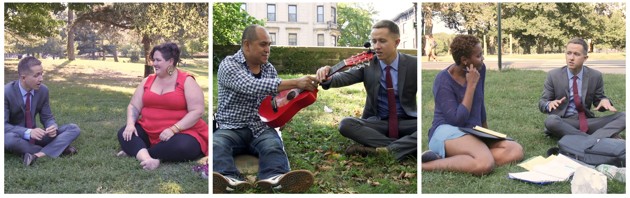
So I didn’t try that one. But I did attempt some others, and you can watch them here in today’s captivating episode of If Our Bodies Could Talk.
One fun behind-the-scenes fact is that I met a guy named Enrique in the park, and he was there practicing on his brand new, red guitar-kelele. (It’s barely larger than a ukelele, and has six strings like a guitar.) We chatted for a while, and I asked if I could play it. He kindly agreed. I played for a long time. I played all of “Stairway to Heaven.” I was sort of testing the waters of his politeness, which were apparently boundless. Anyway, we had to cut this footage because our legal team told us that someone already owns the performance rights to “Stairway to Heaven.”
Stark’s book is a 101 introduction to stranger engagement. It serves primarily to call attention to the profound implications of the art, at times uneasily high-minded for a 100-page primer, as with the opening line “How do you divide the world into known and unknown?”
That is, though, the question at the heart of this practice. Once we consider a person known, our behavior toward them changes entirely. We can emote and commiserate and learn and be ourselves.
When it comes to knowing people, that line is still often drawn at whether you’ve spoken to a person before. If you have, you know them. A significant threshold to be crossed with a simple act.
Michael Fellman - Citizen Sherman (3)
After conquering the CSA, Sherman turned his energies to conquering Indians in the West.
"Disease, slaughter of the buffalo, their economic base, and intrusion of white settlement, together with the extermination of their most warlike younger men, all were serving the eliminate the Indians. The capstone, literally uniting the white surge, was, as Sherman always believed it would be, the railroad." P. 274
"Disease, slaughter of the buffalo, their economic base, and intrusion of white settlement, together with the extermination of their most warlike younger men, all were serving the eliminate the Indians. The capstone, literally uniting the white surge, was, as Sherman always believed it would be, the railroad." P. 274
Subscribe to:
Posts (Atom)