I remember that at the Harry Ransome museum in Austin there was a magic section with prints featuring the history of magic and some of the great historical magicians. I can't remember if there was one of Houdini, but surely there was. He is the most famous magician of all time.
The interesting thing is that some critics say he was not a great magician. Some even say he was not a magician. He was an escape artist, world famous in his time. There is a difference say some magic purists.
Harry Houdini has a cult-like following today. Many magicians have tried to be like Harry. Many followers research his life and Houdini paraphernalia. Many of his cult-like people simply can't get enough of Harry Houdini.
He was born Ehrich Weiss. He claimed he was born in Wisconsin on April 6. Actually he was born on March 24 in Budapest. He renamed himself after the magician Robert-Houdin. Later in life he attacked Houdin unmercifully. Houdini attached everyone he did not like unmercifully.
His early life is seemingly full of facts, mysteries, and fog. The author does not try very hard to separate fact from fiction, which would be hard in this life of this man.
Harry Houdini lied obsessively, though he did not like think of it as lying. Truth and fiction swirled in his mind indistinguishably.
The author has a nice chapter on T. Nelson Downs, the man who is reputed to be the greatest coin magician of all times. He did the greatest coin trick nicknamed "The Miser's Dream" in which he plucked silver dollars out of the air with an empty hand. It helped that according to this book, he could palm 40 silver dollars and make his hand look empty!
The United States Is Being Taught by Facts and Events
In august 1861, several months after the secession of 11 southern states and the outbreak of the Civil War, the abolitionist Frederick Douglass declared that “nations seldom listen to advice from individuals, however reasonable. They are taught less by theories than by facts and events.”
The United States is currently being educated by facts and events. And, as in other times of crisis—war, economic collapse, natural disasters—even those who do not like government are realizing that they need it. Government can protect them; it might save their life and livelihood. Irony will not die in the time of the coronavirus; even many of those who believe the federal government should not intervene in society except for national defense, and would happily privatize most elements of public life, are now straining to have government save society. With this issue, we have a long history.
The times that “try men’s souls,” in Thomas Paine’s phrase, are usually those that test our fundamental ideas and values, or challenge the nations and societies by which we organize ourselves. The coronavirus pandemic is challenging America’s political leaders at all levels, and advocates are pressing them to use their powers in ways that have little recent precedent. It also poses broader questions: What do the people of this republic owe their governments, and what do governments owe their people? For 230 years this has been one of the most significant and fiercely contested questions in our polity. We are now asking it during every waking hour.
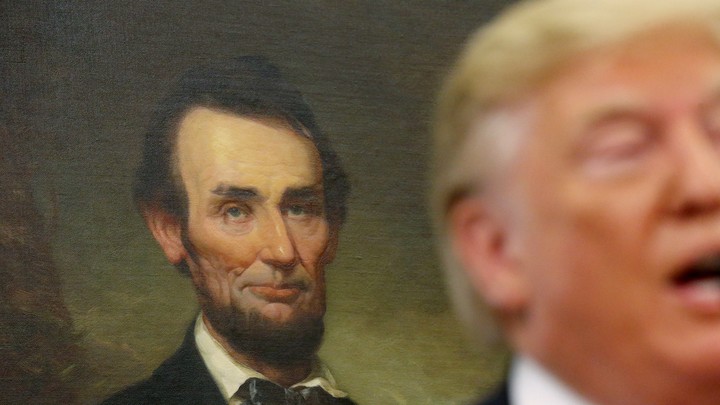
It may seem quaint, but for answers, we could take time to read some history. Some events, usually unanticipated, cause seismic breaks in time. Two such prior crises, when leaders were challenged to preserve and reimagine the America they had inherited, offer particularly relevant lessons. In 1854, the year Abraham Lincoln burst out of political quietude to oppose the expansion of slavery, he said this: “The legitimate object of government is to do for the community of people, whatever they need to have done, but cannot do at all, or cannot so well do for themselves—in their separate and individual capacities.” That Lincoln quote became a favorite of President Franklin D. Roosevelt’s, as he moved toward a bold and experimental use of government to save the American economy in the 1930s.
These greatest of our national crises—the eras of the Civil War and Reconstruction, and of the Great Depression and World War II—are replete with the guidance we now crave. Whatever we call the multitrillion-dollar package about to emerge from Congress—Big Government, emergency relief, stimulus, federal overreach, tyranny—it stems from social “necessity,” a word used ubiquitously in the 1860s and the 1930s. The creation of massive armies, the emancipation of enslaved people, and the energetic imagining of what their freedom would mean—direct aid to people, the creation of public works and jobs, and the mobilization of industry for national ends—all became matters of military or human necessity.
All across the country, Americans are responding to the shock of events, and wondering how this public-health crisis and economic collapse hit so suddenly. And we are once again, as in 1861 and 1933, struggling in fear to understand whether our political institutions, our moral imagination, and our leadership are equipped to respond. In whom and in what do we believe? How should we act in our social isolation? Are our institutions of medicine, public health, education, banking, and politics a match not merely for a virus but for the social collapse that has come with its infection?
Individualism runs extremely deep in the American mind and culture. But it is in our most profound crises that we discover, against the suspicions and beliefs of millions, that government can be our friend, even our savior.
Near the end of the Civil War, President Lincoln admitted: “I claim not to have controlled events, but confess plainly that events have controlled me.” (How we now yearn for that kind of humility from our leaders in high places.) Those leaders who have been forced to answer the question of what governments owe people in existential crises are tested not only on their courage and intellect, but on whether they are capable of the humility necessary to see a “whole,” as the conflict-resolution specialist Donna Hicks writes, where “everyone matters.”
Lincoln was humble, but also firm in his sense of cause, in his utter passion to preserve the Union. He began to capitalize the word Government during the war. “We have, as all will agree, a free Government,” he said, “where every man has a right to be equal with every other man. In this great struggle, this form of Government and every form of human right is endangered if our enemies succeed.”
Douglass and Lincoln started out in quite different places on the question of using federal military might to free African Americans, but by and large, they were on the same page by the summer of 1863. Douglass traveled across the North that year to recruit black men into the Union army under the authority of the Emancipation Proclamation. Early in the war, Douglass had declared that the federal policy of rejecting the enlistment of blacks and the effort to return fugitive slaves to “loyal” owners turned army camps into “slave hunting grounds.” But much had changed. “These were all dark and terrible days for the republic,” he told an audience of potential recruits. “I do not ask you about the dead past. I bring you the living present. Events more mighty than men, eternal Providence, all-wise and all-controlling, have placed us in new relations to the Government and the Government to us.”
Douglass, too, almost always capitalized Government during these years of crisis. And he invoked Shakespeare’s message in Julius Caesar to seize the moment: “There is a tide in the affairs of men, Which taken at the flood, leads on to fortune … We must take the current when it serves, Or lose our ventures.” Emancipation was surely one of those tides in American history. With the Thirteenth Amendment, the federal government used extraordinary power to engage in the largest confiscation of legal private property in all of American history—$3.5 billion worth of human beings. Government proved essential to preserving the Union and ending slavery in America.
During the depression and in the lead-up to World War II, Roosevelt and his New Dealers used extraordinary federal powers to save capitalism and indeed the experiment in democracy known as the United States. Roosevelt’s path to his expansive view of the role of government was a crooked one. As the governor of New York, Roosevelt, who had been born to wealth and educated at elite schools, spoke somewhat vaguely about how government ought to respond to the Depression. But in 1931, he was sure about this much: “Our government is not the master but the creature of the people. The duty of the state towards the citizens is the duty of the servant to its master.” In his acceptance speech for the presidential nomination at the Democratic National Convention in Chicago in July 1932, Roosevelt still proposed rather contradictory policies—cutting government spending and offering relief for the unemployed—but he ended with his famous statement: “I promise you, I pledge myself, to a new deal for the American people.” Those two words—new deal—grew into the identity of an entire era.
In his campaign addresses, Roosevelt began to forge a philosophy of government. In a speech at the Commonwealth Club in San Francisco, Roosevelt contended that the worsening Depression had illuminated an American economy on a new trajectory. “Equality of opportunity as we have known it no longer exists,” the president announced. The economy now steered a course toward “oligarchy,” where all of American industry would soon be dominated by “a dozen corporations and run by perhaps a hundred men.” The nation, he said, needed a “reappraisal of values” and an “economic declaration of rights” for ordinary people.
By 1933, Harry Hopkins, the newly appointed head of the Civil Works Administration, could see the public’s rising expectations of the federal government. Hopkins had just hired 4 million unemployed people for some 400,000 projects, large and small: from road-building, to forest conservation and renewal, to programs that put musicians, actors, and artists back to work. “Clients are assuming that the government has a responsibility to provide,” Hopkins remarked. “The stigma of relief has almost disappeared except among white-collar groups.” Words like civil, public, and especially government had swept into American language while conservative advocates of markets, individual liberty, and business prerogatives stumbled on the defense.
Security quickly became the keyword of the president’s policy agenda. “Among our objectives,” Roosevelt proclaimed, “I place the security of the men, women, and children of the nation first.” Government would now assume responsibility for “decent homes to live in, productive work,” and “security against the hazards and vicissitudes of life.” So much for the American myth of the rugged frontier individualist who could always prevail against the odds.
In a fireside chat in 1935, Roosevelt spoke of a deeper reality: “The old reliance upon the free action of individual wills appears quite inadequate … The intervention of that organized control we call government seems necessary.”
Only activist, interventionist government, Roosevelt and his New Deal team argued, could tame capitalism and raise it from the ashes of its own creation.
Today we live in quite a different moment in the long, turbulent marriage between people and government. Our Social Security checks no longer seem revolutionary, the FDIC stickers on bank doors pass unnoticed. Conservatives warn against nationalizing industrial production, invoking the model of contemporary Venezuela; activists say that the Affordable Care Act is a threat to the rights of states and individuals; and the libertarian businessman Charles Koch claims that “more government means less liberty.” In our current crisis, Congress is trying to find a balance between our oligarchy and the interests of all those dependent upon that “organized control we call government.”
But Americans of all political beliefs now face the same risk of severe illness and hospitalization. Public servants will labor heroically to save them, despite the risks they face themselves. When our governments serve and welcome us, when they protect our civil and political rights, when their laws advance equality of opportunity, when we feel their values and creeds in our hearts, we owe them our allegiance and our civic duty.
Wars worth fighting have to be won. Nazis and terrorists can unify us; so might hunger, or joblessness, or hopelessness, or a scourge like slavery, or defending the right to vote—or a virus. As Harry Hopkins said in 1936, “Work is a moral habit in America.” We have other moral habits that will also sustain us through this crisis, including humility, compassion, and a sense of how the many are much greater than the one. And the many need government.
We want to hear what you think about this article. Submit a letter to the editor or write to letters@theatlantic.com.
DAVID W. BLIGHT is a professor of American history and the director of the Gilder Lehrman Center for the Study of Slavery, Resistance, and Abolition at Yale University. He is the author, most recently, of Frederick Douglass: Prophet of Freedom.

