Sunday, July 19, 2015

Watching the Watchman


Harper Lee's 'Watchmen' Infused With Religious Symbolism

Author Harper Lee.
(RNS) Harper Lee’s “new” book “Go Set a Watchman” is infused with religious life and Christian moral argument, from its title to its final words.
It’s also a book with splashes of humor, enough Victorian poetry references to send readers scrambling for a Norton Anthology, and Bible allusions as the narrator of both novels, Jean Louise “Scout” Finch, grows up to own her own life.
Examples (spoiler alert!) range from small moments to an epic showdown over race, justice and sin in which Scout’s father, the saintly Atticus Finch of Lee’s “To Kill a Mockingbird,” is revealed, as David Gushee writes, as a “polite racist.”
The book starts out lightly. When Jean Louise’s longtime suitor proposes, there’s the lingo of Genesis. “I, like Israel of Old, have labored seven years in the vineyards of the University and the pastures of your father’s office for you,” says Henry “Hank” Clinton.
Unlike Jacob (Israel), however, Hank doesn’t get the wrong bride (Leah) or labor seven years more for his true love (Rachel). Jean Louise was counseled by her aunt, who thinks Hank came from poor white trash, to marry her own “kind.” In this book, “kind” isn’t just about class or race.
The ritual of baptism comes to life in a childhood flashback, as Jean Louise recalls the re-enactment of a tent revival played out with her brother, Jem, and sidekick, Dill.
In “Watchman,” Jem is an unseen memory. (He died in his 20s.)
In the just-released book, young Jem delivers a sermon on the devil in the Maycomb, Ala., setting for the novel. The kids have a fine time until Scout and Dill fall to battling between a Methodist “sprinkle” and a Baptist “immersion” in a murky pond. Who is truly living a Christian life, a moral life, is the question just under the surface.
Anyone who has endured a fracas over music at worship will appreciate the Methodist church scene of outrage in the pews when the congregation’s music director, fresh from summer music camp, tries to “pep up” the organ music and abandon familiar “Southern hymns.”
Only later does the fear of losing the Southern way — rigid segregation —  become clear as the crisis point of the novel, the reason that Atticus and Hank tolerate the Ku Klux Klan and participate in the white “Citizens’ Council.”
In “Mockingbird,” the childlike, reclusive but harmless neighbor Boo Radley is allowed to return to his “place” after his timely rescue of little Scout and her brother. In “Watchman,” there’s a cruel flip side to this seemingly Christian kindness. Atticus wants all people he sees as “childlike” — including all black people — overseen by the paternal wisdom of white society.
Jean Louise, who believes herself colorblind, is shocked to the core, certain she has been betrayed by the father she once idolized. The book’s final chapters are a dense legal, moral and psychological showdown as the young adult Jean Louise fights with her father over truth and equality.
In “Mockingbird” he’s the voice of racial justice, battling for an innocent black man accused of rape — the central conflict of the novel and the film, in which he’s portrayed by Gregory Peck. In “Watchman” Atticus is still interested in justice, but views black people as inferior and unfit to govern their own lives.
“(H)ave you ever considered that you can’t have a set of backward people living among people advanced in one kind of civilization and have a social Arcadia?” he asks.
She battles back, aligning herself with religious truth:
“You are telling them that Jesus loves them, but not much. You are using frightful means to justify ends that you think are for the good of most people. … You just try to kill their souls instead of their bodies. You just try to tell ‘em, ‘Look, be good. Behave yourselves. If you are good and mind us, you can get a lot out of life, but if you don’t mind us, we’ll give you nothing and take away what we’ve already given you.’”
Lee chose her title from Isaiah 21:6: “For thus hath the Lord said unto me, Go, set a watchman, let him declare what he seeth.”
Who is the watchman?
Atticus’ brother, Uncle Jack, brings it home: “Every man’s island, Jean Louise, every man’s watchman, is his conscience.”
If Atticus was the moral spine of “Mockingbird,” in “Watchman” that spine is Jean Louise, stepping out of the murky pond of childhood to claim her own, Bible-steeped moral identity.

Where Monster Trump Came From


How did this monster get created? The decades of GOP lies that brought us Donald Trump, Republican front-runner

Donald Trump did not happen overnight. He's the product of a dangerous, cynical GOP strategy that dates back years

How did this monster get created? The decades of GOP lies that brought us Donald Trump, Republican front-runnerRepublican presidential candidate Donald Trump speaks at FreedomFest, in Las Vegas. (Credit: AP)
How did America get to such a place that someone like Donald Trump can command a lead in the Republican primaries? Trump is the product of a deliberate Republican strategy, adopted by Richard Nixon’s people in 1968, to attract voters with an apocalyptic redemption story rather than reasoned argument.  It has taken almost 50 years, but we have finally arrived at the culmination of postmodern politics in which Republican leaders use words to create their own reality.
After World War II, President Dwight Eisenhower and men like New York Gov. Nelson Rockefeller led the Republican Party with policies based in reasoned argument. They used the government to regulate the economy and to promote social welfare, much as Democrats did, although with a philosophy that emphasized social unity rather than class conflict. The policies of these “Me Too” Republicans infuriated Movement Conservatives on the far right, who insisted that all government activism was communism. In 1964, Movement Conservative spokesman Arizona Sen. Barry Goldwater won the Republican nomination when Rockefeller’s womanizing spectacularly imploded his candidacy. Movement Conservatives used their hero’s nomination to advance a new kind of politics.
America’s moderate consensus was enormously popular, but Phyllis Schlafly, the president of the Illinois Federation of Republican Women, flat-out denied that reality. In her famous book “A Choice Not an Echo,” she insisted that studies showing that voters opposed Goldwater’s extremism were part of a “propaganda machine” that used fake polls, radio and newspapers to destroy anyone but the chosen candidates of an elite cabal. She explained that all government activism outside of military buildup was a conspiracy to bankrupt regular Americans. Financiers and banking interests fed off expensive policies pushed by an educated Eastern elite, and together these men were dragging America into the web of communism.
The world was really quite simple, Schlafly insisted, and it could be understood without any fancy education. It was divided in two, black and white, Communism and Freedom. Eggheads complained that Goldwater “had one-sentence solutions” for complicated problems, she wrote, but simple solutions were the answer. What should America do about communism? Stop it! The very fact that establishment Republicans opposed Goldwater’s nomination proved that he was the right man for the job. He was the “grass roots” candidate, the candidate for the little guy who voted his principles, not because he wanted a payoff.
Goldwater’s candidacy crashed and burned, leaving Republicans in trouble in 1968. To candidate Richard Nixon was left the task of pulling together mainstream Eisenhower Republicans and upstart Movement Conservatives. How could his team attract support for an unlikable candidate who needed to bridge a fundamental ideological gulf? Nixon’s handlers used new media to play to Schlafly’s script. They ignored people’s brains and went for their guts.
“Voters are basically lazy,” one Nixon media adviser wrote. “Reason requires a high degree of discipline, of concentration; impression is easier. Reason pushes the viewer back, it assaults him, it demands that he agree or disagree; impression can envelop him, invite him in, without making an intellectual demand…. When we argue with him, we… seek to engage his intellect…. The emotions are more easily roused, closer to the surface, more malleable….” Nixon’s people hired advertising executive Harry Treleaven, who believed the new medium of television had changed the nature of politics. For him, politicians were no longer policy wonks; they were actors with a narrative.
Under Treleaven, Nixon’s people ignored policy positions and instead used television to create a candidate with a simple message: America was on the brink of disaster, and only Nixon could save it. They hired a brilliant young photographer to put together a series of television ads from stock photographs strung together to create a sense of doom; at the end a voice intoned “Nixon” over an iconic image of the nation. At the end of every ad ran the words: “Vote like your whole world depended on it.”
The campaign also hired a young television producer named Roger Ailes to stage “town hall” events for the candidate. Ailes hand-picked “regular” people to question Nixon in carefully managed shows from which the press was excluded. Ailes arranged applause, the set, Nixon’s answers, the camera angles, the crowd cheering the candidate, the careful shading of Nixon’s makeup. “Let’s face it,” he said. “A lot of people think Nixon is dull. Think he’s a bore, a pain in the ass.” But carefully managed television could “make them forget all that.”
It did. And so, after 1968, Republicans increasingly relied on their apocalyptic redemption story. America was in terrible trouble, because grasping minorities, women and workers wanted government policies that would suck tax dollars from hardworking white people. Democrats backed those policies because they would do anything to buy votes. It was up to Republicans to restore America to its former glory. In a time of dramatic economic and social upheaval, this story reassured voters left behind in the new conditions that the answers to their problems were simple, and that coming up with those answers required no great education or thought. It simply required the right principles.
ADVERTISEMENT
The Movement Conservative story was never based in reality. Facts repeatedly gave way to the narrative that America was on the ropes because of Democratic social welfare policies that sucked tax dollars and threatened the nation’s safety. Ronald Reagan’s Welfare Queen represented the misuse of tax dollars for lazy African-Americans, for example, but he also incorrectly insisted that President Carter had slashed the nation’s military budget, and warned in his inaugural address that the nation was in a crisis that rivaled the Great Depression, a crisis created by government activism.
To avoid niggling fact-checkers, in 1987, President Reagan’s FCC abandoned the Fairness Doctrine, a decision that meant that public broadcasters were no longer required to provide their audience with opposing viewpoints. Within a year, talk radio had taken off, with hosts like Rush Limbaugh hammering home the vision of a nation gone to ruin, awaiting redemption from the latest Movement Conservative candidate. In 1992, Limbaugh began to broadcast a television show, produced by Roger Ailes, to take the story to viewers. By 1994, the show was carried by 225 television stations. Two years later, Ailes would become the CEO of a new media channel, Fox News, which used the same formula—albeit updated—that Ailes had used to package Nixon’s story almost 30 years before.
By the time of the George W. Bush administration, the Movement Conservatives had erased the line between image and reality. In 2004, a senior adviser to Bush famously dismissed “the reality-based community” to journalist Ron Suskind. Gone were the days when politicians could find solutions based on their observations of the careful study of discernible reality. “That’s not the way the world really works anymore…. When we act, we create our own reality…. We’re history’s actors… and you, all of you, will be left to just study what we do,” he said.
This disregard for fact in favor of narrative appears to have become so accepted in the Republican Party that it is now openly driving Republican presidential candidates. Trump’s celebrity candidacy follows the formula. According to him, America is in free fall, with GDP below zero, unemployment at 18-20 percent, and the country overrun by minorities—his venom reserved primarily for Mexicans who, he says, are drug dealers, criminals and rapists.
ADVERTISEMENT
“Our enemies are getting stronger and stronger by the day and we as a country are getting weaker.” Politicians can’t “make America great again” because they are “controlled fully by the lobbyists, by the donors, and by the special interests.” Trump promises to be a “great leader” who has simple answers: He will bring back jobs, make sure Iran doesn’t get nuclear weapons, reduce the debt, in short, find a way to do everything fast and well. “Sadly,” he says, “the American dream is dead. But if I get elected president I will bring it back bigger and better and stronger than ever before.”
Trump is the most cartoonish of the Republican candidates, but he is far from being the only one to bend reality to image. Wisconsin Gov. Scott Walker told a group of Republican donors that British Prime Minister David Cameron had said he had no faith in President Obama’s leadership, a claim Cameron categorically denied. Louisiana Gov. Bobby Jindal insists he has slashed spending 26 percent, a claim professor Robert Mann has eviscerated. Journalist Tom Moran at the Newark Star-Ledger says simply of New Jersey Gov. Chris Christie, “he lies.”
Perhaps most disturbing is that Kentucky Sen. Rand Paul, Scott Walker and surgeon Ben Carson, Republican candidates all, have taken to attributing false quotations to the Founding Fathers. They deny the reality of America’s founding principles and claim instead that America was conceived in the image that they have constructed, the same image that has given us Donald Trump as a leading candidate for the presidency.
Heather Cox Richardson is the author of "To Make Men Free: A History of the Republican Party," amongst several other books, and a professor of history at Boston College.

Thursday, July 16, 2015

AU Leads State in Graduation Raite

Graduation rankings from first to worst for Alabama's 14 public universities: Wake Up Call

UAB graduation.JPG
Which Alabama colleges have the highest percentage of graduates?
Leada Gore | lgore@al.comBy Leada Gore | lgore@al.com 
Email the author | Follow on Twitter
on July 16, 2015 at 6:03 AM, updated July 16, 2015 at 7:23 AM
Reddit
Before too long, students all over the state head back to college. But how many of those who start at a university actually finish?
We're looking at that in today's Wake Up Call.
Nationally, about 55 percent of first-time undergraduates who began school in the fall of 2008 finished a degree within six years. In Alabama, 50 percent finished their degree within six years, but only 26 percent earned their diploma in four.
So where do Alabama's universities rate? Here's the list of public university graduation rates based on students who complete a degree in six years (I know parents - We'd all like four years, but we will give them a break.)
The information covers the 2013 school year and comes from The Chronicle of Higher Education:
  1. Auburn University – 67.9 percent
  2. University of Alabama – 66.7 percent
  3. University of Alabama at Birmingham – 53.5 percent
  4. University of Alabama at Huntsville - 48.4 percent
  5. University of Montevallo – 44.9 percent
  6. Troy University – 35.5 percent
  7. University of South Alabama – 33.2 percent
  8. University of North Alabama – 32.2 percent
  9. Jacksonville State University – 30.8 percent
  10. University of West Alabama – 29.8 percent
  11. Alabama A&M University – 29.1 percent
  12. Auburn University at Montgomery – 27.1 percent
  13. Alabama State University – 25.2 percent

What's Next? Waiving Nooses?

It’s heritage, all right: What those ugly anti-Obama Confederate flag protests really mean

As Confederate flag defenders spread beyond the old Confederacy, the banner becomes a national symbol of racism

 
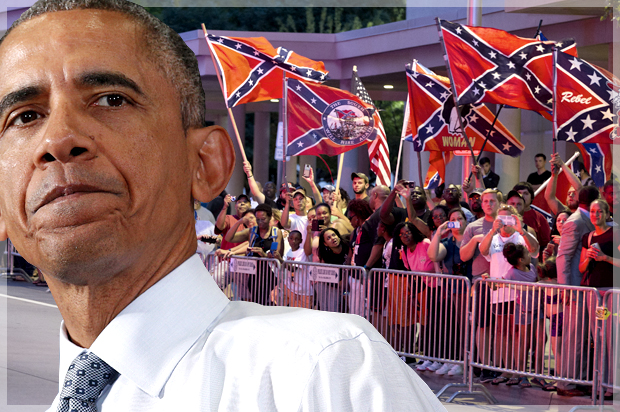
It’s heritage, all right: What those ugly anti-Obama Confederate flag protests really meanBarack Obama; Confederate flags outside his hotel, July 15, 2015, in Oklahoma City. (Credit: Reuters/Kevin Lamarque/AP/Evan Vucci/Photo montage by Salon)
The notion that the Confederate flag is merely a symbol of Southern “heritage,” detached from slavery and Jim Crow, has always been a pernicious lie. It shouldn’t have taken the murder of the Emanuel Nine, by flag-waving white supremacist Dylann Roof, to make that the new national consensus. But it did.
Now the flag’s racist meaning is crystal clear, which is why it’s becoming an ever more beloved symbol for racist morons, even outside the old Confederacy. The ugly Confederate flag tableau that greeted President Obama in Oklahoma City Wednesday night illuminated this new reality. It follows a similar protest earlier this month, when the president visited Nashville, Tenn. Over in Durant, Okla., where the president was scheduled to speak, there was also a Confederate flag protest earlier in the day.
When I first saw reports that some jerks were planning to wave the flag along the president’s motorcade route on social media Wednesday, I admit I shrugged: Another day, another angry right-wing tantrum. It’s OK, they’re losing; let them scream and rant and wave their hate banner. But the sight of the bright flags illuminated against the dark sky, just outside of Obama’s hotel, was unexpectedly vivid and disturbing. Especially since Oklahoma was never part of the Confederacy.
It reminded me of the October 2013 rally attended by Sen. Ted Cruz and Sarah Palin, to protest the closing of national monuments during the Cruz-triggered government shutdown. That protest culminated in an angry rump group heading over to the White House and waving a Confederate flag, outside the home of the black First Family. But hey, it’s “heritage, not hate.”
I’m not sure what to do with the fact that the Oklahoma City flag protest was reportedly led by a black wingnut, Andrew Duncomb, whose Facebook page features lots of smiling, flag-loving white people. (The rest of the folks insulting Obama with the flag were white, according to local news reports.) Duncomb, who calls himself “the black rebel,” is making a career out of claiming the flag really was about “heritage, not hate.” He led a pro-flag protest through the Oklahoma City metro areaon Monday, joined by 30 trucks waving the flag.
According to local news reports, Duncomb was arrested last year, with four white friends, on charges of shooting at a sheriff’s deputy. Using his Facebook identity to post in a comment thread, Duncomb suggested the news reports “stretched” the truth, but didn’t deny it.  I found no reporting on what became of the case. “Look at these people, they all followed the black guy out here,” Duncomb told local media Wednesday night. “Do you think that any of them are racists?”  It’s hard not to think of Dave Chappelle’s famous character Clayton Bigsby, the blind KKK member who doesn’t know that he’s black. They sure do love him over at Red Nation Rising.
ADVERTISEMENT
The African Americans who showed up to support the president weren’t buying Duncomb’s claim that the flag is about “heritage, not hate,” or that it wasn’t meant as a racist insult to our first black president. A black woman wearing on Obama T-shirt broke into tears telling Politico: “He should’ve had a better welcome than he had.”
That flag is and always has been a symbol of white supremacy, a symbol of treason, and a repudiation of the multiracial democracy the Civil War helped establish. But I have to admit: the people who say the flag is about “heritage” are actually half right. It’s about heritage, all right – a heritage of hate. Increasingly it’s a symbol of our national racist heritage, which we must admit is shared by the north and the south.
But I confess I’m rattled as the flag becomes a common sight where Obama visits. What’s next: waving nooses?