I'm just shy of 40 years-old. I spend most Saturday nights at home
in yoga pants, rereading favorite novels or watching old movies, or
playing Monopoly
Junior with my seven-year-old. (If you think Monopoly is boring,
then you haven't tried Monopoly Junior.)
This way of spending my Saturday nights
makes me happy. If you went back and
told my cooler 20-year-old self about the typical evening that awaits
the future her, though, she would
be pretty devastated that her life turns out to be so ... boring.
That a Saturday night spent reading a book -- not even a new
book -- qualifies as a great time.
"What the hell happens to me?" she would wonder. A lot of people
feel that way to some extent when we look back at our younger selves and
realize how much we've
changed. The answer, of course, is that we all grow up -- and for
many of us, what it means to be "happy" slowly evolves into something
completely
different.
Happiness becomes less the high-energy, totally-psyched
experience of a teenager partying while his parents are out of town, and
more the peaceful, relaxing experience of an overworked mom who's
been dreaming of that hot bath all day. The latter isn't less "happy"
than the former -- it's a different way of understanding what happiness
is.
Social psychologists describe this change as a consequence of a
gradual shifting from promotion motivation -- seeing our
goals in terms of what we can gain, or how we can end up better off, to
prevention motivation -- seeing our goals in terms of avoiding loss and
keeping things running smoothly. Everyone, of course, has both
motivations. But the relative amounts of each differ from person to
person, and can shift with experience as we age.
Research from Northwestern University in the journal Psychology and Agingsuggests that
promotion-mindedness is most prevalent among the young, because youth
is a time for focusing on your hopes for the future, what you ideally
want to do -- you don't have much in the way of responsibilities, and
you still believe you can do anything you set your mind to. That and
you think you are immortal. This is more or less a recipe for strong
promotion motivation.
As we get older, illusions of immortality vanish. There is a
mortgage that needs to be paid, a home that must be maintained, and
children to be cared for. (Speaking of children, new mothers are an
especially prevention-minded group. They have the daunting task of
somehow protecting a completely
vulnerable, clueless, yet hell-bent-on-exploration infant from a
world filled with germs, stairs, pointy objects, and electrical outlets.
New motherhood is
mostly about ceaseless vigilance.)
The older we get, the more we want to hang on to what we've already
got -- the things we've worked so hard to achieve. We also have more
experience with
pain and loss, having been knocked around a bit by life, and having
learned a few lessons the hard way.
In a recent set of studies, psychologists Cassie Mogliner, Sepandar
Kamvar, and Jennifer Aaker looked for evidence of how our sense of
happiness changes
with age by analyzing twelve million personal blogs. Specifically,
they were interested in seeing what kinds of emotions the bloggers
mentioned when they
talked about feeling "happy."
They found that younger bloggers described experiences of happiness as being times when they felt excited, ecstatic, or elated
-- they way
you feel when you are anticipating the joys the future will bring -
like finding love, getting ahead at work, or moving to a new town.
Older bloggers were more inclined to describe happy experiences as moments of feeling peaceful, relaxed, calm, or relieved
- they way you
feel when you are getting along with your spouse, staying healthy,
and able to make your mortgage payments. This kind of happiness is less
about what lies
ahead, and more about being content in your current circumstances.
(You can see these age-related differences in motivation very much reflected in the workplace,
where older workers have more prevention-motivated concerns - like job
security and flexible work schedules, while people under thirty have
more promotion concerns -- like opportunities to develop skills.)
If you're like me, and you find that your life has become more about
pursuing peace and relaxation than giddy excitement, rest assured that
you aren't
missing out on happiness. Your happiness has evolved, just as you
have. Even though our version seems less fun by the standards of our
younger selves, that doesn't mean
it's less good.
After World War II, psychiatry came into its own, balancing talk therapy with hard science.Credit Getty Images/SuperStock
One of the most miserable experiences of my young adulthood, in the mid-1980s, was the year I spent in formal Freudian psychoanalysis. How well I remember lying on that uncomfortable couch with its built-in simulacrum of a pillow, as I struggled desperately to just “let my mind go,” to free associate, to disinter childhood memories or impulses that might prove remotely useful to me or at least satisfy my psychiatrist, who often seemed to be picking distractedly at lint on her skirt. She was a brilliant woman, no doubt about it, yet I always left her office feeling like a failure, and the science writer in me couldn’t help wondering, Where is the clinical evidence that this excruciating and expensive ordeal really works?
As Jeffrey A. Lieberman, chairman of psychiatry at the Columbia University College of Physicians and Surgeons, makes clear in his chatty, expert, sometimes scathing but ultimately upbeat account of the history of psychiatry, the evidence, quite simply, doesn’t exist. Whether for the treatment of relatively mild afflictions like my dysthymia, or for serious conditions like bipolar disorder, schizophrenia or depression, psychoanalysis never had much, if any proof of efficacy. Yet the Freudian conceit that repressed desires and conflicts were the source of mental illness, and that talking those urges out of hiding could lead to a cure, dominated American psychiatry for over half a century, Lieberman says, stranding the field in “an intellectual desert” from which it has only recently emerged. “Sigmund Shlomo Freud,” Lieberman writes, was “simultaneously psychiatry’s greatest hero and its most calamitous rogue.”
Lieberman recognizes that many people remain skeptical about his specialty and uncomfortable with the notion of mental illness generally. It’s one thing for somebody to suffer from a malfunctioning of the body’s infrastructure, like thyroid disease or appendicitis. But mental illness targets the mind, the seat of the self, and its symptoms are often disguised as personal defects — laziness, weakness, a bad attitude. Lieberman tells the story of an unidentified celebrity and his wife, who brought their Yale-student daughter to him for advice. The daughter had been behaving erratically, skipping classes, accusing her sorority sisters of theft, insisting to a professor that James Joyce was speaking to her in code. After a lengthy interview and a series of medical tests and scans to rule out alternatives, Lieberman concluded that the daughter suffered from schizophrenia and recommended she be hospitalized for her initial treatment. The famous father was indignant, insisting, “She doesn’t need to be locked up in a hospital, for God’s sake. She just needs to buckle down and get her act together!” Despite parental balking, the daughter spent three weeks in the hospital, where she was prescribed the antipsychotic drug risperidone along with cognitive and group therapy sessions, and her condition improved dramatically. Yet after her release, Lieberman said, her parents’ skepticism again took hold, the daughter received no further outpatient treatment and she very likely relapsed into psychosis.
One in four people will suffer from mental illness at some point in life. “You are more likely to need services from psychiatry than from any other medical specialty,” Lieberman notes. And those services are ready and able. “For the first time in its long and notorious history,” he adds, “psychiatry can offer scientific, humane and effective treatments” to combat most mental disorders. If public wariness persists, Lieberman says, perhaps psychiatry itself is to blame — for not coming clean about the sins of its past, and for failing to elucidate how the profession has changed.
In “Shrinks,” he takes on both tasks. He describes psychiatry’s inglorious beginnings as “the stepchild of medicine.” By the 19th century, researchers could distinguish between neurological disorders with obvious physical causes that were visible on autopsy, like the blockages behind strokes, or the clumping proteins in the brains of the demented; and mental illnesses, which left no obvious mark on the brain. Neurologists claimed as their turf the palpable brain pathologies and were accorded the same respect given to cardiologists, gastroenterologists or any other medical specialist. Psychiatrists traded in the invisible realm of mental illness, with no concrete tools or assays to validate a diagnosis, and no treatments to offer besides. For much of psychiatry’s history, nothing could be done for severely disturbed patients but warehouse them in remote asylums, which were located at such a remove from other hospitals that the presiding psychiatrists were nicknamed alienists. Psychiatrists were often considered the Western version of shamans or witch doctors, from which another professional epithet likely arose: shrinks, a shortening of the headshrinkers often lumped together with other tribalist figurines.
The ineffable nature of mental illness also proved fertile aeroponics for quacks, hucksters and would-be do-gooders who did terrible things. Among them was Wilhelm Reich, the Austrian psychiatrist active in the early- to mid-20th century, who attributed mental illness to the constriction of hidden energy currents that he called orgones and prescribed as treatment that patients strip down to their underwear, dangle a rubber hose around their neck and squeeze into one of Reich’s closet-size “orgone accumulators.” Then there was Walter Freeman, everybody’s favorite medical monster, who “performed ice-pick lobotomies on no fewer than 2,500 patients in 23 states by the time of his death in 1972.” Lieberman describes meeting a lobotomized patient during his medical training and being struck by the man’s robotic voice and “lifeless and blank” eyes.
Lieberman recounts the noble if often futile efforts of some of his predecessors to find reliable biomarkers for mental illness. In 1968, for example, researchers using the new technique of chromatography excitedly announced that the urine of schizophrenic patients left a distinctive “mauve spot” on blotting paper not seen in the urine tests of healthy people. The triumph was short-lived; other researchers soon traced the rosy spotting to the drugs the patients were taking rather than to any metabolic signature of the illness itself. Nevertheless, the struggle to put psychiatry on a firmer and more scientific footing was essential, Lieberman says, and here is where Freud led us astray.
Freud knew he lacked evidence for many of his “daring ideas about mental illness,” Lieberman says. Yet rather than conducting research to fill in the gaps, he instead began attacking anybody who questioned him. “He demanded complete loyalty to his theory, and insisted that his disciples follow his clinical techniques without deviation,” Lieberman argues, thereby “fossilizing a promising and dynamic scientific theory into a petrified religion.”
Lieberman hails the advent of the Diagnostic and Statistical Manual of Mental Disorders, the “bible of psychiatry” that describes in symptomatic detail all mental illnesses currently recognized by its publisher, the American Psychiatric Association, and therefore billable for insurance purposes. He recounts, at rather too much length, the infighting that erupted over different editions of the manual, including the latest version, published during his tenure as president of the A.P.A., but he makes a convincing case that its format has given the field a precision and reliability it lacked in the past. Psychiatrists have also taken advantage of new imaging technology to scan the brains of living patients, tracking subtle differences between the well and the ill that may not be obvious post-mortem.
Ultimately, though, the real secret to psychiatry’s success is drugs. One by one, the most devastating and formerly intractable mental diseases were tamed, if not completely routed, by pharmaceuticals: chlorpromazine for schizophrenia, lithium for bipolar disease, imipramine for depression. Lieberman describes the serendipity behind each spectacular discovery. He glides over the very real problem of side effects, and the fact that psychiatric drugs don’t always work or stop working over time. Still, for all the hand-wringing in some quarters that we are an overmedicated society, psychiatric drugs give patients what no rubber hose or hectoring daddy can: peace of mind, a piece of sky, a life.
SHRINKS
The Untold Story of Psychiatry
By Jeffrey A. Lieberman with Ogi Ogas
Illustrated. 342 pp. Little, Brown & Company. $28.
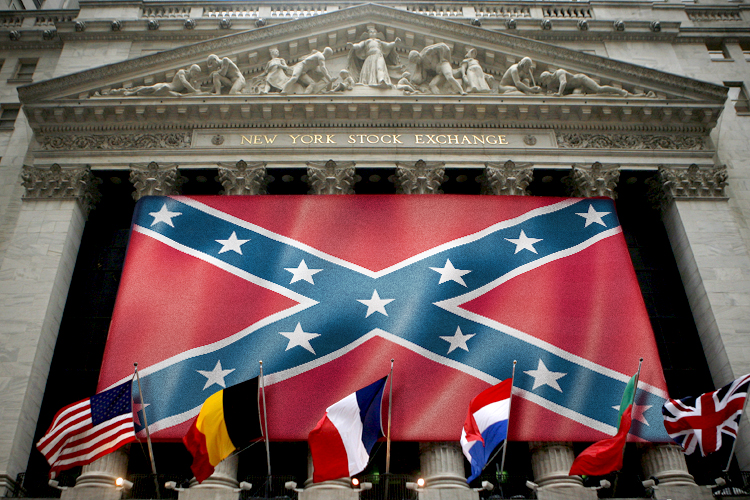
(Credit: Reuters/Eric Thayer/photo collage by Salon)
As my colleague Paul Campos noted earlier this week,
the Supreme Court will hand down a ruling later this year on whether a
state can stop its citizens from purchasing specialty license plates
featuring the Confederate flag. The case is a complex and interesting
one that raises all sorts of questions about free speech. But while the
court has been grappling with the limits and mandates of the First
Amendment, the outside world has been engaged in a different, less
esoteric discussion.
It’s one
that’s popped up time and again throughout American history, and will
undoubtedly continue to rears its head — at least so long as “Sweet Home
Alabama” is a staple of classic rock radio. What, really, is the
meaning of the Confederate flag? Is it simply a sign of Southern
heritage, as former Rep. Ben Jones argued recently? Or is it a symbol of “treason in the defense of slavery,” as Campos writes?
Seeking
answers, Salon recently spoke over the phone with James McPherson, the
celebrated historian of American history and author of the classic “Battle Cry of Freedom: The Civil War Era” and this year’s “The War That Forged a Nation: Why the Civil War Still Matters.”
We discussed the creation of the flag, the way its meaning changed
throughout U.S. history, and how Confederate leaders might feel about
its continued prevalence today. Our conversation has been edited for
clarity and length and can be found below.
Most
schoolchildren are taught the story (or myth) of Betsy Ross and the
creation of the U.S. flag. Is there a story behind the Confederate flag,
too?
Well, we know who designed the Confederate battle
flag, which is the one you’re talking about; the St. Andrew’s Cross, red
background and blue cross with the white stars on it. That’s actually
not the Confederate national flag, although it appeared as part of the
third and fourth Confederate national flags.
The
original Confederate national flag had three broad bars, a red bar, a
white bar and red bar, and then the blue field with initially seven
stars on it to represent the first seven confederate states that
seceded. And then when four more went out after the firing on Fort
Sumter, there were 11 stars on it, and eventually 13 because both
Kentucky and Missouri had “rump” confederate governments and were
admitted to the Confederate Congress.
So why did they create a separate battle flag?
At
the first battle of Bull Run or Manassas that Confederate national
flag, which is the one that gets called the “Stars and Bars,” on a calm
day with no wind to stretch it out, looked very much like the American
flag. The American flag, of course, had 13 red and white strips and a
blue field with stars in it. The Confederate flag had three bars, red,
white, red and a blue field with stars on it. So Gen. Pierre G. T.
Beauregard decided that he needed to design a different national flag so
that it would be distinguished from the American flag. There was so
much confusion about which flag was which at the first battle of Bull
Run.
So he came up with a design for the Confederate battle flag,
the red background and the blue St. Andrew’s cross with the stars in it.
That’s documented. There’s no mythology about the creation of the
Confederate battle flag. Subsequently the Confederate national flag was
changed into first a white background with a blue and red field in the
upper left hand corner, with the stars on it. It went through a couple
more evolutions, but the flag that has come down to us as the
Confederate flag is really the battle flag, and it was carried as the
battle flag in the Army of Northern Virginia but not necessarily in the
other Confederate armies. There were a variety of battle flags in other
Confederate armies.
Did the Stars and Bars’
transformation from being the flag for the Army of Northern Virginia to a
symbol intended to represent the entire Confederacy happen quickly,
once Reconstruction ended? Or was it a gradual process from then to now?
It
gradually took on a representative quality. I would say by the 1890s,
maybe even in the 1880s, when Confederate monuments started going up …
that battle flag took on this representative character. I think ever
since the 1890s it has represented the Confederacy.
And
did people back then see it as representing something apart from
slavery, as the flag’s defenders do today? Or were they more comfortable
asserting that it was a symbol of white supremacy?
Initially,
it was associated with Confederate heritage. But it’s come to be
associated in the last 60 or 70 years as much with white supremacy and
resistance to the civil rights movement.
In the 1940s … that
Confederate flag came to represent white supremacy as a form of defense
against the beginnings of the civil rights movement. It became the
symbol of the Dixiecrat Party in 1948 — which, as you know, seceded from
the Democratic Party because of the civil rights plank that Humbert
Humphrey got inserted in the Democratic Party’s platform in 1948. I
think ever since then it’s become a symbol of white supremacy.
In
the minds of many it continues to be associated with Confederate
heritage — but as Confederate heritage itself has become increasingly
associated with slavery (which was the essential reason for the
Confederacy in the first place) the Confederate flag is now symbolic of
both slavery and white supremacy and of the relationship between the two
of them. Would Jefferson Davis be surprised by the
symbolic power the flag’s come to hold? I would imagine that, at the
time, he had bigger things on his mind.
I don’t think
Jefferson Davis would have been surprised. I think some other prominent
Confederates, maybe Robert E. Lee, would be surprised by the important
symbolism it’s taken on.
Davis himself was unreconstructed, never
took the oath of allegiance to the United States. He said he didn’t want
a pardon because he hadn’t done anything wrong. He continued to be a
spokesman for the Confederacy having been right even though [it was]
defeated. To the extent that the Confederate flag has not become a
symbol for much of what the Confederacy stood for, I don’t think he
would be surprised and I don’t think he would be concerned about it.
There's a lot of stuff online this week about Ted Cruz. I have decided not to "read up" on him. Maybe if he gets the Republican nomination, but not till then. Until then he's not worth my time.
Ted Cruz says, “In both law and
politics, I think the essential battle is the meta-battle of framing the
narrative.” From his reading of Sun Tzu he has learned that a battle is
won by “choosing the terrain on which it will be fought.”Credit Photograph by Pari Dukovic
Ted
Cruz, the Republican junior senator from Texas, has heard the line
about how the Party needs to become more moderate to win Presidential
elections. “It is amazing that the wisdom of the chattering class to the
Republicans is always, always, always ‘Surrender your principles and
agree with the Democrats,’ ” he told me. “That’s been true for my entire
lifetime. The chattering classes have consistently said, ‘You crazy
Republicans have to give up on what you believe and become more like
Democrats.’ And, I would note, every time Republicans do that we lose.”
Cruz then offered a short history of recent Presidential politics.
Richard Nixon ran as a conservative, twice a winner; Gerald Ford,
moderate, loser; Ronald Reagan, also twice a winner. “President George
Herbert Walker Bush ran as a strong conservative, ran to continue the
third term of Ronald Reagan, continue the Ronald Reagan revolution,”
Cruz went on. “Then he raised taxes and in ’92 ran as an establishment
moderate—same candidate, two very different campaigns. First one won,
second one lost. In 1996, you got Bob Dole; 2000 and 2004, you have
George W. Bush; 2008, John McCain; 2012, Mitt Romney. And what does the
entire D.C. Republican consulting class say? ‘In 2016, we need another
establishment moderate!’ Hasn’t worked in four decades. ‘But next time
will be the time!’ ”
As the midterm elections
grow closer, with the Presidential race to follow, the Republican Party
is still split roughly along the historical lines that Cruz described.
On the issues, the differences between the two wings appear modest, but
the temperamental, even geographic, distinctions are profound.
Establishment Republicans, based in Washington, remain at some level
committed to uphold rudimentary operations of government and at least
talk about broadening the Party’s appeal. Ardent conservatives,
including those in the Tea Party movement, regard the Capitol as a
cesspool of corruption, and they see compromise as betrayal. The outcome
of this struggle is uncertain, as illustrated by the varying political
fortunes of two leading establishment figures. Mitch McConnell, the
Republican leader in the Senate, easily survived a primary challenge in
Kentucky, but Eric Cantor, the Party’s leader in the House, went down to
a humiliating defeat in his primary in Virginia.
Cruz’s
ascendancy reflects the dilemma of the modern Republican Party, because
his popularity within the Party is based largely on an act that was
reviled in the broader national community. Last fall, Cruz’s strident
opposition to Obamacare led in a significant way to the shutdown of the
federal government. “It was not a productive enterprise,” John McCain
told me. “We needed sixty-seven votes in the Senate to stop Obamacare,
and we didn’t have it. It was a fool’s errand, and it hurt the
Republican Party and it hurt my state. I think Ted has learned his
lesson.” But Cruz has learned no such lesson. As he travels the country,
he has hardened his positions, delighting the base of his party but
moving farther from the positions of most Americans on most issues. He
denies the existence of man-made climate change, opposes comprehensive
immigration reform, rejects marriage equality, and, of course, demands
the repeal of “every blessed word of Obamacare.” (Cruz gets his own
health-care coverage from Goldman Sachs, where his wife is a
vice-president.) Cruz has not formally entered the 2016 Presidential
race, but he is taking all the customary steps for a prospective
candidacy. He has set up political-action committees to raise money,
travelled to early primary states, like Iowa and New Hampshire, and
campaigned for Republican candidates all over the country. His message,
in substance, is that on the issues a Cruz Presidency would be roughly
identical to a Sarah Palin Presidency.
Cruz and I
were talking in a back room at the Fort Worth Convention Center earlier
this month, during the Texas Republican Convention. A crowd of more
than seven thousand greeted Cruz’s speech there rapturously. They
cheered his anti-Washington gibes. “I spent all week in Washington,
D.C., and it’s great to be back in America,” he told the delegates. On
another occasion at the convention, Cruz noted that some people think
the name of the Washington Redskins football team is offensive. “There’s
an easy way to fix that,” he said. “You can just drop the word
‘Washington.’ ” (Cruz’s go-to hashtag is #makedclisten.) Cruz’s
convention booth, designed to resemble a rustic Texas cabin, with a
saddle out front, was the most popular in the hall. Hundreds of people
stood in line for hours to have their photograph taken with him.
Still,
Cruz’s historical narrative of Presidential politics is both
self-serving and questionable on its own terms. Conveniently, he begins
his story after the debacle of Barry Goldwater, a conservative purist
whom Cruz somewhat resembles. Nixon ran as a healer and governed, by
contemporary standards, as a moderate, opening up relations with China,
signing into law measures banning sex discrimination, expanding the use
of affirmative action, establishing the Environmental Protection Agency,
and signing the Clean Air Act. Reagan’s record as governor of
California included support for tax increases, gun control, and abortion
rights, so he sometimes appeared less conservative than his modern
reputation suggests. George W. Bush won (if he won) as a self-advertised
“compassionate conservative.” So, at this point, Cruz’s concerted
attempt to establish himself as the most extreme conservative in the
race for the Republican nomination has not evoked much fear in
Democrats. “We all hope he runs,” one Democratic senator told me. “He’s
their Mondale.” (Running against Reagan as an unalloyed liberal in 1984,
Walter Mondale lost every state but his native Minnesota.) Such
skepticism was nowhere in evidence at the convention in Fort Worth, and
at the series of talks Cruz gave he was invariably introduced as he was
at the Defense of Texas Marriage Amendment rally: “Ladies and gentlemen,
I give you the next President of the United States!” Cruz
is conservative in appearance as well as ideology. He dresses like an
I.B.M. salesman circa 1975, in boxy blue suits, white shirts, and red
ties. His black hair is just long enough to be slicked back. When he
speaks to an audience, he usually offers a half smile that suggests an
unspoken bond with his listeners. He paces the stage, like a
motivational speaker, and he extemporizes but doesn’t ramble. It’s easy
to follow his speeches, because he sticks to an outline, in keeping with
his training as a college debater.
“Marriage
is under assault,” Cruz told the crowd. “It is under assault in a way
that is pervasive. We’re seeing marriage under assault in the courts,
including, sadly, the Supreme Court of the United States. It struck down
the California marriage laws. California had a referendum. They asked
the voters of California, ‘Do you want marriage to be a traditional
marriage between one man and one woman?’ And the voters of
California—those crazy right-wing kooks—said, ‘Yes, now that you mention
it, we like marriage to be between one man and one woman!’ Went to the
U.S. Supreme Court, and the U.S. Supreme Court said, ‘You can’t say
that,’ and struck it down. You want to know what judicial activism is?
Judicial activism is judges imposing their policy preferences on the
words of the Constitution.” (Cruz’s views on marriage equality are
widely shared within the Texas Republican Party. The John Birch Society
was allowed to have a booth at the convention, but Log Cabin
Republicans, a gay-rights group, wasn’t.)
As Cruz
built to his peroration, he said, “I’m going to encourage three very
simple things. No. 1, I’m going to encourage each and every man and
woman here to pray. If ever there was an issue on which we should come
to our knees to God about, it is preserving marriage of one man and one
woman. And this is an issue on which we need as many praying warriors as
possible to turn back the tide.
“A second thing
I’ll tell you: when the President tried to impose federal law in Utah, I
introduced federal legislation, along with Senator Mike Lee, to prevent
the federal government from setting aside the marriage laws of the
states across this country. We need to stand and defend marriage, and we
need to defend the prerogative of the citizens of Texas to determine
what marriage means in the state of Texas. “He was sent here from the future to terminate me, but then he really got into grilling.”Buy the print » “And
the third thing we need to do is we need to rise up and we need to turn
this country around,” Cruz said, to a growing rumble of cheers. “We’ve
got an election coming up in 2014, and, let me tell you, it’s going to
be phenomenal. We’re going to retake the U.S. Senate! And I’ll tell you
this: as good as 2014’s going to be, 2016’s going to be even better!”
Cruz
came to the Senate, in 2012, and then to national prominence, through
an unusual route. Like many politicians, he is a lawyer, but his legal
expertise is of a special kind, which helps explain both his fame and
his notoriety. Before he ran for the Senate, Cruz was on his way to
becoming one of the most notable appellate advocates in the country. “He
was and is the best appellate litigator in the state of Texas,” James
Ho, who succeeded Cruz as solicitor general of the state, told me. Trial
lawyers, civil or criminal, are often brought into cases when there are
compromises to be made; much of their work winds up involving
settlements or plea bargains. But appellate litigators, like Cruz,
generally appear after the time for truce has passed. Their job is to
make their best case and let the chips fall where they may. That is the
kind of politician Cruz has become—one who came to Washington not to
make a deal but to make a point. Citing Margaret Thatcher, Cruz often
puts his approach this way: “First you win the argument, then you win
the vote.”
Many
senators turn the foyers of their Washington offices into shrines to
their states. Al Franken, for instance, covers the walls with pennants
from every college in Minnesota. But in Cruz’s foyer, in the Dirksen
Building, there are only a couple of framed portraits (of Texans who
have served in the Senate) and a Dr Pepper-branded refrigerator. (Dr
Pepper is headquartered in Plano.) The room looks as if Cruz had just
moved in. Three years ago, he was an obscure long shot making his first
run for public office. As he frequently puts it, “I was at two per cent
in the polls, and the margin of error was three per cent.” Cruz ranks
ninety-fourth in seniority in the Senate. Last fall, though, he nearly
single-handedly precipitated the shutdown of the federal government.
Today, polls show Cruz in the thick of the crowded race for the 2016
Republican Presidential nomination, along with Rand Paul, Marco Rubio,
Chris Christie, and others. Last year, he won the Values Voter Summit’s
Presidential straw poll. Last month, he won the straw poll at the
Republican Leadership Conference and, not surprisingly, the straw poll
at the Texas G.O.P. convention. The speed of Cruz’s rise makes Barack
Obama’s ascent seem almost stately. Cruz’s
inner office is dominated by a three-panel painting of Ronald Reagan in
Berlin, before the Brandenburg Gate. Reagan is Cruz’s hero, though
Cruz, at forty-three, is too young ever to have voted for him. Like
Reagan, Cruz believes in limited government, but his basis for that
belief differs in a significant way from Reagan’s. Reagan thought
limited government was a matter of political choice; Cruz believes it is
a constitutional mandate. Cruz comes to that belief from a position of
unusual intimacy with the constitutional text.
When
Cruz was in his early teens, in Houston, his parents enrolled him in an
after-school program run by Rolland Storey, a retired energy executive
who wanted to instill the values of the free market in young people. At
the Free Enterprise Institute, Storey had his young charges read Milton
Friedman, Friedrich Hayek, and other authors revered by conservatives,
and then give speeches at Rotary Clubs and similar venues around the
state. “They created a spinoff group called the Constitutional
Corroborators,” Cruz told me. “And they took five of the students, all
of whom had been involved on the free-market side, and we focussed on
studying the Constitution. So we’d meet on Tuesdays and Thursdays, for a
couple of hours each night, and study the Constitution, read the
Federalist Papers, read the Anti-Federalist Papers, read the debates on
ratification. And we memorized a shortened mnemonic version of the
Constitution.”
I asked for an example.
“TCCNCCPCC PAWN MOMMA RUN,”
Cruz said. “Taxes, credit, commerce, naturalization, coinage,
counterfeiting, post office, copyright, courts, piracy, Army, war, Navy,
militia, money for militia, Washington, D.C., rules, and necessary and
proper.”
This was more than a parlor trick.
During the past several decades, the ideological battles over the
Constitution have often come down to the originalists, closely aligned
with the textualists, against those who believe that the Constitution
also protects some nontextual, or unenumerated, rights. The right to
privacy is the paradigmatic unenumerated right, one that is not
mentioned in the text of the Constitution but has been recognized by
judges to include, for example, a woman’s right to abortion. Cruz’s
memorization trick was an early stage in a textualist’s education. To
textualists, the meaning of the Constitution is limited to the precise
terms of the document, and nothing more.
“Ted
was just an amazing speaker at fourteen, by far the most impressive
student we ever had,” Winston Elliott III, who became affiliated with
Storey’s organization when Cruz was a student and now serves as its
president, told me. “Our program is very much committed to private
property, free markets, and constitutionally limited government. When it
came to the Constitution, Rolland was a great believer in original
intent, and so the focus was very much on what the Constitution says. We
brought in a memorization expert. We wanted them to focus on the words.
Ted was just an ideal student, because he just absorbed everything, and
he came from a conservative family in the first place.”
Cruz
first achieved national notice last September, when he staged a
twenty-one-hour talking marathon on the Senate floor against Obamacare,
as part of the political offensive that led to the government shutdown.
In the best-known part of the speech, he read Dr. Seuss’s “Green Eggs
and Ham” as a bedtime story to his two young daughters watching in
Houston, who were supposedly tuned in to C-SPAN. (Later,
he also read long excerpts from the novels of Ayn Rand, one of his
literary heroes.) Several times, he drew an analogy between the
“oppression” of Obamacare and the oppression that his father, Rafael,
faced as a young man in Cuba. “I view that from a very personal
perspective, because fifty-five years ago, when my father came from
Cuba, he was eighteen, he was penniless, and he couldn’t speak English,”
Cruz said on the Senate floor. “But he was lucky to be able to apply
for a student visa, to get to America. He was lucky to be accepted to
the University of Texas, to flee the Batista regime, where he had been
imprisoned and tortured as a kid.” Later, Cruz said, “Thank the good
Lord that when my dad was a teen-age immigrant in Texas fifty-five years
ago, how grateful I am that some well-meaning liberal did not come and
put his arm around him and say, ‘Let me take care of you. Let me give
you a government check. Let me make you dependent on the government.
Don’t bother washing dishes. Don’t bother working.’ ”
At
the Texas Republican Convention, the line for photographs with Ted Cruz
snaked through the exhibition hall. To keep those waiting from getting
restless, Rafael Cruz worked the line, shaking hands and posing for
photographs. White-haired, vigorous, and charismatic at seventy-five,
Rafael is a familiar figure to those who have followed his son’s career.
He introduces Ted’s stump speech with the boast “He will not
compromise!”
Rafael Cruz fled Batista’s Cuba for
Texas in 1957 after aligning himself with the anti-Batista movement. He
returned to Cuba for just a month, in 1959, and became convinced that
Fidel Castro was even worse than his predecessor, so he settled in the
United States for good. He majored in mathematics at the University of
Texas at Austin, and met and married Eleanor Darragh, who was born and
raised in Delaware. (Rafael had two daughters from a previous marriage.)
Rafael and Eleanor started an oil-services company after moving to
Calgary, in Alberta, Canada, where Rafael Edward Cruz was born, in 1970.
(Ted’s birth in Canada, with dual American and Canadian citizenship,
has raised the question of whether he is a “native born” citizen and
thus eligible, under the Constitution, to be President. The answer is
not completely clear, but it seems likely that the Constitution does not
bar a Cruz Presidency. Recently, Ted Cruz formally gave up his Canadian
citizenship.) “You’ll have to forgive Roland. He still uses ‘stomach’ and ‘abdominals’ interchangeably.”Buy the print »Rafael
and Eleanor split up a few years after Ted was born, and Rafael moved
to Houston. Six months later, Eleanor and young Ted also went to
Houston. The couple reconciled (though they eventually divorced), and
Rafael experienced a religious awakening. He left the oil business and
became a charismatic minister. Pastor Cruz, as he is often called, is
not currently affiliated with any church or denomination, but he is a
sought-after surrogate for his son on the campaign trail. In his
speeches and talks, he operates as a kind of political id for Ted, much
as Ted operates as the id of the Republican Party. Rafael attacks Obama
and the Democrats with a religious intensity. In many of these talks,
Rafael draws explicit parallels between Fidel Castro and Barack Obama as
twin betrayers of the concepts of “hope and change.”
“It
all started for us in 1980, when Ted was nine years old,” Rafael Cruz
told me. “I was involved with a group called the Religious Roundtable,
which was working with the Moral Majority to help mobilize Christians to
elect Ronald Reagan. All during that year, we talked every night about
how important it was to get rid of this socialist-leftist President
Carter and replace him with a constitutional conservative, Ronald
Reagan. I must have told Ted a dozen times, ‘When I was in Cuba and they
took away our freedoms, I had a place to go. If we lose our freedoms
here, where are we going to go?’ ”
Ted
Cruz arrived at Princeton in the fall of 1988, after graduating from
Houston’s Second Baptist High School. He quickly became friends with
David Panton, a sixteen-year-old freshman from Jamaica. They became
debating partners and roommates for the rest of their college years and
at Harvard Law. “Ted’s views today politically are almost identical to
when I met him,” Panton told me. “There’s nothing he says today that I
didn’t hear in college. It all came from his father and from the
Constitutional Corroborators.”
There
are two main kinds of college debating programs. One focusses on a
single topic every year, and the other, Cruz and Panton’s specialty, is
known as parliamentary debate. “In parliamentary debate, they don’t give
you the subjects in advance. You just have to be fast on your feet and
know a lot about a lot of different subjects,” Panton said. “Ted was the
best debater in the country, hands down. He was the No. 1 debater our
senior year.”
At Princeton, Cruz wrote a senior
thesis about a topic that was obscure at the time but later became of
wide interest in the conservative legal movement: the Ninth and Tenth
Amendments. The Ninth states, “The enumeration in the Constitution, of
certain rights, shall not be construed to deny or disparage others
retained by the people”; and the Tenth reads, “The powers not delegated
to the United States by the Constitution, nor prohibited by it to the
states, are reserved to the states respectively, or to the people.” Ever
since the Bill of Rights was ratified, near the end of the eighteenth
century, the meaning of these provisions has proved elusive to scholars
and judges. Robert Bork compared the Ninth to an inkblot. Liberal
scholars have generally viewed the Ninth Amendment, in particular, as a
guarantee that the Constitution represents a floor for, not a ceiling
on, the rights of individuals. In his thesis, Cruz wrote that he
intended to “elaborate upon a conception of the Ninth and Tenth
Amendments which revitalizes the Founders’ commitment to limiting
government, to restraining the reach of our none-too-angelic leaders.”
The conclusion is debatable, but the level of erudition in the thesis is
extraordinary, especially for a twenty-one-year-old who had not yet
gone to law school.
The thesis was so good that
the professor who supervised Cruz’s work, Robert George, decided to play
a joke on him. “When I was grading it, I dog-eared the first page and
wrote ‘C-plus’ on it, so it was the first thing he’d see,” George told
me. “Then inside I wrote, ‘Just kidding—A.’ I thought it might do Ted
some good to wonder for a second whether he really was the smartest guy
in the room.” A widely respected conservative legal philosopher, known
for his opposition to same-sex marriage and abortion rights, George
played godfather to right-leaning students on campus. “It’s an
occupational hazard for academics like me to assume that our best
students are going to become academics themselves. And so I was sure
that Ted was going to become a professor.” But Cruz was already on his
way to Harvard Law School.
“He came to class
with his right hand in the air and he kept it in the air for the whole
semester,” Alan Dershowitz, who taught Cruz’s criminal-law class, told
me. Cruz and Panton sat next to each other, and both disagreed with most
of what Dershowitz said throughout the semester. “They were pro death
penalty, they questioned the exclusionary rule, and they were both
completely brilliant.” (Panton became the second black president of the Harvard Law Review,
after Barack Obama. He now works in private equity, in Atlanta.) At
Harvard, Cruz’s ambitions came into focus. “He was going to clerk for
Michael Luttig, on the Fourth Circuit, who was the big feeder for the
conservative Justices on the Supreme Court, and then clerk on the
Court,” Dershowitz said. “And of course that’s exactly what he did.”
From
1996 to 1997, Cruz clerked for Chief Justice William H. Rehnquist, and
again he impressed both ideological allies and adversaries with his
intelligence and persuasiveness. “We became friends on the first day of
our clerkships,” Neal Katyal, who clerked for Stephen Breyer and went on
to become Acting Solicitor General in the Obama Administration, said.
“We spent the next year arguing about just about everything, especially
the death penalty, which Ted definitely supported. He was conservative,
of course, but he was not an ideologue. He knew how to make arguments
based on the law. He was obviously already a very good lawyer.” After
his clerkships, Cruz faced the first genuine crossroads of his career.
Until then, he had followed an élite path from the Ivy League to coveted
clerkships. Now he had to decide what kind of lawyer he was going to
be. Cruz turned down an offer from a big firm (with a big signing bonus)
and joined a boutique firm then known as Cooper & Carvin, in
Washington.
“When I was clerking for the Chief,
Chuck Cooper and Mike Carvin came and recruited me,” Cruz told me.
Cooper was a former Rehnquist clerk. At the time, the firm was nine
months old and had only six lawyers. Cruz was the first new associate
the partners recruited. Cooper and Carvin had served in senior roles in
the Reagan Justice Department, and they created a firm that combined
their passion for high-level litigation with conservative politics.
Cooper has long been the outside counsel to the National Rifle
Association, and, he recalled, “Ted was basically my lieutenant on all
N.R.A. matters.” He helped Cooper prepare his testimony before the House
Judiciary Committee in favor of the impeachment of Bill Clinton. Cruz
also worked on Representative John Boehner’s civil lawsuit against
Representative Jim McDermott, a Democrat, for illegally leaking the
recording of a phone call involving Newt Gingrich. (Boehner won the
case, and McDermott was forced to pay damages, including more than a
million dollars of Boehner’s legal fees.) Carvin, who has since moved on
to another firm, said, “Ted was the best law partner I ever had, but he
was a junior associate.” Soon enough, though, it became clear that
Cruz’s ambitions extended beyond success as a private lawyer. “Ted had
this obvious burning interest in matters of important public policy,”
Cooper recalled. “He had the obvious tools to succeed at the highest
levels of politics. It was clear to me that it was at least in the back
of his mind, and I encouraged it.” (Cooper later became best known for
leading the legal defense of California’s Proposition 8, which banned
same-sex marriage, before the law was ultimately overturned.) And
so, in 1999, Cruz went to work as a domestic-policy adviser on the
George W. Bush Presidential campaign. “I essentially had responsibility
for all the policy that touched on law,” Cruz told me. “So we all
divided up the issues, but anything law-related fell under my bailiwick.
The campaign was a year and a half of incredibly intense
eighteen-to-twenty-hour days. The best part of the campaign was I met my
wife. We were one of eight marriages that came out of the campaign, so I
tell young people, ‘If you want to meet your spouse, go join a
political campaign.’ ” (Heidi Cruz lives in Houston with their
daughters.) “O.K., Mr. Slow and Steady—let’s see you stick this one.”Buy the print » When
the result of the 2000 campaign devolved into a legal struggle over the
vote in Florida, Cruz was well situated to play an important role. By
the Thursday after Election Day, he was in Tallahassee. “Through an odd
bit of serendipity, it happened that I was the only practicing lawyer,
and, in particular, constitutional litigator, who had been on the
full-time campaign team,” Cruz told me. “One of the realities of the
recount and life is that lawyers and political folks don’t really speak
the same language. By the accident of being in that place I found
myself, there was sort of a small leadership team that consisted of Jim
Baker and Josh Bolten and Ted Olson and George Terwilliger and Ben
Ginsberg and me. And I’m twenty-nine years old, this kid, and all of
these other folks are Cabinet members and masters of the universe.”
Ginsberg, the national counsel to the Bush campaign, and his associates
set up seven teams of lawyers to address the sprawling controversies
generated by the recount, and Cruz was the only lawyer who served on all
seven. His job was to encourage communication and assure consistent
positions.
“I’ve been amused at some of the
subsequent descriptions of Bush versus Gore, because they sort of
described us as this fine-oiled machine with a careful strategy,” Cruz
said. “It was one tiny notch slightly below utter chaos.”
Cruz’s
initial assignment was to assemble a legal team. His first call was to
his former mentor Carvin, who wound up representing Bush before the
Florida Supreme Court. Cruz’s second call was to a Washington lawyer
named John Roberts. “John had been a friend and a Rehnquist clerk—I’ve
known John a long time,” Cruz said. “Everyone we called, without
exception, dropped everything and came down. And for a young lawyer, I
mean, it was a breathtaking and humbling experience to get the chance to
carry the bag and work alongside some of the most talented lawyers in
the country.”
Conservatives
have long denounced liberal judges and lawyers for judicial
activism—that is, for using the courts to overrule the work of the
democratically elected branches of government. Roe v. Wade, which
invalidated state laws banning abortion around the country, is the
consummate act of liberal judicial activism. In the eighties and
nineties, however, as Reagan nominees began to dominate the federal
judiciary, conservatives began to use the courts for their own political
ends as well. Conservatives like Cruz never stopped denouncing liberals
for their efforts to use the courts to promote their ideological
agenda, even as they began to do much the same thing themselves. The
heart of Cruz’s legal career was a sustained and often successful
undertaking to use the courts for conservative ends, like promoting the
death penalty, lowering the barriers between church and state, and
undermining international institutions and agreements.
In
the nineteen-nineties, several states created the position of solicitor
general, a chief appellate advocate, modelled on the one in the United
States Department of Justice, which represents the federal government
before the Supreme Court. The Texas job was started in 1999, when John
Cornyn was the state attorney general. (Cornyn is now Cruz’s senior
colleague in the Senate.) But when Greg Abbott became attorney general
of Texas, in 2002, he decided to expand the responsibilities of the
solicitor general beyond simply handling appeals in cases involving the
state. Abbott had served on the Texas Supreme Court and developed
strongly conservative views on legal issues. “I wanted someone who had
the capability to handle appellate arguments in court, but I wanted to
do so much more,” Abbott told me. “I wanted Texas to be a national
leader on the profound legal issues of the day. I wanted us to be able
to have a larger footprint, a larger impact.”
Though
Cruz was only thirty-two, he persuaded Abbott that he was up to the
job. In 2003, he moved to Austin. “We wanted Ted to take a leadership
role in the United States in articulating a vision of strict
construction. I look for employees with batteries included,” Abbott
said. “Ted was supercharged and ready to go.” In effect, he asked Cruz
to roam the country in search of cases that might advance the
Constitutional agenda that Cruz had first embraced as a teen-ager.
Sometimes Texas was an actual party to the cases Cruz argued, and
sometimes he simply volunteered to write friend-of-the-court briefs for
causes that he and Abbott supported. They intervened in cases supporting
gun-owners’ rights, states’ rights, and the right to religious
expression in public places. In one high-profile case, Cruz wrote the
brief that persuaded the court to approve a monument of the Ten
Commandments outside the state capitol, in Austin. (Abbott argued that
case.)
In just over six years, Cruz argued nine
cases before the U.S. Supreme Court, more than any other Texas lawyer
during this period and more than all but a few lawyers in the country.
In addition, he filed dozens of briefs in federal and state appeals
courts. In his arguments before the high court, Cruz won five cases and
lost four, but that understates the magnitude of his success. The cases
he lost were rather minor; in one of them he appeared as a friend of the
court. The cases he won had more drama and importance. The most
notable, from 2008, began, as Cruz recounted to me, when “two teen-age
girls who were walking home one night stumbled into a gang initiation
and were horribly gang-raped and murdered. One of the most brutal crimes
that shocked the conscience of the city of Houston. Ernesto Medellín
was one of the leaders of the gang, and he was apprehended several days
later, and he confessed to it right away. His confession was one of the
most chilling documents I’ve ever read, handwritten, where he describes
bragging about raping these little girls. He describes showing off his
bloodstained clothes. He describes keeping, as a trophy of the night,
one of the little girls’ Mickey Mouse watches. This was an unrepentant
murderer. He was convicted, he was sentenced to death, and then the case
took a strange turn.”
The World Court, which is
the judicial arm of the United Nations, issued a directive to the
United States to reopen the cases of Medellín, who was Mexican, and
fifty other Mexican nationals who were on death row. After their
arrests, none of the defendants had been offered the consular services
of the Mexican government, a right that the United States was
treaty-bound to honor. In a crucial twist, the Administration of George
W. Bush agreed with the World Court judgment. The Justice Department
asserted that the cases, including Medellín’s, should be reopened,
because the defendants had not been granted their rights under the
treaty. As both a legal and a political matter, Texas’s position looked
weak. How could Abbott (and Cruz) take on a President of the United
States who also happened to be a fellow-Republican and fellow-Texan? And
how, in any event, could the state of Texas overrule a judgment of both
the United States government and the World Court?
“In
both law and politics, I think the essential battle is the meta-battle
of framing the narrative,” Cruz told me. “As Sun Tzu said, Every battle
is won before it’s fought. It’s won by choosing the terrain on which it
will be fought. So in litigation I tried to ask, What’s this case about?
When the judge goes home and speaks to his or her grandchild, who’s in
kindergarten, and the child says, ‘Paw-Paw, what did you do today?’ And
if you own those two sentences that come out of the judge’s mouth, you
win the case. “So
let’s take Medellín as an example of that,” Cruz went on. “The other
side’s narrative in Medellín was very simple and easy to understand.
‘Can the state of Texas flout U.S. treaty obligations, international
law, the President of the United States, and the world? And, by the way,
you know how those Texans are about the death penalty anyway!’ That’s
their narrative. That’s what the case is about. When Justice Kennedy
comes home and he tells his grandson, ‘This case is about whether a
state can ignore U.S. treaty obligations,’ we lose.
“So
I spent a lot of time thinking about, What’s a different narrative to
explain this case? Because, as you know, just about every observer in
the media and in the academy thought we didn’t have a prayer. This is a
hopeless case.” Cruz
decided to change the narrative into one about the separation of
powers. He refashioned the case from a fight between Texas and the
United States to one between the executive branch and the legislative
branch of the federal government, with Texas advocating for Congress. He
argued that the President could not order Texas to reopen the cases
without the specific authorization of Congress. Cruz duelled with
Stephen Breyer and other skeptical Justices for well over the allotted
thirty minutes. Breyer ribbed Cruz: “As I read the Constitution, it says
all treaties made, or which shall be made, under the authority of the
United States shall be the supreme law of the land, and the judges in
every state—I guess it means including Texas”—the audience
laughed—“shall be bound thereby.” “There are three courses of action we can take now—I can call you Ace, Chief, or Big Guy.”October 28, 2002Buy the print » “Certainly,
Justice Breyer,” Cruz answered. “Texas, of course, does not dispute
that the Constitution, laws, and treaties are the supreme law of the
land.” But, he went on, the President’s order, in this case, was none of
these. The questioning of Cruz became so raucous that, at one point,
Justice John Paul Stevens felt compelled to interject, “You said there
are six reasons. . . . I really would like to hear what those reasons
are without interruption from all of my colleagues.” Cruz won the case,
six-to-three, with Stevens joining the Court’s conservatives. In another
case, a major challenge to Texas’s 2003 electoral redistricting on the
ground that it discriminated against minorities, the number of
plaintiffs before the Court was so large that Cruz was allowed to file a
hundred-and-twenty-three-page brief in response, well above the usual
page limit. He won that case as well.
Cruz
became so comfortable before the Justices that he even employed a touch
of humor, which is always risky at the Supreme Court. In 2008, the
Justices invited Cruz to argue in support of Louisiana’s position that
the Constitution permitted the execution of an individual who raped a
child. (To be asked to argue a case as a friend of the court is itself a
significant honor for a lawyer.) At one point, Justice Stevens asked
whether any country had ever made punishments for rape more draconian.
“It’s interesting if you look at the history in England,” Cruz said.
“Blackstone actually talks about how rape under Saxon law was punishable
by death, and then there was a period—1285—where the punishment was
‘relaxed’ to loss of the eyes and testicles. That was William the
Conqueror’s kinder, gentler version.” Laughter followed. Still, the
court ruled that Louisiana could not execute the defendant.
In
2010, Greg Abbott was planning on running to succeed Rick Perry as
governor, and Cruz decided to step out on his own and run for attorney
general. By this point, Cruz had reached such a level of prominence as
solicitor general that he had basically cleared the field to take over
for his boss. But Perry decided to run for reëlection and, as a result,
so did Abbott. Cruz stepped down as solicitor general and joined a law
firm in Houston. In short order, another opportunity presented itself:
Kay Bailey Hutchison was retiring from the U.S. Senate, opening up a
seat in the 2012 election.
Cruz flew to
Washington for a conference of the Federalist Society for Law and Public
Policy Studies. There he arranged to meet with Mike Lee, a newly
elected senator from Utah. The two had much in common. Both were former
Supreme Court clerks and both had an intense interest in constitutional
law. (The son of Rex Lee, who was Solicitor General in the Reagan
Administration, Mike Lee clerked for Samuel Alito during his first year
on the Court.) “At that point, I felt like I had already known Ted,
because three of my co-clerks were Princeton undergrads, and he was a
legendary debater,” Lee recalled. Cruz and Lee hit it off. “He and I see
a lot of things the same way, through a similar lens. As someone who
has studied the Constitution throughout his entire life, he understands
the importance of federalism and separation of powers. As a former
Supreme Court clerk and appellate litigator, he is very aware of how the
courts look at things. But he also knows that we can’t leave every
constitutional question to the courts. The legislative branch has to
follow the Constitution, too.” The two men took a long walk around the
Capitol grounds. By the end, Lee had agreed to endorse Cruz for the
Senate. David
Dewhurst, the lieutenant governor of Texas (an especially powerful
position there), was far and away the best-known and best-financed
candidate for the Senate seat in 2012. But Cruz, calling himself a
“constitutional conservative,” rallied the Tea Party movement to his
side and battered Dewhurst as a conciliator and a defender of the status
quo. Tea Party favorites like Sarah Palin, Rick Santorum, Rand Paul,
and Jim DeMint swarmed the state for Cruz, and conservative
political-action committees like the Club for Growth bought millions of
dollars’ worth of advertisements on his behalf. Dewhurst finished ahead
of Cruz in the first round of voting—forty-five per cent to thirty-four
per cent—but then Cruz won the runoff, with fifty-seven per cent of the
vote. The general election was a formality against Texas’s moribund
Democratic Party.
Cruz made
his influence felt in the Senate even before he took office. He was
invited to join the weekly lunch of the Senate Republican caucus on
December 4, 2012, which happened to be the day the full Senate was
debating the United Nations treaty on the Rights of Persons with
Disabilities. The treaty seemed fairly uncontroversial, but Cruz, as the
tribune of the Tea Party movement, was opposed. “I was a newly elected
senator who hadn’t even been sworn in yet, but I did just pass on,
having just come from the campaign trail, that issues of U.S.
sovereignty resonate powerfully with the American people,” Cruz told me.
The issues in the treaty were broadly similar to those in the Medellín
case, in that they involved the interplay between American law and
international institutions.
Dick
Durbin, the Illinois Democrat who is the assistant majority leader,
recalled Cruz’s influence on Republicans at that lunch. “These people
walked out scared as hell,” he said. “And I thought, This guy is wasting
no time to flex his muscles over there.”
As part
of the effort to pass the treaty, supporters brought Bob Dole, the
widely respected former Republican majority leader, to the Senate floor,
in a wheelchair, to lobby for passage. But Dole, and the treaty,
failed. John McCain told me, “It was the most embarrassing day in my
time in the Senate, to force Bob Dole to watch that.”
Cruz
explained, “I personally have been passionate for a long, long time
about protecting U.S. sovereignty, that our laws should reflect American
values, American mores, and not be governed by the laws or tribunals of
foreign nations or foreign institutions. I urged my soon-to-be
colleagues to protect U.S. sovereignty, and ultimately they did so.”
On
another early trip as a senator-elect, Cruz made a speech to the
Federalist Society, to which he has since returned several times.
Founded in 1982, the society is a forum for discussion of conservative
legal ideas. It takes no formal positions on issues, and members don’t
agree with each other on every topic, but it has long operated as the
network for potential Republican judicial nominees and executive-branch
officials. In practice, the Federalist approach has meant an
“originalist” view of the Constitution, which, in turn, reflects the
priorities of the modern Republican Party—including an expansive view of
an individual’s right to bear arms under the Second Amendment, a
rejection of constitutional protections for a woman’s right to choose to
have an abortion, a porous barrier between church and state, and a
narrow conception of the power of the federal government to intervene in
the economy. Dozens of judges have brought a Federalist orientation to
the bench in recent years; Cruz is the first politician, and the first
prospective President, to put their ideas at the center of national
debate. “Like many people in this room, I’ve grown up with the
Federalist Society,” he said soon after he arrived in Washington. “This
has been my home for my entire adult life, my entire professional life.”
It was at a later Federalist Society dinner that Cruz was inspired to
write a series of reports on what he found to be abuses of power by the
Obama Administration. The idea came from another prominent conservative
lawyer, Justice Samuel Alito, who was the speaker that evening. Cruz’s
facility with constitutional argument draws admiration even from those
who do not share his views. “Ted is able to use erudite constitutional
analysis with politically appealing slogans—that’s a rare talent,”
Walter Dellinger, the former acting Solicitor General in the Clinton
Administration, who has debated Cruz, told me. “The only problem is that
Ted’s view of the Constitution—based on states’ rights and a narrow
scope of federal power—was rejected at the Constitutional Convention in
Philadelphia, and then was resurrected by John C. Calhoun, and the
Confederates during the Civil War, when it failed again. It’s still
around now. I think it’s wrong, but Ted does a very sophisticated
version of that view.” “I’m sorry—I’m totally blanking on your species.”October 27, 2003Buy the print »
Since
taking office, Cruz has had little use for the traditional political
norms of the Capitol, as he showed when he signed a fund-raising letter
for the Senate Conservatives Fund, which aims to defeat incumbent
Republican senators whom it deems unduly moderate. Challenged by his
colleagues in the Republican caucus, Cruz vowed to refrain from
targeting incumbents. But then it happened again, with the Madison
Project, which also supports candidates who challenge Republican
incumbents. “It’s time to elect some conservatives who won’t run from a
fight!” Cruz wrote, according to Politico. (Cruz says the letter went
out without his permission.) Just a few months after Cruz had taken
office, McCain was referring to him, in public, as a “wacko bird.” (The
insult still stings. Introducing her husband to the delegates at the
Republican convention in Fort Worth, Heidi Cruz denied that he was a
wacko bird.)
By one reckoning, the
twenty-one-hour speech Cruz mounted against Obamacare last September was
his consummate wacko-bird moment. At that time, the House and the
Senate were weighing a continuing resolution, which would keep the
federal government funded and open. The Republican House, with Cruz’s
encouragement, had passed a budget that denied all funds for the
Affordable Care Act. It was clear that this budget would never pass the
Democrat-controlled Senate and certainly never be signed by the
President. So Cruz’s speech merely delayed the inevitable—the passage of
a budget that included money for the bill.
There
are generally two kinds of senators: those who legislate and those who
run for President. Cruz’s speech, and its aftermath, locked down his
status in the second category. John Cornyn, his Texas colleague, opposed
Cruz’s efforts on the shutdown. “Ted is very smart and very articulate
and he has a huge following, but the question is whether what he’s doing
is going to help us be a majority party,” Cornyn told me. “The great
thing about the Senate is that you are a free agent; you can follow your
conscience. But if you want to be effective you can’t get your way a
hundred per cent of the time. We need to think about the eighty-twenty
rule. We need to get back to the idea that it doesn’t always have to be a
hundred per cent our way.”
Cruz takes a
different view of his role in the shutdown. While the government was
closed, the Obamacare Web site, healthcare.gov, made its disastrous
début, and the polls turned against the Democrats. Cruz felt that his
political argument, not the failure of the Web site, produced the
political turnaround. “Many voices in Washington say the fight that we
had last fall was not successful,” Cruz told me. “Like any good
litigator, at times you think of a battle as a long-term battle. You
don’t always accomplish everything in the first skirmish. As a
consequence of millions of people last summer and fall getting engaged
in that battle, I believe we dramatically elevated the national debate
over the harms of Obamacare. And today Democrats are running scared, and
the prevailing wisdom is Republicans are quite likely to win control of
the Senate because of Obamacare.” In
any event, Cruz still glories in flouting the conventions of
senatorial, even Republican Party, courtesy. Earlier this year, Mitch
McConnell, the Republican leader in the Senate, made a procedural deal
with the Democrats so that fifty votes, not sixty, would be needed to
raise the debt ceiling. The lower threshold would allow senators like
McConnell, as well as John Cornyn, to vote against raising the debt
ceiling, which would help them in their primaries against Tea Party
challengers. By objecting, Cruz forced some of his Republican colleagues
to make a tough, politically risky vote. “I
have to tell you that there’s nothing that I’ve done in my year and a
half that enraged my colleagues more,” Cruz said of his debt-ceiling
maneuver. “The Republican leadership asked every Republican senator to
affirmatively consent to lowering the threshold to taking up the debt
ceiling from sixty votes to fifty votes. And the argument was twofold:
No. 1, if we do so, it will pass, and we want it to pass. That is the
outcome we want. And, No. 2, if we don’t, the Democrats can pass it on
their own. Every one of us can vote no. We can go and tell our
constituents we opposed the thing—we just consented to allow it to
happen. And my response was simply to say that there is no universe in
which I can consent to lowering the threshold and making it easier for
Harry Reid to add trillions of debt to our nation.” To Cruz, McConnell’s
procedural legerdemain defined what was wrong with Washington. “It’s
part of the reason why I’ve said many times that I think the biggest
divide we’ve got in this country is not between Republicans and
Democrats,” he said. “It’s between entrenched politicians in Washington
in both parties and the American people.”
The
way Cruz characterizes the divide in American politics—Washington vs.
the people—is demonstrably incorrect. Far more significant than the
conflict between the capital and the people is the ideological clash
between left and right. Cruz’s rhetoric is mostly an exercise, in the
manner of Sun Tzu, of framing the narrative in the most advantageous
way. “Anti-Washington” is better positioning than “doctrinaire,” but
that is what Cruz is, even compared with his likely rivals for the
Republican Presidential nomination. Unlike Marco Rubio, Cruz opposes
comprehensive immigration reform; unlike Rand Paul, Cruz embraces the
confrontational foreign policy associated with the George W. Bush
Administration. Cruz speaks of challenging “the corrupt bipartisan cabal
in Washington,” but what he’s really proposing is a purification
ritual, the fulfillment of a conservative agenda that has moved well to
the right of that of his hero Ronald Reagan. The only Republicans he
wants to challenge are those who want to coöperate or compromise with
Democrats. As he told the delegates in Fort Worth, Cruz wants to
“abolish” the Internal Revenue Service, “audit” the Federal Reserve
(though it’s not clear what that means), and, of course, repeal the
Affordable Care Act.
Cruz’s sincerity in these
goals is beyond question. When he was solicitor general of Texas, he had
a piece of advice for the lawyers on his staff. “I tried to stress to
every lawyer in the office that if any lawyer from the S.G.’s office
stands in front of the judge and says, ‘The law is X and the facts are
Y,’ then that judge would always, always trust that we are levelling
with them and telling the truth.” He’s approached politics the same way.
“Since I became a senator, a year and a half ago, I’ve kept two
promises to the people of Texas,” he said. “I have endeavored to do what
I said I was going to do and I have always told the truth. It says
something about Washington that those are perceived as radical acts.” ♦