Saturday, January 2, 2021


Shared with Your friends
Friends
The vagabond, my doppelgänger, rapped at my door most of the night but I refused to answer. Now he's gone, but I know he will be back at the most inopportune time. He will not stop until he gains entrance.

Some of us march to the beat of a different drum, but don't forget the fife and the bugle.

 IDEAS

Engaging With Trump’s Die-Hard Supporters Isn’t Productive

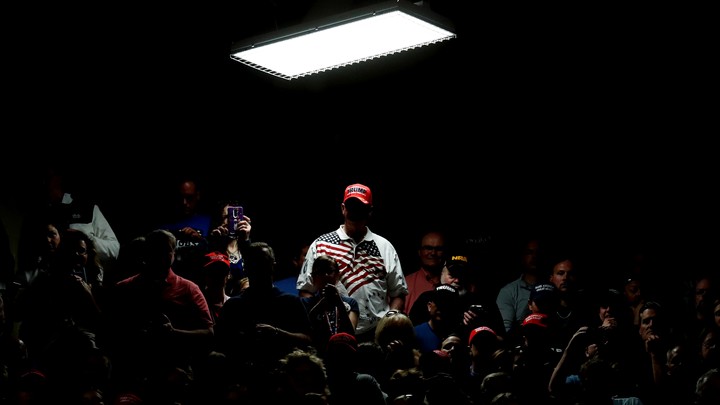
Supporters of U.S. President Donald Trump wait for him to appear for a rally
LEAH MILLIS / REUTERS

President-elect Joe Biden made national unity a centerpiece of his campaign, and no patriotic American who wants to repair the damage of the Donald Trump years can argue with such a noble call. The election is over, and we can now undertake the tasks Trump neglected, including fighting the coronavirus pandemic and restoring our alliances. But millions of Americans are not ready to declare that bygones are bygones and engage the loyal Trump supporters they might still find among their neighbors, friends, or families.

They are not wrong to feel this way.

That may sound like a profoundly un-civic, even un-American, stance. After all, Democrats, independents, and what’s left of the last few sensible Republicans should not stop trying to solve problems together. To cease all political communication would not only be foolish, but our system of government does not allow it. Even in the minority, a party can help or hinder the process of governing.

Nonetheless, ordinary people worn out by the dramas and lies of the past four years have a right to refuse to take Trump’s most enthusiastic supporters seriously. To reject further debate with people whose views are completely incoherent is not only understandable, but sensible.

I am not talking about all 74 million people who voted for Trump. Some voters may well have supported Trump in both 2016 and 2020 with a sense of hesitancy, perhaps focused on a single issue, such as abortion, or because they were making a raw and self-interested calculation about taxes. Trump picked these voters up from Republican campaigns that came before him, and he will bequeath them to the Republican candidates who come after him. Some of these voters, as we learned this year, can be persuaded to reject candidates such as Trump.

Instead, I am talking about the people who are giving Trump their full-throated support to the very end, even as he mulls a military coup; the people who buy weird paintings ofTrump crossing the Delaware, or who believe that Trump is an agent of Jesus Christ, or who think that Trump is fighting a blood-drinking ring of pedophiles. These supporters have gone far beyond political loyalty and have succumbed to a kind of mass delusion. It is not possible to engage them. Indeed, to argue with them is to legitimize their beliefs, which itself is unhealthy for our democracy.

I don’t want to treat our fellow citizens with open contempt, or to confront and berate them. Rather, I am arguing for silence. The Trump loyalists who still cling to conspiracy theories and who remain part of a cult of personality should be deprived of the attention they seek, shunned for their antidemocratic lunacy, and then outvoted at the ballot box.

If we’ve learned one thing about “Trumpism,” it is that there is no such thing as “Trumpism.” No content anchors it; no program or policy comes from it. No motivating ideology stands behind it, unless we think of general grievance and a hatred of cultural and intellectual elites as an “idea.” And when views are incoherent and beliefs are rooted in fantasies, compromise is impossible. Further engagement is not only unwarranted, but it can also become counterproductive.

This is why I see no point in a “national conversation” or in “reaching out,” or other euphemisms for attempts to better understand the movement that formed around Trump. We already understand: Trump tapped into traditions of ethnic and regional grievances and social resentments that are present in every democracy and wedded them to bizarre theories and conspiracies.

Perhaps most important, much of our own sense of well-being will be lost if we continue to engage with people who believe that millions of votes were falsified from coast to coast, that the military should move into the swing states and hold new elections, or even that thousands of Chinese troops were bombed into submission on the border of Maine.

Ordinary people should tune out the noise. No one needs to think one more minute about why a woman from New York would speed along in her car while ranting into her phoneabout stolen elections when she ought to have been watching the road. And the media have a particular obligation to end their fascination with these Trump voters. We don’t need yet another pilgrimage to diners and gas stations to hear from people whose only sources of information are cable-news hosts plumping fantasies about Venezuelan voting machines. We need not ruminate on the evangelical writer who thinks we must pray for the crackpot lawyer Sidney Powell. And journalists should stop providing media oxygen to would-be heroes such as the Texas mayor who said that if Trump called on him to take up arms, he’d engage in civil war.

The only people who need to engage such voters are political strategists, because enough of these voters in the right states can drive the Electoral College into a ditch. But the rest of us no longer need to participate in long chin-pulling exercises about “what they reallywant” or why they cannot grasp reality.

We must go on as a nation, and as families. Of course you still love your uncle, even if he is bellowing about stolen elections at Christmas dinner, just as you love your sister-in-law even while she’s trying to ruin a wedding reception by holding forth on socialist saboteurs. But neither they nor the millions of other diehards deserve our engagement. The sooner we refuse to continue such conversations, the sooner we might return to being a serious nation.

TOM NICHOLS is the author of the forthcoming book Our Own Worst Enemy: The Assault From Within on Modern Democracy.

Friday, January 1, 2021


Shared with Your friends
Friends
Intellectually I am primarily a student of American history. My primary framework for understanding politics and current events is to first put everything into historical perspective as I can best understand it. In my world understanding history at the highest level is to deal with it thru historiography. Though I am not an academic, I approach the study of history like an academician. Historiography interests me more than "history." History, as a serious study then, is historiography. The passage below best explains it.
"To know history, Edward Hallett Carr says, you must know the historian.
He says this because history is not only events that happened but also our understanding of those events. More, history is the interaction among events, historians, and the readers. Only by knowing more about the historian and the he or she has lived through and studied can we really know the history as recorded by that historian. The uniqueness of those interactions will define the choices made about what to include, what to exclude, what to emphasize, and what to deemphasize. History, as a serious study then, is historiography."
-John Herbert Roper, Sr. C. Vann Woodward, "A Southern Historian and His Critics," P. XI


Shared with Your friends
Friends
"For last year's words belong to last year's language
And next year's words await another voice.
And to make an end is to make a beginning."
- T.S. Eliot
Happy New Year


Other prominent voices, the gatekeepers, will proclaim that "these are the moments that mattered" in the year 2020 as they create a narrative for the year that was. Lists of that sort are a type of status-signaling — an exercise in social capital in which the truth rains down from the chorus of the elect onto the regular people below.

And of course, with Joe Biden (in all likelihood) being inaugurated on Jan. 20 and the Age of Trump in its present form mutating into some new monstrosity, there are lists of Donald Trump's foibles, most embarrassing moments and other low points. For those Americans and others smothered by Trumpism, in some cases literally, such lists are a way of celebrating his defeat. They function as a form of symbolic and temporary catharsis.

Ultimately, in this new year 2021, lists are being made by people everywhere. In their various forms they embody people's hopes, desires, promises, dreams, regrets and disappointments. Lists are also a way of maintaining control of one's life and destiny in the face of uncertainty. 

Advertisement:
00:00/02:36

The Age of Trump, with its resurgent fascism, white supremacy, violence, plague, death, attacks on democracy and civil rights and other forms of evil — and the larger social and political conditions that made Trumpism possible — is a world-historical event. There was a time before Trump and there will be a time after Trump, but Trumpism will be more than a footnote in modern American history. It will be the moment of a great pivot toward either the worst (another version of American fascism) or something much better (the beginning of a project of American renewal).

Whichever the outcome, lists collapse against the weight and meaning of world-historical events. How does one rank Trump and his regime's crimes against democracy, humanity, the environment and overall human decency

Is the worst crime the hundreds of thousands of Americans who are dead because of the Trump regime's sabotage of coronavirus relief efforts? What of the many lives ruined and lifespans shortened, both directly and indirectly, through the resulting economic destruction and the Trump regime's willful negligence? How do we rank those horrors against the thousands of nonwhite migrants and refugees brutalized in Trump's concentration camps? What of the children stolen from their families (and likely to never be reunited with them) by Border Patrol and ICE agents? Where do we rank the Trump regime's empowerment of white supremacist and other right-wing extremists and their acts of political terrorism? Where on a list should we put Trump and his movement's undermining of American democracy and the common good? What of Trump and his inner circle's treasonous and seditious behavior, such as their ongoing coup attempt against the democratically expressed will of the American people? Should ranking the Trump regime's turpitude focus on the defamation done to the country's ideals and values, or the literal number of dead bodies and treasure lost and stolen?

Advertisement:

Lists and other such heuristic devices are an attempt to assert one's agency, an effort to impose order or disorder. But the Age of Trump is not just one horrible thing, but many horrible things both overlapping and simultaneous.

At the Columbia Journalism Review, Jon Allsop writes: "History will surely view Trump's COVID fecklessness as among his very worst disgraces, if not his worst — yet for now, the suffering is so vast that it's hard to keep it adequately in perspective at all, let alone in terms of clear political accountability."

Advertisement:

Quoted in a new essay at The Atlantic, sociologist Arlie Hochshild, author of "Strangers in Their Own Land," offers cautionary words about the true dimensions of Trumpism and the challenge ahead: 

But the UC Berkeley sociologist Arlie Russell Hochschild believes that Trumpism is intimately tied — for now at least — to its namesake, because it exists beyond the logic of policy. It exists in the dreampolitik realm of feelings. "If there's one thing I think the mainstream press still gets wrong about Trump, it's that they are comfortable talking about economics and personality, but they don't give a primacy to feelings," Hochschild told me. "To understand the future of the Republican Party, we have to act like political psychiatrists."…

Hochschild is telling us that Trumpism is not just a garland of public-policy proposals that any other Republican can drape around his or her neck. And it is more complex than a personality trait, or a talent for saying mean stuff on Twitter. Rather, Trumpism is an emotional planet that orbits around Trump's star. Breaking the connection between Trump and the better part of the GOP will require either that Trump disappears (an unlikely proposition) or that a larger star emerges from the Republican backbench (also unlikely).

At the end of our conversation, I asked Hochschild what she's learned from the past four years. "I used to think of political identity as something more solid," she said. "I now think of political identity as like water that's always going somewhere, that needs to go somewhere, but where it goes depends on the lay of the land, the rock formations that stand in its way," she told me. She's still waiting to see where Trump moves the mountain.

To begin to properly make sense of the Age of Trump and its true dimensions will require critical distance and deep, slow thinking. This moment also demands that the full truth be revealed through public hearings, committees and other investigations.

To move forward properly, and to prevent another fascist authoritarian such as Donald Trump from taking power, the American people, in conjunction with responsible elites, must wring out every possible bit of truth from the soiled rag that is the Age of Trump. 

Advertisement:

Of course, some already want to cast that rag into the abyss of a memory well, never to be seen or discussed again. There will be many voices declaring that we must "let the past go," "heal and unify," resist "hysteria" or "forgive and forget." We will be told that President Biden is here to restore normalcy and it's time to "focus on the future."

At some point very soon and perhaps even on Inauguration Day, some pundit or other professional smart person who is a member of the "Church of the Savvy" will begin the work of "organized forgetting" by cannibalizing Abraham Lincoln's famous words: "With malice toward none, with charity for all."

That will not do. America needs a great reckoning to heal the damage caused by Trumpism and its followers, acolytes and leaders. That process will be time consuming. It will not be neat. In a country and society obsessed with speed, where selective forgetting and grand myths are core to the nation's character and political culture, there will be an enormous temptation to forget the Age of Trump almost immediately.

Advertisement:

Thus, the compulsion by many Americans — especially those who are privileged because of their skin color and other identities — towards simple stories and superficial understandings of the country's past, present and future. Some future historian or other observer may well look back at these years and conclude that America's embrace of simple and easy solutions, in the service of organized forgetting, blinded it to the complex problems that would lead to the final downfall of a once-great democracy.


CHAUNCEY DEVEGA

Chauncey DeVega is a politics staff writer for Salon. His essays can also be found at Chaunceydevega.com. He also hosts a weekly podcast, The Chauncey DeVega Show. Chauncey can be followed on Twitter and Facebook.